

3.2
Surface Energy
The origin of surface energy is explained by a model that assumes that particles are
produced by breaking a large solid piece of material into smaller parts. In order to
achieve this, it is necessary to cut the bonds between the neighboring atoms. (In this
simplified explanation, the term “atom” is used equally to describe atoms, ions, and
molecules.) Between each two atoms in the lattice the energy of bonding u is active
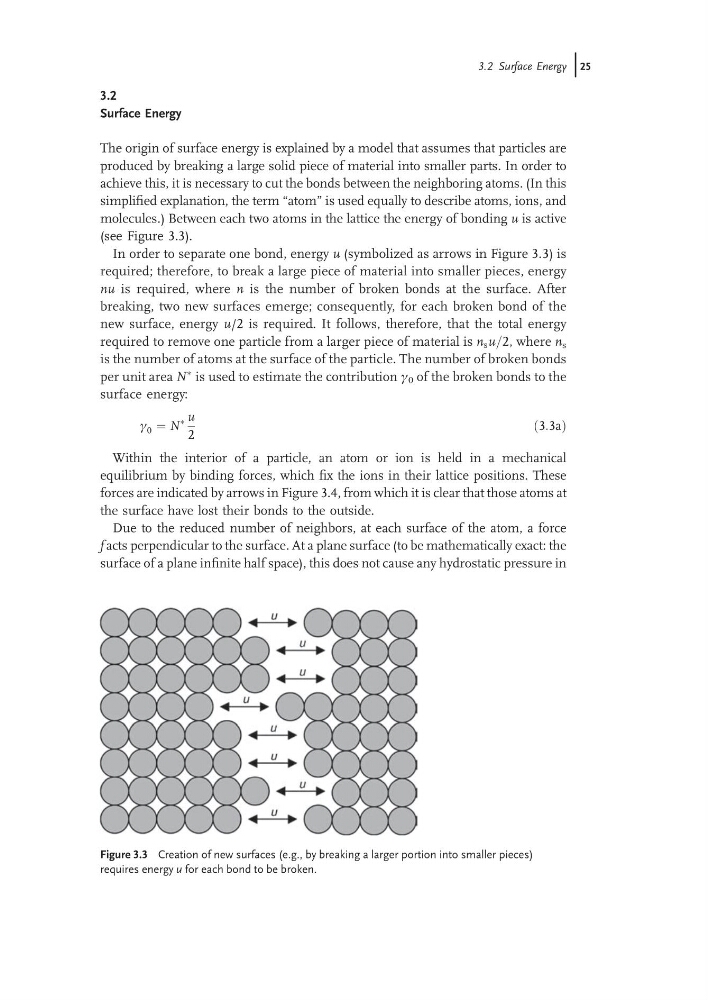
(see Figure 3.3).
In order to separate one bond, energy u (symbolized as arrows in Figure 3.3) is
required; therefore, to break a large piece of material into smaller pieces, energy
nu is required, where n is the number of broken bonds at the surface. After
breaking, two new surfaces emerge; consequently, for each broken bond of the
new surface, energy u/2 is required. It follows, therefore, that the total energy
required to remove one particle from a larger piece of material is n s u=2, where n s
is the number of atoms at the surface of the particle. The number of broken bonds
per unit area N
à is used to estimate the contribution c 0 of the broken bonds to the
surface energy:
c 0 ¼ N
à u
2
ð3:3aÞ
Within the interior of a particle, an atom or ion is held in a mechanical
equilibrium by binding forces, which fix the ions in their lattice positions. These
forces are indicated by arrows in Figure 3.4, from which it is clear that those atoms at
the surface have lost their bonds to the outside.
Due to the reduced number of neighbors, at each surface of the atom, a force
f acts perpendicular to the surface. At a plane surface (to be mathematically exact: the
surface of a plane infinite half space), this does not cause any hydrostatic pressure in
Figure 3.3 Creation of new surfaces (e.g., by breaking a larger portion into smaller pieces)
requires energy u for each bond to be broken.
3.2 Surface Energy j25
Surface Energy
The origin of surface energy is explained by a model that assumes that particles are
produced by breaking a large solid piece of material into smaller parts. In order to
achieve this, it is necessary to cut the bonds between the neighboring atoms. (In this
simplified explanation, the term “atom” is used equally to describe atoms, ions, and
molecules.) Between each two atoms in the lattice the energy of bonding u is active
(see Figure 3.3).
In order to separate one bond, energy u (symbolized as arrows in Figure 3.3) is
required; therefore, to break a large piece of material into smaller pieces, energy
nu is required, where n is the number of broken bonds at the surface. After
breaking, two new surfaces emerge; consequently, for each broken bond of the
new surface, energy u/2 is required. It follows, therefore, that the total energy
required to remove one particle from a larger piece of material is n s u=2, where n s
is the number of atoms at the surface of the particle. The number of broken bonds
per unit area N
à is used to estimate the contribution c 0 of the broken bonds to the
surface energy:
c 0 ¼ N
à u
2
ð3:3aÞ
Within the interior of a particle, an atom or ion is held in a mechanical
equilibrium by binding forces, which fix the ions in their lattice positions. These
forces are indicated by arrows in Figure 3.4, from which it is clear that those atoms at
the surface have lost their bonds to the outside.
Due to the reduced number of neighbors, at each surface of the atom, a force
f acts perpendicular to the surface. At a plane surface (to be mathematically exact: the
surface of a plane infinite half space), this does not cause any hydrostatic pressure in
Figure 3.3 Creation of new surfaces (e.g., by breaking a larger portion into smaller pieces)
requires energy u for each bond to be broken.
3.2 Surface Energy j25