

n ¼ kRy Z À C
ð
Þ
2
ð12:25Þ
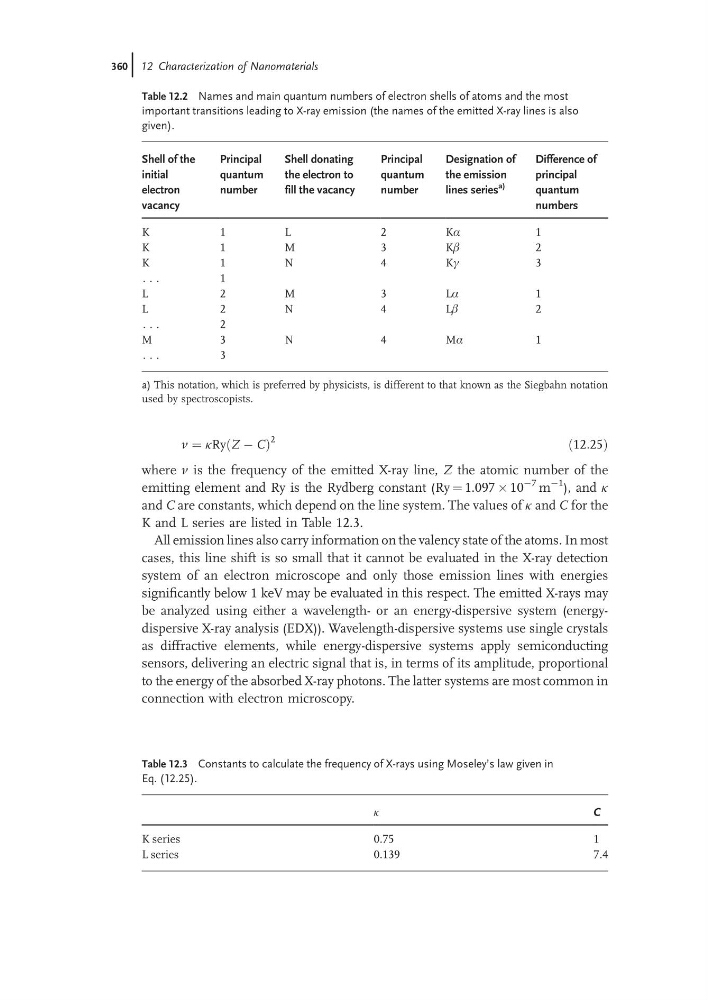
where n is the frequency of the emitted X-ray line, Z the atomic number of the
emitting element and Ry is the Rydberg constant (Ry ¼ 1.097 Â 10
À7 m
À1 ), and k
and C are constants, which depend on the line system. The values of k and C for the
K and L series are listed in Table 12.3.
All emission lines also carry information on the valency state of the atoms. In most
cases, this line shift is so small that it cannot be evaluated in the X-ray detection
system of an electron microscope and only those emission lines with energies
significantly below 1 keV may be evaluated in this respect. The emitted X-rays may
be analyzed using either a wavelength- or an energy-dispersive system (energydispersive X-ray analysis (EDX)). Wavelength-dispersive systems use single crystals
as diffractive elements, while energy-dispersive systems apply semiconducting
sensors, delivering an electric signal that is, in terms of its amplitude, proportional
to the energy of the absorbed X-ray photons. The latter systems are most common in
connection with electron microscopy.
Table 12.2 Names and main quantum numbers of electron shells of atoms and the most
important transitions leading to X-ray emission (the names of the emitted X-ray lines is also
given).
Shell of the
initial
electron
vacancy
Principal
quantum
number
Shell donating
the electron to
fill the vacancy
Principal
quantum
number
Designation of
the emission
lines series
a)
Difference of
principal
quantum
numbers
K
1
L
2
K a
1
K
1
M
3
K b
2
K
1
N
4
K c
3
. . .
1
L
2
M
3
L a
1
L
2
N
4
L b
2
. . .
2
M
3
N
4
M a
1
. . .
3
a) This notation, which is preferred by physicists, is different to that known as the Siegbahn notation
used by spectroscopists.
Table 12.3 Constants to calculate the frequency of X-rays using Moseley’s law given in
Eq. (12.25).
k
C
K series
0.75
1
L series
0.139
7.4
360j 12 Characterization of Nanomaterials
ð
Þ
2
ð12:25Þ
where n is the frequency of the emitted X-ray line, Z the atomic number of the
emitting element and Ry is the Rydberg constant (Ry ¼ 1.097 Â 10
À7 m
À1 ), and k
and C are constants, which depend on the line system. The values of k and C for the
K and L series are listed in Table 12.3.
All emission lines also carry information on the valency state of the atoms. In most
cases, this line shift is so small that it cannot be evaluated in the X-ray detection
system of an electron microscope and only those emission lines with energies
significantly below 1 keV may be evaluated in this respect. The emitted X-rays may
be analyzed using either a wavelength- or an energy-dispersive system (energydispersive X-ray analysis (EDX)). Wavelength-dispersive systems use single crystals
as diffractive elements, while energy-dispersive systems apply semiconducting
sensors, delivering an electric signal that is, in terms of its amplitude, proportional
to the energy of the absorbed X-ray photons. The latter systems are most common in
connection with electron microscopy.
Table 12.2 Names and main quantum numbers of electron shells of atoms and the most
important transitions leading to X-ray emission (the names of the emitted X-ray lines is also
given).
Shell of the
initial
electron
vacancy
Principal
quantum
number
Shell donating
the electron to
fill the vacancy
Principal
quantum
number
Designation of
the emission
lines series
a)
Difference of
principal
quantum
numbers
K
1
L
2
K a
1
K
1
M
3
K b
2
K
1
N
4
K c
3
. . .
1
L
2
M
3
L a
1
L
2
N
4
L b
2
. . .
2
M
3
N
4
M a
1
. . .
3
a) This notation, which is preferred by physicists, is different to that known as the Siegbahn notation
used by spectroscopists.
Table 12.3 Constants to calculate the frequency of X-rays using Moseley’s law given in
Eq. (12.25).
k
C
K series
0.75
1
L series
0.139
7.4
360j 12 Characterization of Nanomaterials