

Inelastic scattered electrons have lost part of their energy in the specimen and a
major part of this energy is converted to X-rays. There are two processes responsible
for this phenomenon:
Deceleration of the electrons in the electric field of the atomic nucleus. This leads
to the emission of “bremsstrahlung” (radiation of deceleration). Although bremsstrahlung is characteristic of the deceleration process, it cannot be used to identify
the decelerating target. Bremsstahlung has a continuous spectrum; the maximum
energy of the emitted photons is equal to that of the incoming electrons.
Ionization of the inner shells of the atoms. This process leads to the emission of
characteristic X-rays, which are used for qualitative and quantitative analysis of
the target.
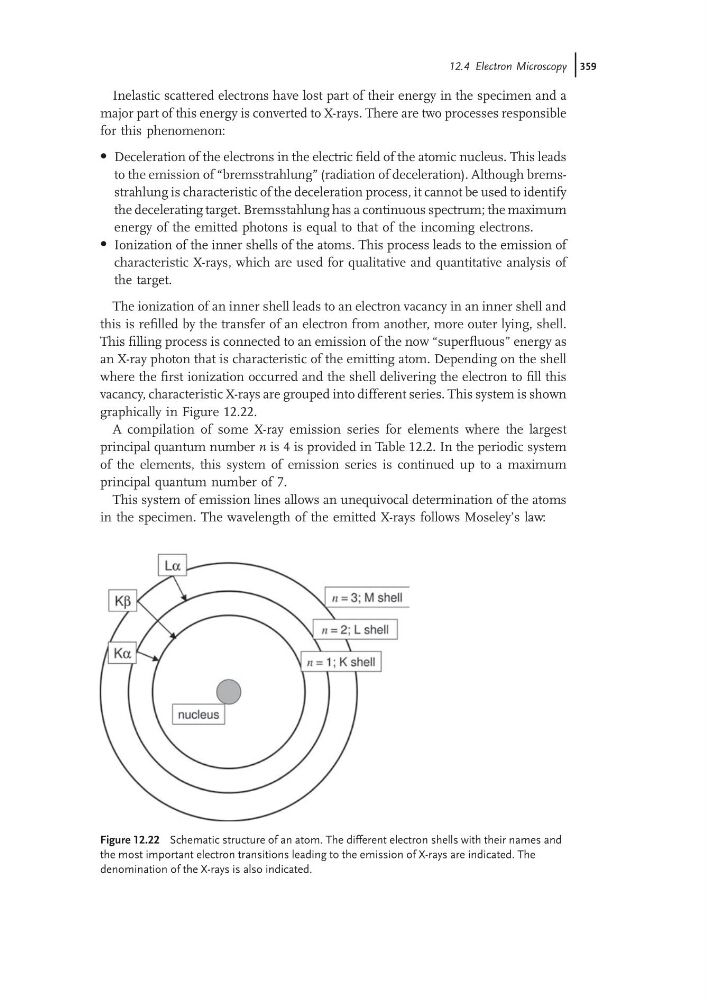
The ionization of an inner shell leads to an electron vacancy in an inner shell and
this is refilled by the transfer of an electron from another, more outer lying, shell.
This filling process is connected to an emission of the now “superfluous” energy as
an X-ray photon that is characteristic of the emitting atom. Depending on the shell
where the first ionization occurred and the shell delivering the electron to fill this
vacancy, characteristic X-rays are grouped into different series. This system is shown
graphically in Figure 12.22.
A compilation of some X-ray emission series for elements where the largest
principal quantum number n is 4 is provided in Table 12.2. In the periodic system
of the elements, this system of emission series is continued up to a maximum
principal quantum number of 7.
This system of emission lines allows an unequivocal determination of the atoms
in the specimen. The wavelength of the emitted X-rays follows Moseley’s law:
Figure 12.22 Schematic structure of an atom. The different electron shells with their names and
the most important electron transitions leading to the emission of X-rays are indicated. The
denomination of the X-rays is also indicated.
12.4 Electron Microscopy j359
major part of this energy is converted to X-rays. There are two processes responsible
for this phenomenon:
Deceleration of the electrons in the electric field of the atomic nucleus. This leads
to the emission of “bremsstrahlung” (radiation of deceleration). Although bremsstrahlung is characteristic of the deceleration process, it cannot be used to identify
the decelerating target. Bremsstahlung has a continuous spectrum; the maximum
energy of the emitted photons is equal to that of the incoming electrons.
Ionization of the inner shells of the atoms. This process leads to the emission of
characteristic X-rays, which are used for qualitative and quantitative analysis of
the target.
The ionization of an inner shell leads to an electron vacancy in an inner shell and
this is refilled by the transfer of an electron from another, more outer lying, shell.
This filling process is connected to an emission of the now “superfluous” energy as
an X-ray photon that is characteristic of the emitting atom. Depending on the shell
where the first ionization occurred and the shell delivering the electron to fill this
vacancy, characteristic X-rays are grouped into different series. This system is shown
graphically in Figure 12.22.
A compilation of some X-ray emission series for elements where the largest
principal quantum number n is 4 is provided in Table 12.2. In the periodic system
of the elements, this system of emission series is continued up to a maximum
principal quantum number of 7.
This system of emission lines allows an unequivocal determination of the atoms
in the specimen. The wavelength of the emitted X-rays follows Moseley’s law:
Figure 12.22 Schematic structure of an atom. The different electron shells with their names and
the most important electron transitions leading to the emission of X-rays are indicated. The
denomination of the X-rays is also indicated.
12.4 Electron Microscopy j359