

12.4.3
Localized Chemical Analysis in the Electron Microscope
Inelastic scattered electrons represent the tools for chemical analysis in an electron
microscope. Inelastic interaction of the incoming electrons with the specimens
initiates a series of processes, characteristic of the composition and the electronic
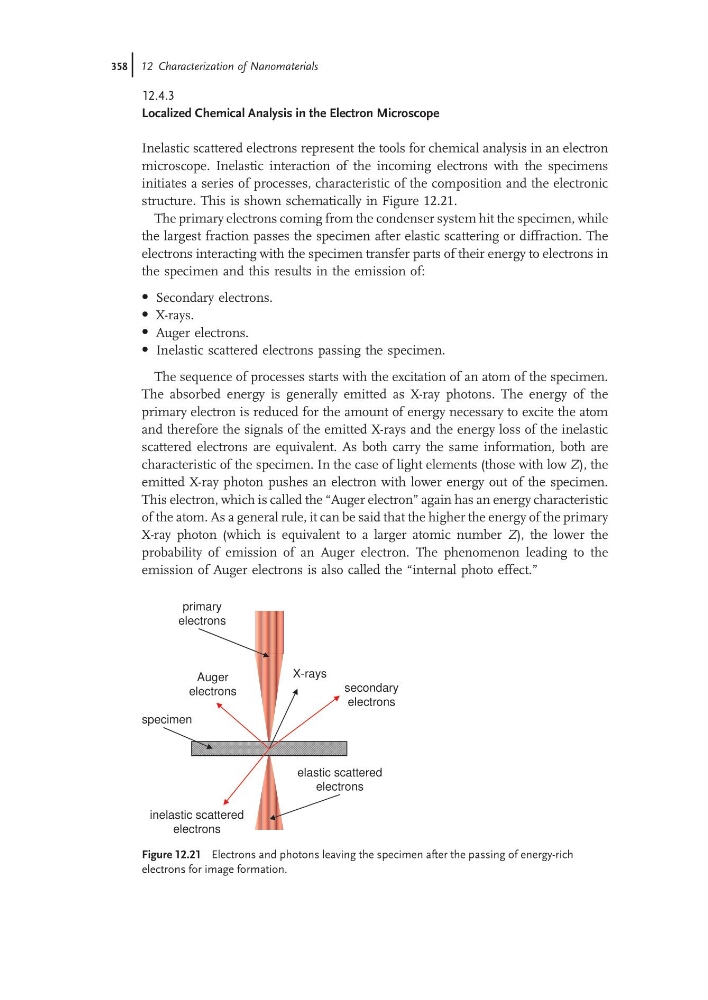
structure. This is shown schematically in Figure 12.21.
The primary electrons coming from the condenser system hit the specimen, while
the largest fraction passes the specimen after elastic scattering or diffraction. The
electrons interacting with the specimen transfer parts of their energy to electrons in
the specimen and this results in the emission of:
Secondary electrons.
X-rays.
Auger electrons.
Inelastic scattered electrons passing the specimen.
The sequence of processes starts with the excitation of an atom of the specimen.
The absorbed energy is generally emitted as X-ray photons. The energy of the
primary electron is reduced for the amount of energy necessary to excite the atom
and therefore the signals of the emitted X-rays and the energy loss of the inelastic
scattered electrons are equivalent. As both carry the same information, both are
characteristic of the specimen. In the case of light elements (those with low Z), the
emitted X-ray photon pushes an electron with lower energy out of the specimen.
This electron, which is called the “Auger electron” again has an energy characteristic
of the atom. As a general rule, it can be said that the higher the energy of the primary
X-ray photon (which is equivalent to a larger atomic number Z), the lower the
probability of emission of an Auger electron. The phenomenon leading to the
emission of Auger electrons is also called the “internal photo effect.”
primary
electrons
Auger
electrons
inelastic scattered
electrons
specimen
elastic scattered
electrons
X-rays
secondary
electrons
Figure 12.21 Electrons and photons leaving the specimen after the passing of energy-rich
electrons for image formation.
358j 12 Characterization of Nanomaterials
Localized Chemical Analysis in the Electron Microscope
Inelastic scattered electrons represent the tools for chemical analysis in an electron
microscope. Inelastic interaction of the incoming electrons with the specimens
initiates a series of processes, characteristic of the composition and the electronic
structure. This is shown schematically in Figure 12.21.
The primary electrons coming from the condenser system hit the specimen, while
the largest fraction passes the specimen after elastic scattering or diffraction. The
electrons interacting with the specimen transfer parts of their energy to electrons in
the specimen and this results in the emission of:
Secondary electrons.
X-rays.
Auger electrons.
Inelastic scattered electrons passing the specimen.
The sequence of processes starts with the excitation of an atom of the specimen.
The absorbed energy is generally emitted as X-ray photons. The energy of the
primary electron is reduced for the amount of energy necessary to excite the atom
and therefore the signals of the emitted X-rays and the energy loss of the inelastic
scattered electrons are equivalent. As both carry the same information, both are
characteristic of the specimen. In the case of light elements (those with low Z), the
emitted X-ray photon pushes an electron with lower energy out of the specimen.
This electron, which is called the “Auger electron” again has an energy characteristic
of the atom. As a general rule, it can be said that the higher the energy of the primary
X-ray photon (which is equivalent to a larger atomic number Z), the lower the
probability of emission of an Auger electron. The phenomenon leading to the
emission of Auger electrons is also called the “internal photo effect.”
primary
electrons
Auger
electrons
inelastic scattered
electrons
specimen
elastic scattered
electrons
X-rays
secondary
electrons
Figure 12.21 Electrons and photons leaving the specimen after the passing of energy-rich
electrons for image formation.
358j 12 Characterization of Nanomaterials