

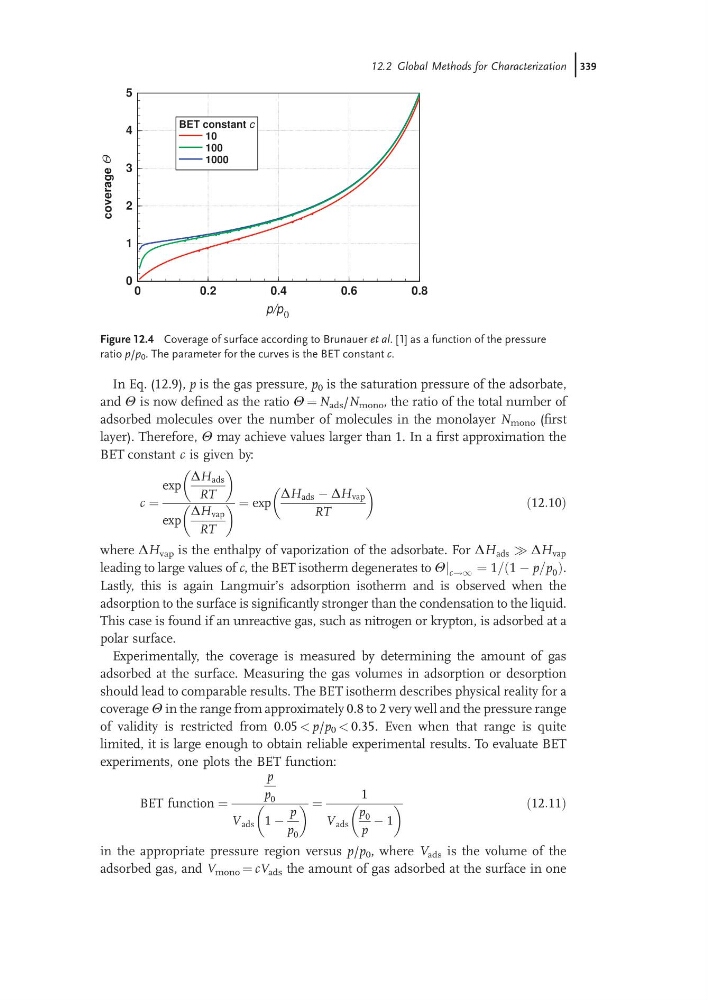
In Eq. (12.9), p is the gas pressure, p 0 is the saturation pressure of the adsorbate,
and H is now defined as the ratio H ¼ N ads /N mono , the ratio of the total number of
adsorbed molecules over the number of molecules in the monolayer N mono (first
layer). Therefore, H may achieve values larger than 1. In a first approximation the
BET constant c is given by:
c ¼
exp
DH ads
RT
exp
DH vap
RT
¼ exp
DH ads À DH vap
RT
ð12:10Þ
where DH vap is the enthalpy of vaporization of the adsorbate. For DH ads ) DH vap
leading to large values of c, the BET isotherm degenerates to Hj c!1 ¼ 1=ð1 À p=p 0 Þ.
Lastly, this is again Langmuir’s adsorption isotherm and is observed when the
adsorption to the surface is significantly stronger than the condensation to the liquid.
This case is found if an unreactive gas, such as nitrogen or krypton, is adsorbed at a
polar surface.
Experimentally, the coverage is measured by determining the amount of gas
adsorbed at the surface. Measuring the gas volumes in adsorption or desorption
should lead to comparable results. The BET isotherm describes physical reality for a
coverage H in the range from approximately 0.8 to 2 very well and the pressure range
of validity is restricted from 0.05 < p/p 0 < 0.35. Even when that range is quite
limited, it is large enough to obtain reliable experimental results. To evaluate BET
experiments, one plots the BET function:
BET function ¼
p
p 0
V ads 1 À
p
p 0
¼
1
V ads
p 0
p
À 1
ð12:11Þ
in the appropriate pressure region versus p/p 0 , where V ads is the volume of the
adsorbed gas, and V mono ¼ cV ads the amount of gas adsorbed at the surface in one
0
0.2
0.4
0.6
0.8
p/p 0
0
1
2
3
4
5
coverage
Θ
BET constant c
10
100
1000
Figure 12.4 Coverage of surface according to Brunauer et al. [1] as a function of the pressure
ratio p/p 0 . The parameter for the curves is the BET constant c.
12.2 Global Methods for Characterization j339
and H is now defined as the ratio H ¼ N ads /N mono , the ratio of the total number of
adsorbed molecules over the number of molecules in the monolayer N mono (first
layer). Therefore, H may achieve values larger than 1. In a first approximation the
BET constant c is given by:
c ¼
exp
DH ads
RT
exp
DH vap
RT
¼ exp
DH ads À DH vap
RT
ð12:10Þ
where DH vap is the enthalpy of vaporization of the adsorbate. For DH ads ) DH vap
leading to large values of c, the BET isotherm degenerates to Hj c!1 ¼ 1=ð1 À p=p 0 Þ.
Lastly, this is again Langmuir’s adsorption isotherm and is observed when the
adsorption to the surface is significantly stronger than the condensation to the liquid.
This case is found if an unreactive gas, such as nitrogen or krypton, is adsorbed at a
polar surface.
Experimentally, the coverage is measured by determining the amount of gas
adsorbed at the surface. Measuring the gas volumes in adsorption or desorption
should lead to comparable results. The BET isotherm describes physical reality for a
coverage H in the range from approximately 0.8 to 2 very well and the pressure range
of validity is restricted from 0.05 < p/p 0 < 0.35. Even when that range is quite
limited, it is large enough to obtain reliable experimental results. To evaluate BET
experiments, one plots the BET function:
BET function ¼
p
p 0
V ads 1 À
p
p 0
¼
1
V ads
p 0
p
À 1
ð12:11Þ
in the appropriate pressure region versus p/p 0 , where V ads is the volume of the
adsorbed gas, and V mono ¼ cV ads the amount of gas adsorbed at the surface in one
0
0.2
0.4
0.6
0.8
p/p 0
0
1
2
3
4
5
coverage
Θ
BET constant c
10
100
1000
Figure 12.4 Coverage of surface according to Brunauer et al. [1] as a function of the pressure
ratio p/p 0 . The parameter for the curves is the BET constant c.
12.2 Global Methods for Characterization j339