

The data in Figure 11.41 show that this SWNT nanocomposite, which consists of
60 wt% nanotubes, has an ultimate strength of 1.8 GPa, the Young’s modulus is
80 GPa, and the yield stress is approximately 0.7 GPa. Of particular interest is the
huge plastic deformation that occurs after the yield stress is reached; this deformation, which resembles superplasticity, is possible because these fibers do not develop
any necking. It may be assumed that slippage between the individual nanotubes
within the fiber might contribute to this large plastic deformation. The mechanism
involved may be essentially the same as for plastic deformation, as assumed for the
material depicted in Figures 11.39 and 11.40. The ultimate stress of such a
composite is 2- or 3-fold that of an average steel and lies within the range of values
found in the very best quality steel wires.
The addition of graphene to improve the strength of a polymer shows first very
promising results. In particular, graphene oxide plates, which have the advantage of
forming good bonding to the surrounding polymer, deliver optimal results. In a
most successful application, graphene oxide synthesized by functionalization of the
surface to make the sheets hydrophilic was incorporated into a polyimide polymer
film by in situ polymerization. The resulting film has a thickness of 0.1 mm. The
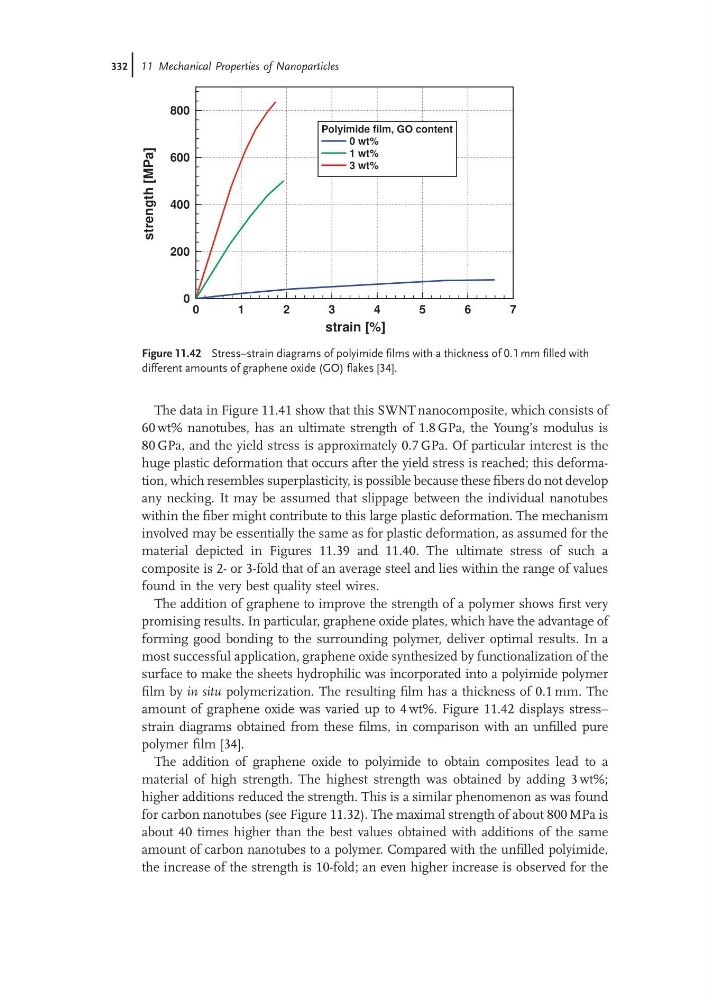
amount of graphene oxide was varied up to 4 wt%. Figure 11.42 displays stress–
strain diagrams obtained from these films, in comparison with an unfilled pure
polymer film [34].
The addition of graphene oxide to polyimide to obtain composites lead to a
material of high strength. The highest strength was obtained by adding 3 wt%;
higher additions reduced the strength. This is a similar phenomenon as was found
for carbon nanotubes (see Figure 11.32). The maximal strength of about 800 MPa is
about 40 times higher than the best values obtained with additions of the same
amount of carbon nanotubes to a polymer. Compared with the unfilled polyimide,
the increase of the strength is 10-fold; an even higher increase is observed for the
0
1
2
3
4
5
6
7
strain [%]
0
200
400
600
800
Polyimide film, GO content
0 wt%
1 wt%
3 wt%
strength [MPa]
Figure 11.42 Stress–strain diagrams of polyimide films with a thickness of 0.1 mm filled with
different amounts of graphene oxide (GO) flakes [34].
332j 11 Mechanical Properties of Nanoparticles
60 wt% nanotubes, has an ultimate strength of 1.8 GPa, the Young’s modulus is
80 GPa, and the yield stress is approximately 0.7 GPa. Of particular interest is the
huge plastic deformation that occurs after the yield stress is reached; this deformation, which resembles superplasticity, is possible because these fibers do not develop
any necking. It may be assumed that slippage between the individual nanotubes
within the fiber might contribute to this large plastic deformation. The mechanism
involved may be essentially the same as for plastic deformation, as assumed for the
material depicted in Figures 11.39 and 11.40. The ultimate stress of such a
composite is 2- or 3-fold that of an average steel and lies within the range of values
found in the very best quality steel wires.
The addition of graphene to improve the strength of a polymer shows first very
promising results. In particular, graphene oxide plates, which have the advantage of
forming good bonding to the surrounding polymer, deliver optimal results. In a
most successful application, graphene oxide synthesized by functionalization of the
surface to make the sheets hydrophilic was incorporated into a polyimide polymer
film by in situ polymerization. The resulting film has a thickness of 0.1 mm. The
amount of graphene oxide was varied up to 4 wt%. Figure 11.42 displays stress–
strain diagrams obtained from these films, in comparison with an unfilled pure
polymer film [34].
The addition of graphene oxide to polyimide to obtain composites lead to a
material of high strength. The highest strength was obtained by adding 3 wt%;
higher additions reduced the strength. This is a similar phenomenon as was found
for carbon nanotubes (see Figure 11.32). The maximal strength of about 800 MPa is
about 40 times higher than the best values obtained with additions of the same
amount of carbon nanotubes to a polymer. Compared with the unfilled polyimide,
the increase of the strength is 10-fold; an even higher increase is observed for the
0
1
2
3
4
5
6
7
strain [%]
0
200
400
600
800
Polyimide film, GO content
0 wt%
1 wt%
3 wt%
strength [MPa]
Figure 11.42 Stress–strain diagrams of polyimide films with a thickness of 0.1 mm filled with
different amounts of graphene oxide (GO) flakes [34].
332j 11 Mechanical Properties of Nanoparticles