

18 MPa is of great interest with regard to technical applications and especially as the
strain to rupture is barely influenced. The addition of more than 4 wt% single-wall
carbon nanotubes appears to be of minimal value, as the mechanical properties are
not significantly influenced beyond this point.
Remarkably higher strengths and Young’s moduli may be obtained with strands
of carbon nanotubes. For example, Li et al. [32] produced such strands with lengths
of up to a few centimeters, and consisting of single- and double-wall nanotubes. The
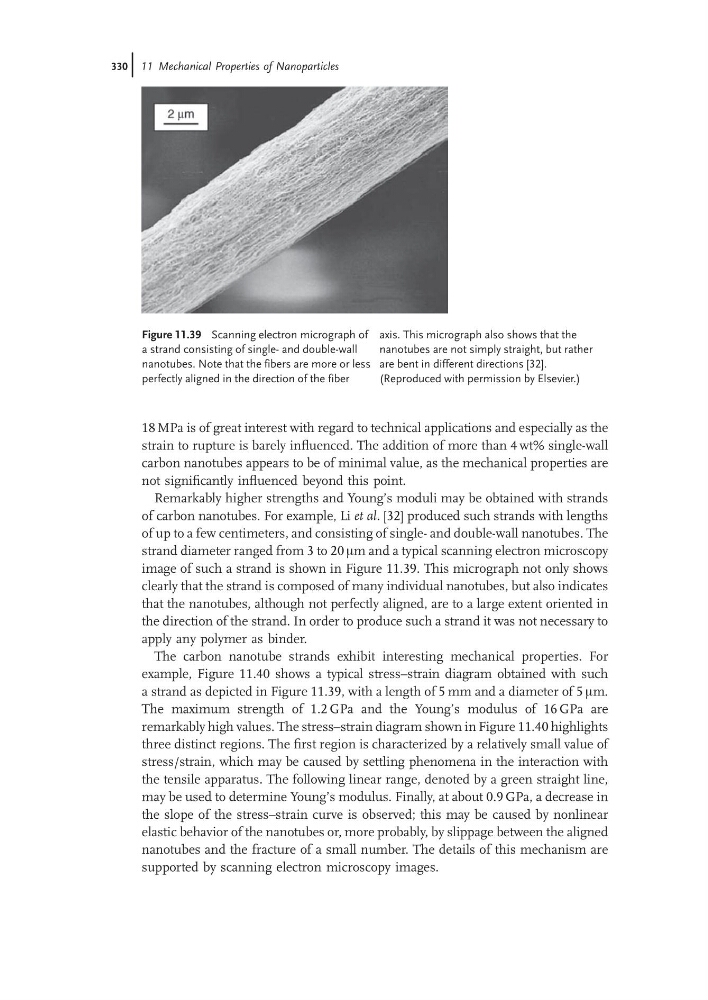
strand diameter ranged from 3 to 20 mm and a typical scanning electron microscopy
image of such a strand is shown in Figure 11.39. This micrograph not only shows
clearly that the strand is composed of many individual nanotubes, but also indicates
that the nanotubes, although not perfectly aligned, are to a large extent oriented in
the direction of the strand. In order to produce such a strand it was not necessary to
apply any polymer as binder.
The carbon nanotube strands exhibit interesting mechanical properties. For
example, Figure 11.40 shows a typical stress–strain diagram obtained with such
a strand as depicted in Figure 11.39, with a length of 5 mm and a diameter of 5 mm.
The maximum strength of 1.2 GPa and the Young’s modulus of 16 GPa are
remarkably high values. The stress–strain diagram shown in Figure 11.40 highlights
three distinct regions. The first region is characterized by a relatively small value of
stress/strain, which may be caused by settling phenomena in the interaction with
the tensile apparatus. The following linear range, denoted by a green straight line,
may be used to determine Young’s modulus. Finally, at about 0.9 GPa, a decrease in
the slope of the stress–strain curve is observed; this may be caused by nonlinear
elastic behavior of the nanotubes or, more probably, by slippage between the aligned
nanotubes and the fracture of a small number. The details of this mechanism are
supported by scanning electron microscopy images.
Figure 11.39 Scanning electron micrograph of
a strand consisting of single- and double-wall
nanotubes. Note that the fibers are more or less
perfectly aligned in the direction of the fiber
axis. This micrograph also shows that the
nanotubes are not simply straight, but rather
are bent in different directions [32].
(Reproduced with permission by Elsevier.)
330j 11 Mechanical Properties of Nanoparticles
strain to rupture is barely influenced. The addition of more than 4 wt% single-wall
carbon nanotubes appears to be of minimal value, as the mechanical properties are
not significantly influenced beyond this point.
Remarkably higher strengths and Young’s moduli may be obtained with strands
of carbon nanotubes. For example, Li et al. [32] produced such strands with lengths
of up to a few centimeters, and consisting of single- and double-wall nanotubes. The
strand diameter ranged from 3 to 20 mm and a typical scanning electron microscopy
image of such a strand is shown in Figure 11.39. This micrograph not only shows
clearly that the strand is composed of many individual nanotubes, but also indicates
that the nanotubes, although not perfectly aligned, are to a large extent oriented in
the direction of the strand. In order to produce such a strand it was not necessary to
apply any polymer as binder.
The carbon nanotube strands exhibit interesting mechanical properties. For
example, Figure 11.40 shows a typical stress–strain diagram obtained with such
a strand as depicted in Figure 11.39, with a length of 5 mm and a diameter of 5 mm.
The maximum strength of 1.2 GPa and the Young’s modulus of 16 GPa are
remarkably high values. The stress–strain diagram shown in Figure 11.40 highlights
three distinct regions. The first region is characterized by a relatively small value of
stress/strain, which may be caused by settling phenomena in the interaction with
the tensile apparatus. The following linear range, denoted by a green straight line,
may be used to determine Young’s modulus. Finally, at about 0.9 GPa, a decrease in
the slope of the stress–strain curve is observed; this may be caused by nonlinear
elastic behavior of the nanotubes or, more probably, by slippage between the aligned
nanotubes and the fracture of a small number. The details of this mechanism are
supported by scanning electron microscopy images.
Figure 11.39 Scanning electron micrograph of
a strand consisting of single- and double-wall
nanotubes. Note that the fibers are more or less
perfectly aligned in the direction of the fiber
axis. This micrograph also shows that the
nanotubes are not simply straight, but rather
are bent in different directions [32].
(Reproduced with permission by Elsevier.)
330j 11 Mechanical Properties of Nanoparticles