

11.3.3
Carbon Nanotube- and Graphene-Based Composites
Nanocomposites with carbon nanotubes or graphene as filler are very promising, as
both materials are extremely stiff; the Young’s modulus is around 1 TPa, carbon
nanotubes exhibits a maximum tensile strength close to 30 GPa [29] and graphene
130 GPa [30]. However, these values are under dispute; other authors report Young’s
moduli for carbon nanotubes in the range from 0.64 to 1.8 TPa. In any case,
whatever the correct values are, carbon nanotubes and graphene are stiffer and
exhibit higher strength than any other material available in large quantities for
reasonable prices. Additionally, it is not too difficult to distribute carbon nanotubes
or graphene in a polymer matrix. This makes these composites a highly promising
class of materials. At present, the technical realization is heading in two different
directions: (i) composites with relatively small additions of nanotubes or graphene
sheets and (ii) especially in the case of nanotubes, materials where the binding
polymer is the minor phase.
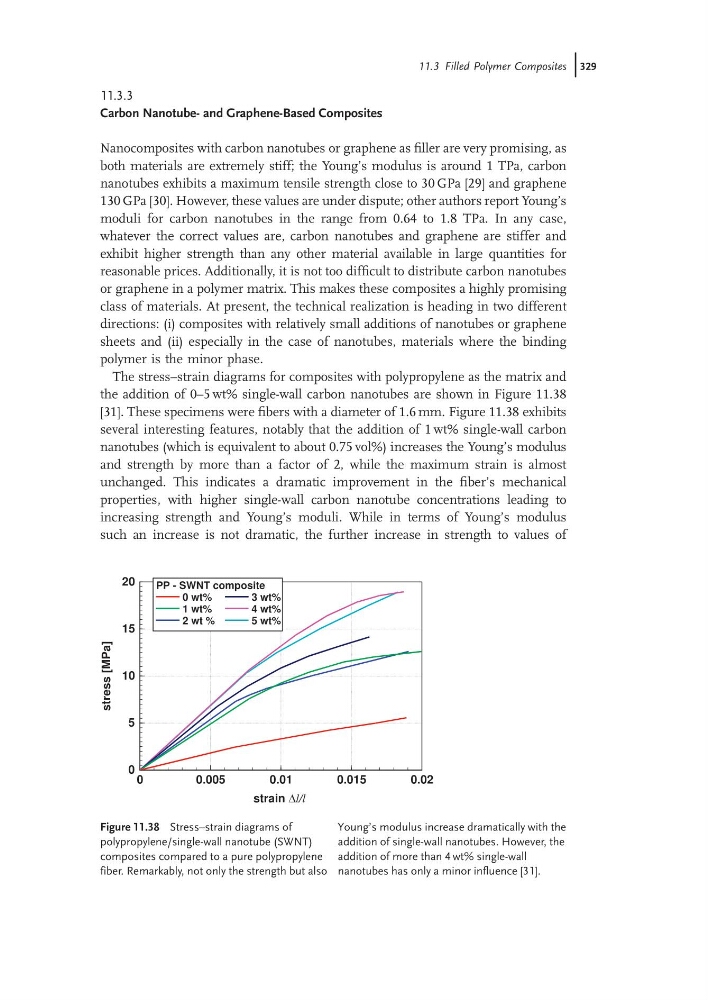
The stress–strain diagrams for composites with polypropylene as the matrix and
the addition of 0–5 wt% single-wall carbon nanotubes are shown in Figure 11.38
[31]. These specimens were fibers with a diameter of 1.6 mm. Figure 11.38 exhibits
several interesting features, notably that the addition of 1 wt% single-wall carbon
nanotubes (which is equivalent to about 0.75 vol%) increases the Young’s modulus
and strength by more than a factor of 2, while the maximum strain is almost
unchanged. This indicates a dramatic improvement in the fiber’s mechanical
properties, with higher single-wall carbon nanotube concentrations leading to
increasing strength and Young’s moduli. While in terms of Young’s modulus
such an increase is not dramatic, the further increase in strength to values of
0
0.005
0.01
0.015
0.02
0
5
10
15
20
PP - SWNT composite
0 wt%
1 wt%
2 wt %
3 wt%
4 wt%
5 wt%
strain Δl/l
stress [MPa]
Figure 11.38 Stress–strain diagrams of
polypropylene/single-wall nanotube (SWNT)
composites compared to a pure polypropylene
fiber. Remarkably, not only the strength but also
Young’s modulus increase dramatically with the
addition of single-wall nanotubes. However, the
addition of more than 4 wt% single-wall
nanotubes has only a minor influence [31].
11.3 Filled Polymer Composites j329
Carbon Nanotube- and Graphene-Based Composites
Nanocomposites with carbon nanotubes or graphene as filler are very promising, as
both materials are extremely stiff; the Young’s modulus is around 1 TPa, carbon
nanotubes exhibits a maximum tensile strength close to 30 GPa [29] and graphene
130 GPa [30]. However, these values are under dispute; other authors report Young’s
moduli for carbon nanotubes in the range from 0.64 to 1.8 TPa. In any case,
whatever the correct values are, carbon nanotubes and graphene are stiffer and
exhibit higher strength than any other material available in large quantities for
reasonable prices. Additionally, it is not too difficult to distribute carbon nanotubes
or graphene in a polymer matrix. This makes these composites a highly promising
class of materials. At present, the technical realization is heading in two different
directions: (i) composites with relatively small additions of nanotubes or graphene
sheets and (ii) especially in the case of nanotubes, materials where the binding
polymer is the minor phase.
The stress–strain diagrams for composites with polypropylene as the matrix and
the addition of 0–5 wt% single-wall carbon nanotubes are shown in Figure 11.38
[31]. These specimens were fibers with a diameter of 1.6 mm. Figure 11.38 exhibits
several interesting features, notably that the addition of 1 wt% single-wall carbon
nanotubes (which is equivalent to about 0.75 vol%) increases the Young’s modulus
and strength by more than a factor of 2, while the maximum strain is almost
unchanged. This indicates a dramatic improvement in the fiber’s mechanical
properties, with higher single-wall carbon nanotube concentrations leading to
increasing strength and Young’s moduli. While in terms of Young’s modulus
such an increase is not dramatic, the further increase in strength to values of
0
0.005
0.01
0.015
0.02
0
5
10
15
20
PP - SWNT composite
0 wt%
1 wt%
2 wt %
3 wt%
4 wt%
5 wt%
strain Δl/l
stress [MPa]
Figure 11.38 Stress–strain diagrams of
polypropylene/single-wall nanotube (SWNT)
composites compared to a pure polypropylene
fiber. Remarkably, not only the strength but also
Young’s modulus increase dramatically with the
addition of single-wall nanotubes. However, the
addition of more than 4 wt% single-wall
nanotubes has only a minor influence [31].
11.3 Filled Polymer Composites j329