

when nylon-6 is used as the matrix material. However, the heat release rate for a
polypropylene filled with 4 wt% layered silicate is shown in Figure 11.37, where the
reduction in heat release rate is much more dramatic than for the composite
containing nylon-6 as the matrix material.
According to the data in Figure 11.37, polypropylene/4 wt% silicate nanocomposites have no higher rate of heat release than do equivalent nanocomposites with
nylon-6 as the matrix. However, while this leads to a much wider variety of materials
for technical applications, the strength of the polypropylene matrix composites is
significantly lower, even when it is improved by the addition of phyllosilicates.
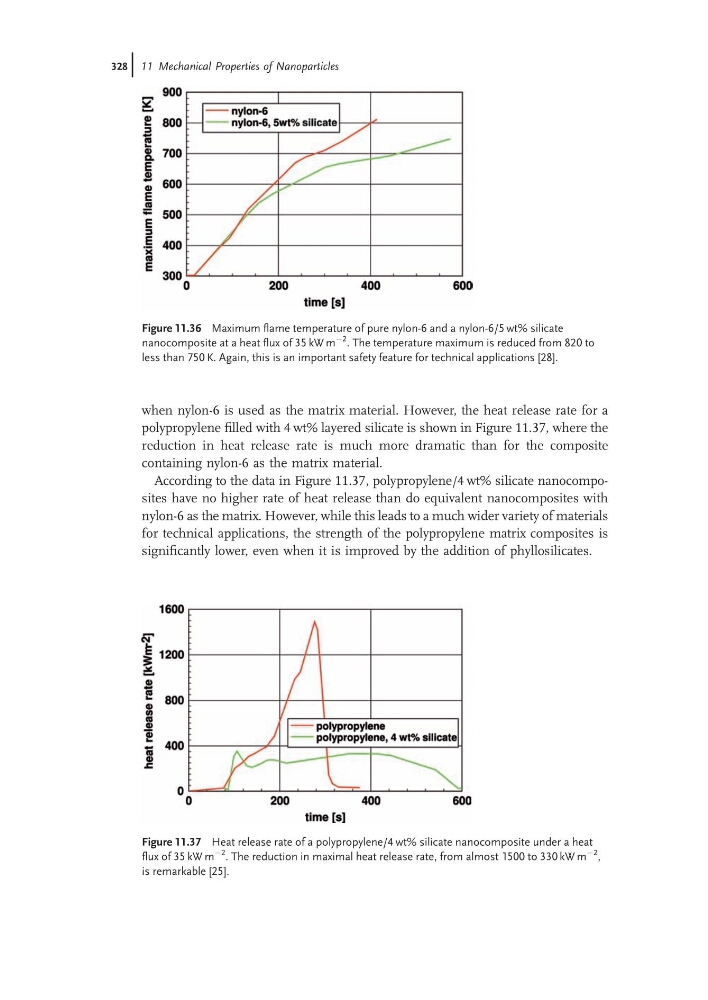
Figure 11.36 Maximum flame temperature of pure nylon-6 and a nylon-6/5 wt% silicate
nanocomposite at a heat flux of 35 kW m
À2 . The temperature maximum is reduced from 820 to
less than 750 K. Again, this is an important safety feature for technical applications [28].
Figure 11.37 Heat release rate of a polypropylene/4 wt% silicate nanocomposite under a heat
flux of 35 kW m
À2
. The reduction in maximal heat release rate, from almost 1500 to 330 kW m
À2
,
is remarkable [25].
328j 11 Mechanical Properties of Nanoparticles
polypropylene filled with 4 wt% layered silicate is shown in Figure 11.37, where the
reduction in heat release rate is much more dramatic than for the composite
containing nylon-6 as the matrix material.
According to the data in Figure 11.37, polypropylene/4 wt% silicate nanocomposites have no higher rate of heat release than do equivalent nanocomposites with
nylon-6 as the matrix. However, while this leads to a much wider variety of materials
for technical applications, the strength of the polypropylene matrix composites is
significantly lower, even when it is improved by the addition of phyllosilicates.
Figure 11.36 Maximum flame temperature of pure nylon-6 and a nylon-6/5 wt% silicate
nanocomposite at a heat flux of 35 kW m
À2 . The temperature maximum is reduced from 820 to
less than 750 K. Again, this is an important safety feature for technical applications [28].
Figure 11.37 Heat release rate of a polypropylene/4 wt% silicate nanocomposite under a heat
flux of 35 kW m
À2
. The reduction in maximal heat release rate, from almost 1500 to 330 kW m
À2
,
is remarkable [25].
328j 11 Mechanical Properties of Nanoparticles