

the maximal strain before the specimen breaks is significantly lower. (ii) The
Young’s modulus of the filled material is, independently of the temperature, higher
than that of the pristine material. The data in Figure 11.34 show that the polymer
matrices filled with layered silicate are stiffer and exhibit a significantly higher
strength as compared to unfilled material. This relatively high strength at elevated
temperatures is of particular importance for uses in automobiles.
A further major property of these composites is equally important, namely that
their flammability is significantly reduced as compared to the pure polymer.
Advantages in this direction are realized in the released heat and maximum
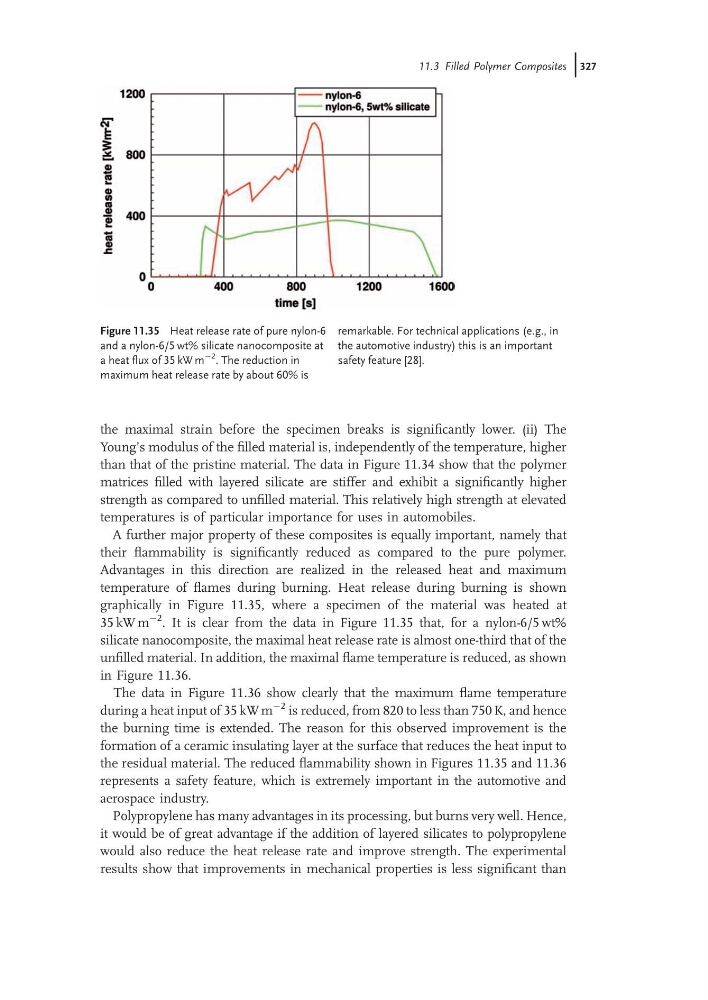
temperature of flames during burning. Heat release during burning is shown
graphically in Figure 11.35, where a specimen of the material was heated at
35 kW m
À2 . It is clear from the data in Figure 11.35 that, for a nylon-6/5 wt%
silicate nanocomposite, the maximal heat release rate is almost one-third that of the
unfilled material. In addition, the maximal flame temperature is reduced, as shown
in Figure 11.36.
The data in Figure 11.36 show clearly that the maximum flame temperature
during a heat input of 35 kW m
À2 is reduced, from 820 to less than 750 K, and hence
the burning time is extended. The reason for this observed improvement is the
formation of a ceramic insulating layer at the surface that reduces the heat input to
the residual material. The reduced flammability shown in Figures 11.35 and 11.36
represents a safety feature, which is extremely important in the automotive and
aerospace industry.
Polypropylene has many advantages in its processing, but burns very well. Hence,
it would be of great advantage if the addition of layered silicates to polypropylene
would also reduce the heat release rate and improve strength. The experimental
results show that improvements in mechanical properties is less significant than
Figure 11.35 Heat release rate of pure nylon-6
and a nylon-6/5 wt% silicate nanocomposite at
a heat flux of 35 kW m
À2 . The reduction in
maximum heat release rate by about 60% is
remarkable. For technical applications (e.g., in
the automotive industry) this is an important
safety feature [28].
11.3 Filled Polymer Composites j327
Young’s modulus of the filled material is, independently of the temperature, higher
than that of the pristine material. The data in Figure 11.34 show that the polymer
matrices filled with layered silicate are stiffer and exhibit a significantly higher
strength as compared to unfilled material. This relatively high strength at elevated
temperatures is of particular importance for uses in automobiles.
A further major property of these composites is equally important, namely that
their flammability is significantly reduced as compared to the pure polymer.
Advantages in this direction are realized in the released heat and maximum
temperature of flames during burning. Heat release during burning is shown
graphically in Figure 11.35, where a specimen of the material was heated at
35 kW m
À2 . It is clear from the data in Figure 11.35 that, for a nylon-6/5 wt%
silicate nanocomposite, the maximal heat release rate is almost one-third that of the
unfilled material. In addition, the maximal flame temperature is reduced, as shown
in Figure 11.36.
The data in Figure 11.36 show clearly that the maximum flame temperature
during a heat input of 35 kW m
À2 is reduced, from 820 to less than 750 K, and hence
the burning time is extended. The reason for this observed improvement is the
formation of a ceramic insulating layer at the surface that reduces the heat input to
the residual material. The reduced flammability shown in Figures 11.35 and 11.36
represents a safety feature, which is extremely important in the automotive and
aerospace industry.
Polypropylene has many advantages in its processing, but burns very well. Hence,
it would be of great advantage if the addition of layered silicates to polypropylene
would also reduce the heat release rate and improve strength. The experimental
results show that improvements in mechanical properties is less significant than
Figure 11.35 Heat release rate of pure nylon-6
and a nylon-6/5 wt% silicate nanocomposite at
a heat flux of 35 kW m
À2 . The reduction in
maximum heat release rate by about 60% is
remarkable. For technical applications (e.g., in
the automotive industry) this is an important
safety feature [28].
11.3 Filled Polymer Composites j327