

of the micrograph. Unfortunately, in this image it is quite difficult to estimate the size
of the silicate sheets, although they may be in the range of a few hundred nanometers.
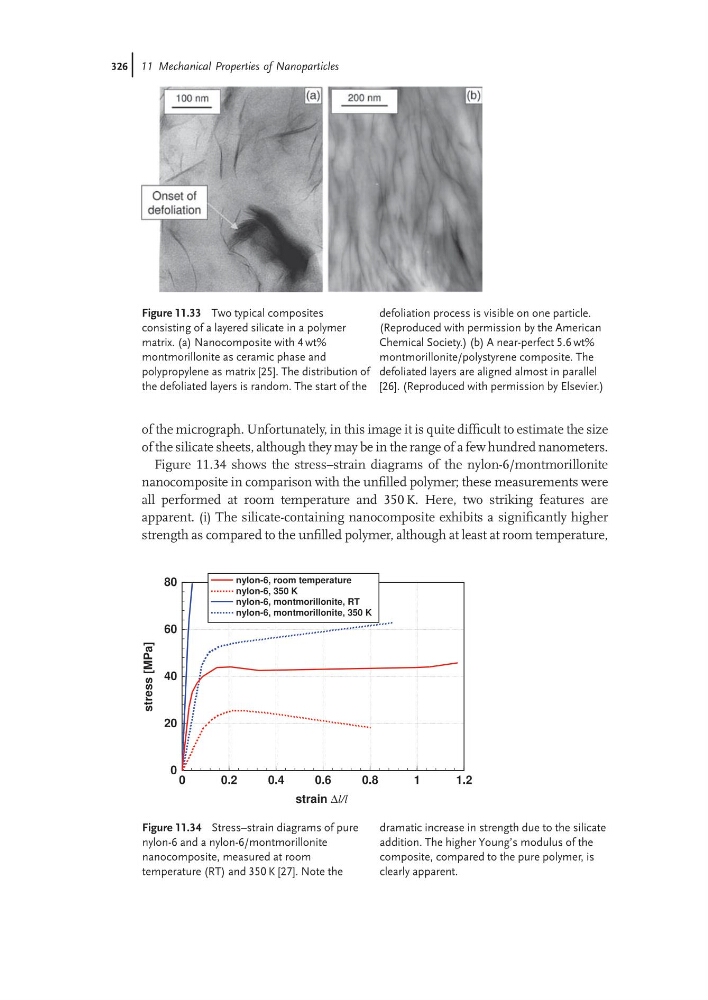
Figure 11.34 shows the stress–strain diagrams of the nylon-6/montmorillonite
nanocomposite in comparison with the unfilled polymer; these measurements were
all performed at room temperature and 350 K. Here, two striking features are
apparent. (i) The silicate-containing nanocomposite exhibits a significantly higher
strength as compared to the unfilled polymer, although at least at room temperature,
Figure 11.33 Two typical composites
consisting of a layered silicate in a polymer
matrix. (a) Nanocomposite with 4 wt%
montmorillonite as ceramic phase and
polypropylene as matrix [25]. The distribution of
the defoliated layers is random. The start of the
defoliation process is visible on one particle.
(Reproduced with permission by the American
Chemical Society.) (b) A near-perfect 5.6 wt%
montmorillonite/polystyrene composite. The
defoliated layers are aligned almost in parallel
[26]. (Reproduced with permission by Elsevier.)
0
0.2
0.4
0.6
0.8
1
1.2
0
20
40
60
80
nylon-6, room temperature
nylon-6, 350 K
nylon-6, montmorillonite, RT
nylon-6, montmorillonite, 350 K
strain Δl/l
stress [MPa]
Figure 11.34 Stress–strain diagrams of pure
nylon-6 and a nylon-6/montmorillonite
nanocomposite, measured at room
temperature (RT) and 350 K [27]. Note the
dramatic increase in strength due to the silicate
addition. The higher Young’s modulus of the
composite, compared to the pure polymer, is
clearly apparent.
326j 11 Mechanical Properties of Nanoparticles
of the silicate sheets, although they may be in the range of a few hundred nanometers.
Figure 11.34 shows the stress–strain diagrams of the nylon-6/montmorillonite
nanocomposite in comparison with the unfilled polymer; these measurements were
all performed at room temperature and 350 K. Here, two striking features are
apparent. (i) The silicate-containing nanocomposite exhibits a significantly higher
strength as compared to the unfilled polymer, although at least at room temperature,
Figure 11.33 Two typical composites
consisting of a layered silicate in a polymer
matrix. (a) Nanocomposite with 4 wt%
montmorillonite as ceramic phase and
polypropylene as matrix [25]. The distribution of
the defoliated layers is random. The start of the
defoliation process is visible on one particle.
(Reproduced with permission by the American
Chemical Society.) (b) A near-perfect 5.6 wt%
montmorillonite/polystyrene composite. The
defoliated layers are aligned almost in parallel
[26]. (Reproduced with permission by Elsevier.)
0
0.2
0.4
0.6
0.8
1
1.2
0
20
40
60
80
nylon-6, room temperature
nylon-6, 350 K
nylon-6, montmorillonite, RT
nylon-6, montmorillonite, 350 K
strain Δl/l
stress [MPa]
Figure 11.34 Stress–strain diagrams of pure
nylon-6 and a nylon-6/montmorillonite
nanocomposite, measured at room
temperature (RT) and 350 K [27]. Note the
dramatic increase in strength due to the silicate
addition. The higher Young’s modulus of the
composite, compared to the pure polymer, is
clearly apparent.
326j 11 Mechanical Properties of Nanoparticles