

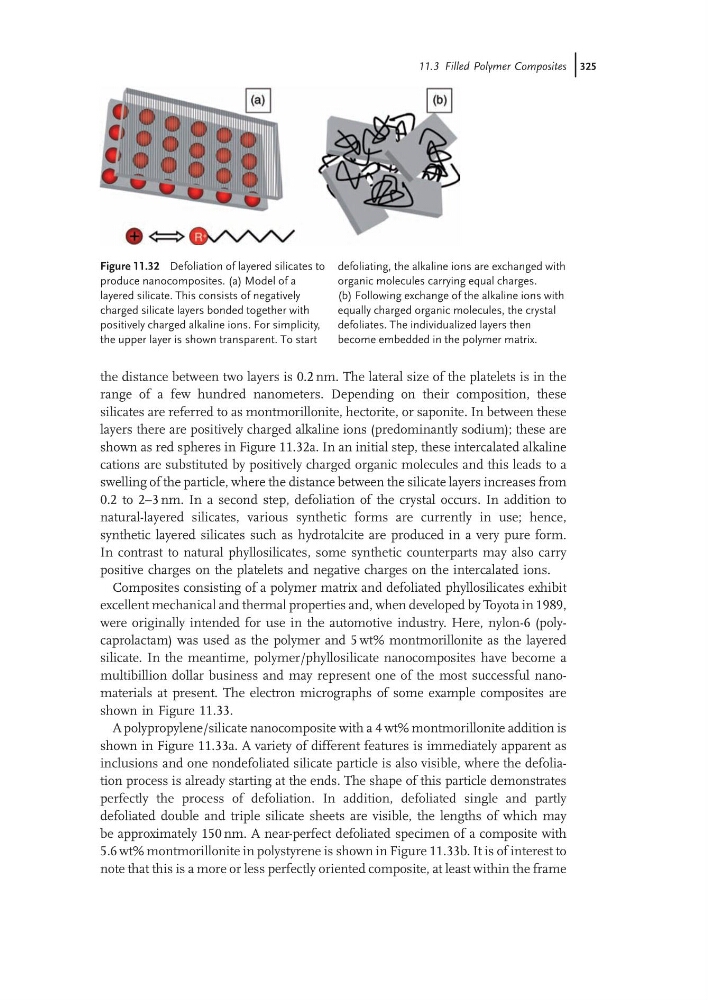
the distance between two layers is 0.2 nm. The lateral size of the platelets is in the
range of a few hundred nanometers. Depending on their composition, these
silicates are referred to as montmorillonite, hectorite, or saponite. In between these
layers there are positively charged alkaline ions (predominantly sodium); these are
shown as red spheres in Figure 11.32a. In an initial step, these intercalated alkaline
cations are substituted by positively charged organic molecules and this leads to a
swelling of the particle, where the distance between the silicate layers increases from
0.2 to 2–3 nm. In a second step, defoliation of the crystal occurs. In addition to
natural-layered silicates, various synthetic forms are currently in use; hence,
synthetic layered silicates such as hydrotalcite are produced in a very pure form.
In contrast to natural phyllosilicates, some synthetic counterparts may also carry
positive charges on the platelets and negative charges on the intercalated ions.
Composites consisting of a polymer matrix and defoliated phyllosilicates exhibit
excellent mechanical and thermal properties and, when developed by Toyota in 1989,
were originally intended for use in the automotive industry. Here, nylon-6 (polycaprolactam) was used as the polymer and 5 wt% montmorillonite as the layered
silicate. In the meantime, polymer/phyllosilicate nanocomposites have become a
multibillion dollar business and may represent one of the most successful nanomaterials at present. The electron micrographs of some example composites are
shown in Figure 11.33.
A polypropylene/silicate nanocomposite with a 4 wt% montmorillonite addition is
shown in Figure 11.33a. A variety of different features is immediately apparent as
inclusions and one nondefoliated silicate particle is also visible, where the defoliation process is already starting at the ends. The shape of this particle demonstrates
perfectly the process of defoliation. In addition, defoliated single and partly
defoliated double and triple silicate sheets are visible, the lengths of which may
be approximately 150 nm. A near-perfect defoliated specimen of a composite with
5.6 wt% montmorillonite in polystyrene is shown in Figure 11.33b. It is of interest to
note that this is a more or less perfectly oriented composite, at least within the frame
Figure 11.32 Defoliation of layered silicates to
produce nanocomposites. (a) Model of a
layered silicate. This consists of negatively
charged silicate layers bonded together with
positively charged alkaline ions. For simplicity,
the upper layer is shown transparent. To start
defoliating, the alkaline ions are exchanged with
organic molecules carrying equal charges.
(b) Following exchange of the alkaline ions with
equally charged organic molecules, the crystal
defoliates. The individualized layers then
become embedded in the polymer matrix.
11.3 Filled Polymer Composites j325
range of a few hundred nanometers. Depending on their composition, these
silicates are referred to as montmorillonite, hectorite, or saponite. In between these
layers there are positively charged alkaline ions (predominantly sodium); these are
shown as red spheres in Figure 11.32a. In an initial step, these intercalated alkaline
cations are substituted by positively charged organic molecules and this leads to a
swelling of the particle, where the distance between the silicate layers increases from
0.2 to 2–3 nm. In a second step, defoliation of the crystal occurs. In addition to
natural-layered silicates, various synthetic forms are currently in use; hence,
synthetic layered silicates such as hydrotalcite are produced in a very pure form.
In contrast to natural phyllosilicates, some synthetic counterparts may also carry
positive charges on the platelets and negative charges on the intercalated ions.
Composites consisting of a polymer matrix and defoliated phyllosilicates exhibit
excellent mechanical and thermal properties and, when developed by Toyota in 1989,
were originally intended for use in the automotive industry. Here, nylon-6 (polycaprolactam) was used as the polymer and 5 wt% montmorillonite as the layered
silicate. In the meantime, polymer/phyllosilicate nanocomposites have become a
multibillion dollar business and may represent one of the most successful nanomaterials at present. The electron micrographs of some example composites are
shown in Figure 11.33.
A polypropylene/silicate nanocomposite with a 4 wt% montmorillonite addition is
shown in Figure 11.33a. A variety of different features is immediately apparent as
inclusions and one nondefoliated silicate particle is also visible, where the defoliation process is already starting at the ends. The shape of this particle demonstrates
perfectly the process of defoliation. In addition, defoliated single and partly
defoliated double and triple silicate sheets are visible, the lengths of which may
be approximately 150 nm. A near-perfect defoliated specimen of a composite with
5.6 wt% montmorillonite in polystyrene is shown in Figure 11.33b. It is of interest to
note that this is a more or less perfectly oriented composite, at least within the frame
Figure 11.32 Defoliation of layered silicates to
produce nanocomposites. (a) Model of a
layered silicate. This consists of negatively
charged silicate layers bonded together with
positively charged alkaline ions. For simplicity,
the upper layer is shown transparent. To start
defoliating, the alkaline ions are exchanged with
organic molecules carrying equal charges.
(b) Following exchange of the alkaline ions with
equally charged organic molecules, the crystal
defoliates. The individualized layers then
become embedded in the polymer matrix.
11.3 Filled Polymer Composites j325