

more probable, the shear stress between the organic binder and the ceramic filler
leads to debonding [21]. An electron micrograph of such a structure (nacre) is shown
in Figure 11.30c. Clearly, there is not too much idealization in the model structure
shown in Figure 11.30a but, according to the authors, there exists an optimum
aspect ratio of the ceramic bricks that corresponds to the condition that protein and
mineral fail at the same load. However, this design of a platelet-enforced nanocomposite is optimized for only one load direction. When assuming mechanical
loads in directions perpendicular to the platelets, the structure shown in
Figure 11.30a is not necessarily the best. Considerations such as these are of major
importance when discussing the optimal structures of composites with plateletshaped fillers.
In order to produce such a platelet/polymer nanocomposite, small particles of
ceramic materials crystallizing in layered structures are applied. The best results are
obtained when these particles are defoliated, which means that larger particles are
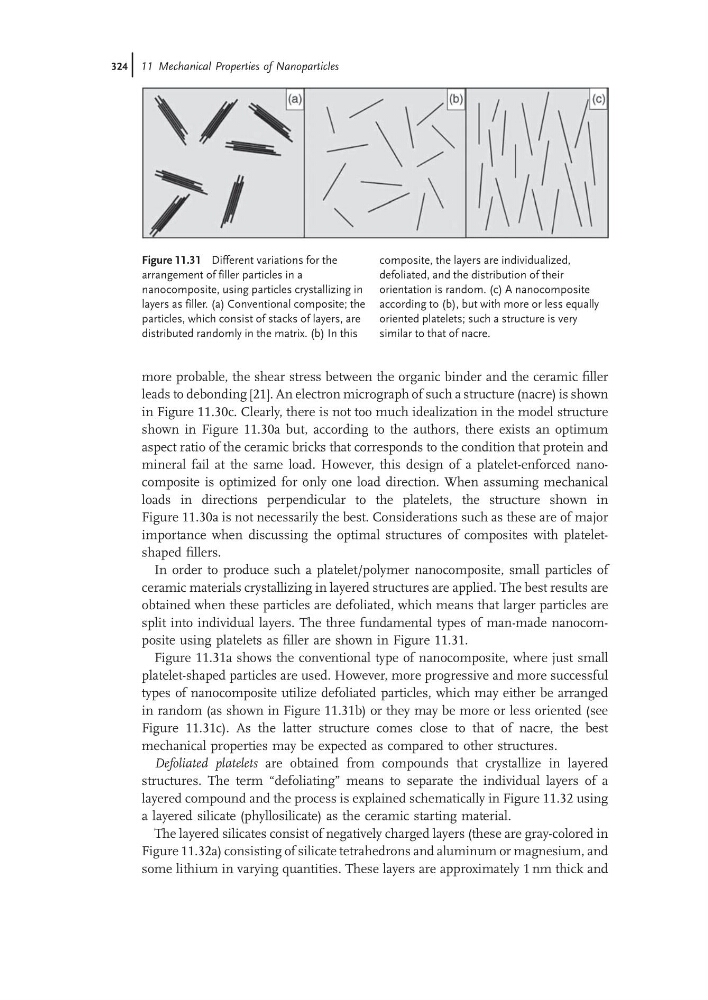
split into individual layers. The three fundamental types of man-made nanocomposite using platelets as filler are shown in Figure 11.31.
Figure 11.31a shows the conventional type of nanocomposite, where just small
platelet-shaped particles are used. However, more progressive and more successful
types of nanocomposite utilize defoliated particles, which may either be arranged
in random (as shown in Figure 11.31b) or they may be more or less oriented (see
Figure 11.31c). As the latter structure comes close to that of nacre, the best
mechanical properties may be expected as compared to other structures.
Defoliated platelets are obtained from compounds that crystallize in layered
structures. The term “defoliating” means to separate the individual layers of a
layered compound and the process is explained schematically in Figure 11.32 using
a layered silicate (phyllosilicate) as the ceramic starting material.
The layered silicates consist of negatively charged layers (these are gray-colored in
Figure 11.32a) consisting of silicate tetrahedrons and aluminum or magnesium, and
some lithium in varying quantities. These layers are approximately 1 nm thick and
Figure 11.31 Different variations for the
arrangement of filler particles in a
nanocomposite, using particles crystallizing in
layers as filler. (a) Conventional composite; the
particles, which consist of stacks of layers, are
distributed randomly in the matrix. (b) In this
composite, the layers are individualized,
defoliated, and the distribution of their
orientation is random. (c) A nanocomposite
according to (b), but with more or less equally
oriented platelets; such a structure is very
similar to that of nacre.
324j 11 Mechanical Properties of Nanoparticles
leads to debonding [21]. An electron micrograph of such a structure (nacre) is shown
in Figure 11.30c. Clearly, there is not too much idealization in the model structure
shown in Figure 11.30a but, according to the authors, there exists an optimum
aspect ratio of the ceramic bricks that corresponds to the condition that protein and
mineral fail at the same load. However, this design of a platelet-enforced nanocomposite is optimized for only one load direction. When assuming mechanical
loads in directions perpendicular to the platelets, the structure shown in
Figure 11.30a is not necessarily the best. Considerations such as these are of major
importance when discussing the optimal structures of composites with plateletshaped fillers.
In order to produce such a platelet/polymer nanocomposite, small particles of
ceramic materials crystallizing in layered structures are applied. The best results are
obtained when these particles are defoliated, which means that larger particles are
split into individual layers. The three fundamental types of man-made nanocomposite using platelets as filler are shown in Figure 11.31.
Figure 11.31a shows the conventional type of nanocomposite, where just small
platelet-shaped particles are used. However, more progressive and more successful
types of nanocomposite utilize defoliated particles, which may either be arranged
in random (as shown in Figure 11.31b) or they may be more or less oriented (see
Figure 11.31c). As the latter structure comes close to that of nacre, the best
mechanical properties may be expected as compared to other structures.
Defoliated platelets are obtained from compounds that crystallize in layered
structures. The term “defoliating” means to separate the individual layers of a
layered compound and the process is explained schematically in Figure 11.32 using
a layered silicate (phyllosilicate) as the ceramic starting material.
The layered silicates consist of negatively charged layers (these are gray-colored in
Figure 11.32a) consisting of silicate tetrahedrons and aluminum or magnesium, and
some lithium in varying quantities. These layers are approximately 1 nm thick and
Figure 11.31 Different variations for the
arrangement of filler particles in a
nanocomposite, using particles crystallizing in
layers as filler. (a) Conventional composite; the
particles, which consist of stacks of layers, are
distributed randomly in the matrix. (b) In this
composite, the layers are individualized,
defoliated, and the distribution of their
orientation is random. (c) A nanocomposite
according to (b), but with more or less equally
oriented platelets; such a structure is very
similar to that of nacre.
324j 11 Mechanical Properties of Nanoparticles