

1.5 vol% filler content, are shown graphically in Figure 11.29. In addition, in contrast
to the example shown in Figure 11.28, there was a decrease in the Young’s modulus
of the filled material, in contrast to the pure PMMA.
11.3.2
Polymer-Based Nanocomposites Filled with Platelets
Among the most exciting nanocomposites are the polymer/ceramic nanocomposites, where the ceramic phase is platelet-shaped. This type of composite is preferred
in nature and is found in the structure of bones, where it consists of crystallized
mineral platelets of a few nanometers thickness that are bound together with
collagen as the matrix. One prominent example is that of nacre, which exhibits a
“bricks-and-mortar” structure where the thickness of the aragonite bricks is a few
hundred nanometers. Even when nacre does not exhibit a “real” nanostructure,
there are crack-resistant elements in this structure that are essential in order to
understand the properties of these composites and provide direction for further
development. The structure of these composites, consisting of ceramic platelets (the
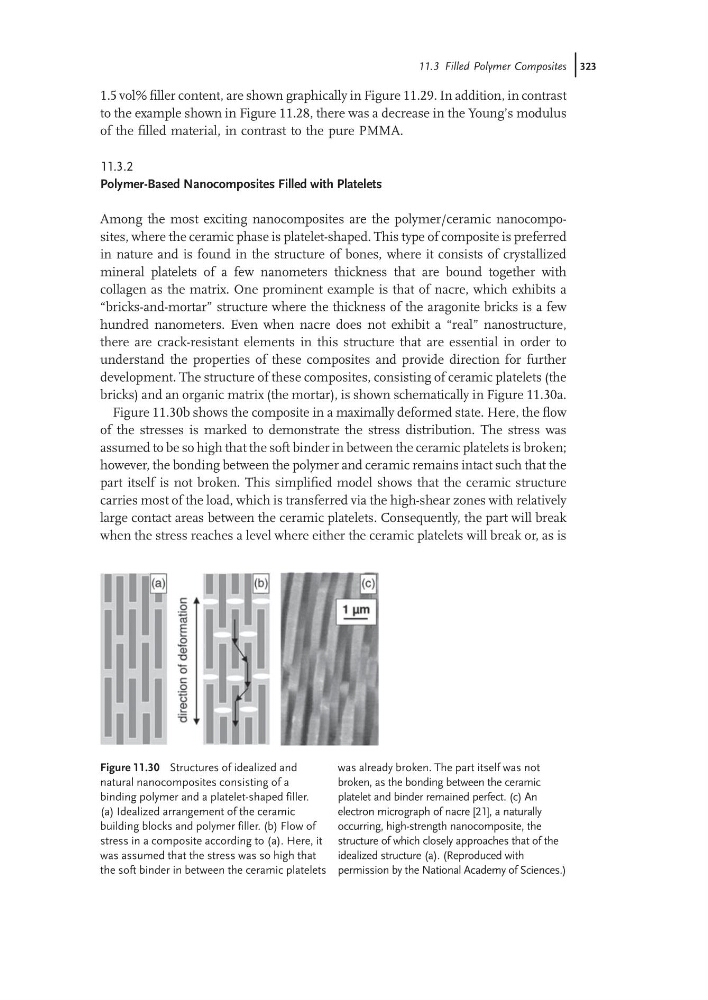
bricks) and an organic matrix (the mortar), is shown schematically in Figure 11.30a.
Figure 11.30b shows the composite in a maximally deformed state. Here, the flow
of the stresses is marked to demonstrate the stress distribution. The stress was
assumed to be so high that the soft binder in between the ceramic platelets is broken;
however, the bonding between the polymer and ceramic remains intact such that the
part itself is not broken. This simplified model shows that the ceramic structure
carries most of the load, which is transferred via the high-shear zones with relatively
large contact areas between the ceramic platelets. Consequently, the part will break
when the stress reaches a level where either the ceramic platelets will break or, as is
Figure 11.30 Structures of idealized and
natural nanocomposites consisting of a
binding polymer and a platelet-shaped filler.
(a) Idealized arrangement of the ceramic
building blocks and polymer filler. (b) Flow of
stress in a composite according to (a). Here, it
was assumed that the stress was so high that
the soft binder in between the ceramic platelets
was already broken. The part itself was not
broken, as the bonding between the ceramic
platelet and binder remained perfect. (c) An
electron micrograph of nacre [21], a naturally
occurring, high-strength nanocomposite, the
structure of which closely approaches that of the
idealized structure (a). (Reproduced with
permission by the National Academy of Sciences.)
11.3 Filled Polymer Composites j323
to the example shown in Figure 11.28, there was a decrease in the Young’s modulus
of the filled material, in contrast to the pure PMMA.
11.3.2
Polymer-Based Nanocomposites Filled with Platelets
Among the most exciting nanocomposites are the polymer/ceramic nanocomposites, where the ceramic phase is platelet-shaped. This type of composite is preferred
in nature and is found in the structure of bones, where it consists of crystallized
mineral platelets of a few nanometers thickness that are bound together with
collagen as the matrix. One prominent example is that of nacre, which exhibits a
“bricks-and-mortar” structure where the thickness of the aragonite bricks is a few
hundred nanometers. Even when nacre does not exhibit a “real” nanostructure,
there are crack-resistant elements in this structure that are essential in order to
understand the properties of these composites and provide direction for further
development. The structure of these composites, consisting of ceramic platelets (the
bricks) and an organic matrix (the mortar), is shown schematically in Figure 11.30a.
Figure 11.30b shows the composite in a maximally deformed state. Here, the flow
of the stresses is marked to demonstrate the stress distribution. The stress was
assumed to be so high that the soft binder in between the ceramic platelets is broken;
however, the bonding between the polymer and ceramic remains intact such that the
part itself is not broken. This simplified model shows that the ceramic structure
carries most of the load, which is transferred via the high-shear zones with relatively
large contact areas between the ceramic platelets. Consequently, the part will break
when the stress reaches a level where either the ceramic platelets will break or, as is
Figure 11.30 Structures of idealized and
natural nanocomposites consisting of a
binding polymer and a platelet-shaped filler.
(a) Idealized arrangement of the ceramic
building blocks and polymer filler. (b) Flow of
stress in a composite according to (a). Here, it
was assumed that the stress was so high that
the soft binder in between the ceramic platelets
was already broken. The part itself was not
broken, as the bonding between the ceramic
platelet and binder remained perfect. (c) An
electron micrograph of nacre [21], a naturally
occurring, high-strength nanocomposite, the
structure of which closely approaches that of the
idealized structure (a). (Reproduced with
permission by the National Academy of Sciences.)
11.3 Filled Polymer Composites j323