

or smaller ceramic particles in the polymer matrix, respectively. Clearly, by using
fillers with a smaller grain size the size of the cracks that may occur during
mechanical deformation are also smaller. Therefore, according to Eq. (11.10), a
higher strength might be expected. Such behavior might be expected primarily in
cases where the binding between the polymer matrix and the filler is poor.
However, in most cases, it will be difficult to fill the polymer matrix with isolated
grains; rather, it is to be expected that nanopowders will be introduced as
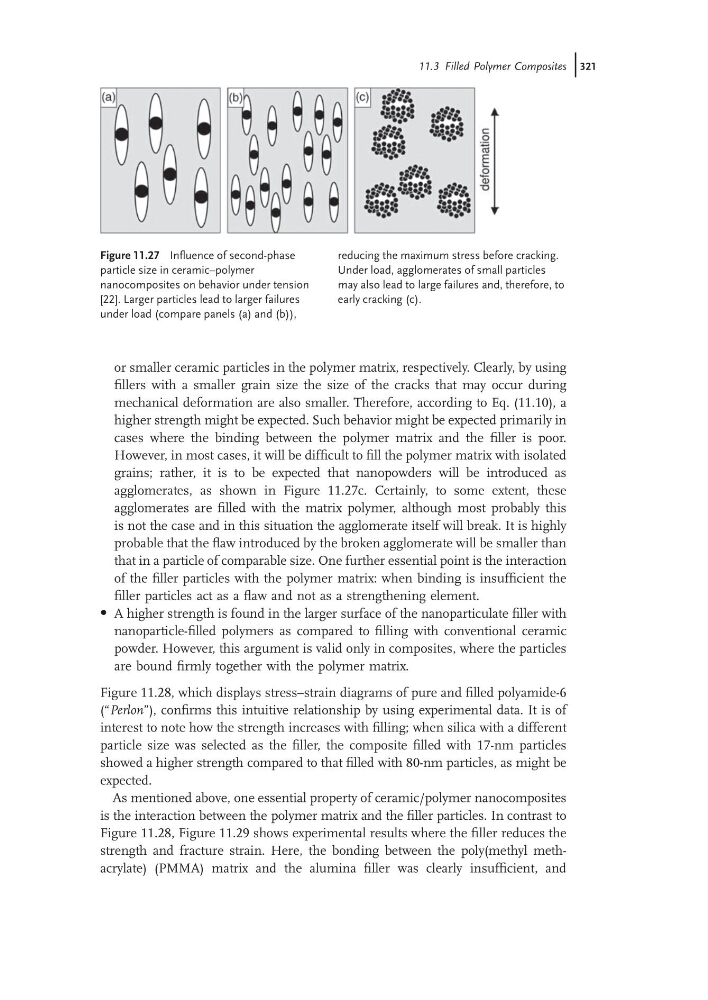
agglomerates, as shown in Figure 11.27c. Certainly, to some extent, these
agglomerates are filled with the matrix polymer, although most probably this
is not the case and in this situation the agglomerate itself will break. It is highly
probable that the flaw introduced by the broken agglomerate will be smaller than
that in a particle of comparable size. One further essential point is the interaction
of the filler particles with the polymer matrix: when binding is insufficient the
filler particles act as a flaw and not as a strengthening element.
A higher strength is found in the larger surface of the nanoparticulate filler with
nanoparticle-filled polymers as compared to filling with conventional ceramic
powder. However, this argument is valid only in composites, where the particles
are bound firmly together with the polymer matrix.
Figure 11.28, which displays stress–strain diagrams of pure and filled polyamide-6
(“Perlon”), confirms this intuitive relationship by using experimental data. It is of
interest to note how the strength increases with filling; when silica with a different
particle size was selected as the filler, the composite filled with 17-nm particles
showed a higher strength compared to that filled with 80-nm particles, as might be
expected.
As mentioned above, one essential property of ceramic/polymer nanocomposites
is the interaction between the polymer matrix and the filler particles. In contrast to
Figure 11.28, Figure 11.29 shows experimental results where the filler reduces the
strength and fracture strain. Here, the bonding between the poly(methyl methacrylate) (PMMA) matrix and the alumina filler was clearly insufficient, and
Figure 11.27 Influence of second-phase
particle size in ceramic–polymer
nanocomposites on behavior under tension
[22]. Larger particles lead to larger failures
under load (compare panels (a) and (b)),
reducing the maximum stress before cracking.
Under load, agglomerates of small particles
may also lead to large failures and, therefore, to
early cracking (c).
11.3 Filled Polymer Composites j321
fillers with a smaller grain size the size of the cracks that may occur during
mechanical deformation are also smaller. Therefore, according to Eq. (11.10), a
higher strength might be expected. Such behavior might be expected primarily in
cases where the binding between the polymer matrix and the filler is poor.
However, in most cases, it will be difficult to fill the polymer matrix with isolated
grains; rather, it is to be expected that nanopowders will be introduced as
agglomerates, as shown in Figure 11.27c. Certainly, to some extent, these
agglomerates are filled with the matrix polymer, although most probably this
is not the case and in this situation the agglomerate itself will break. It is highly
probable that the flaw introduced by the broken agglomerate will be smaller than
that in a particle of comparable size. One further essential point is the interaction
of the filler particles with the polymer matrix: when binding is insufficient the
filler particles act as a flaw and not as a strengthening element.
A higher strength is found in the larger surface of the nanoparticulate filler with
nanoparticle-filled polymers as compared to filling with conventional ceramic
powder. However, this argument is valid only in composites, where the particles
are bound firmly together with the polymer matrix.
Figure 11.28, which displays stress–strain diagrams of pure and filled polyamide-6
(“Perlon”), confirms this intuitive relationship by using experimental data. It is of
interest to note how the strength increases with filling; when silica with a different
particle size was selected as the filler, the composite filled with 17-nm particles
showed a higher strength compared to that filled with 80-nm particles, as might be
expected.
As mentioned above, one essential property of ceramic/polymer nanocomposites
is the interaction between the polymer matrix and the filler particles. In contrast to
Figure 11.28, Figure 11.29 shows experimental results where the filler reduces the
strength and fracture strain. Here, the bonding between the poly(methyl methacrylate) (PMMA) matrix and the alumina filler was clearly insufficient, and
Figure 11.27 Influence of second-phase
particle size in ceramic–polymer
nanocomposites on behavior under tension
[22]. Larger particles lead to larger failures
under load (compare panels (a) and (b)),
reducing the maximum stress before cracking.
Under load, agglomerates of small particles
may also lead to large failures and, therefore, to
early cracking (c).
11.3 Filled Polymer Composites j321