

particles of the filler or agglomerates, the poorer are the properties obtained.
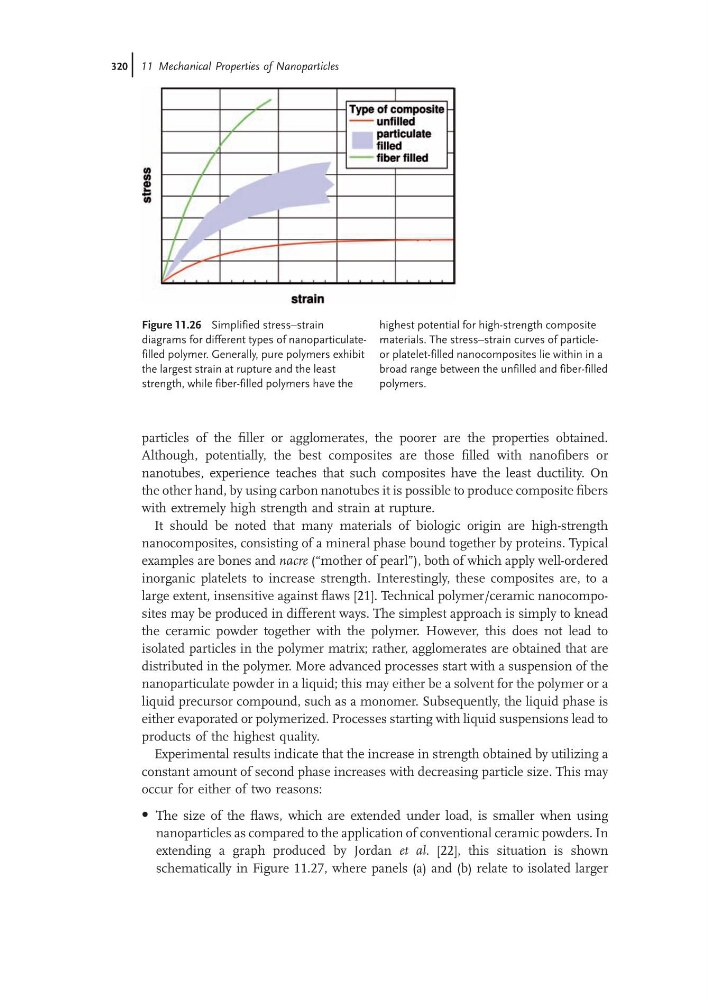
Although, potentially, the best composites are those filled with nanofibers or
nanotubes, experience teaches that such composites have the least ductility. On
the other hand, by using carbon nanotubes it is possible to produce composite fibers
with extremely high strength and strain at rupture.
It should be noted that many materials of biologic origin are high-strength
nanocomposites, consisting of a mineral phase bound together by proteins. Typical
examples are bones and nacre (“mother of pearl”), both of which apply well-ordered
inorganic platelets to increase strength. Interestingly, these composites are, to a
large extent, insensitive against flaws [21]. Technical polymer/ceramic nanocomposites may be produced in different ways. The simplest approach is simply to knead
the ceramic powder together with the polymer. However, this does not lead to
isolated particles in the polymer matrix; rather, agglomerates are obtained that are
distributed in the polymer. More advanced processes start with a suspension of the
nanoparticulate powder in a liquid; this may either be a solvent for the polymer or a
liquid precursor compound, such as a monomer. Subsequently, the liquid phase is
either evaporated or polymerized. Processes starting with liquid suspensions lead to
products of the highest quality.
Experimental results indicate that the increase in strength obtained by utilizing a
constant amount of second phase increases with decreasing particle size. This may
occur for either of two reasons:
The size of the flaws, which are extended under load, is smaller when using
nanoparticles as compared to the application of conventional ceramic powders. In
extending a graph produced by Jordan et al. [22], this situation is shown
schematically in Figure 11.27, where panels (a) and (b) relate to isolated larger
Figure 11.26 Simplified stress–strain
diagrams for different types of nanoparticulatefilled polymer. Generally, pure polymers exhibit
the largest strain at rupture and the least
strength, while fiber-filled polymers have the
highest potential for high-strength composite
materials. The stress–strain curves of particleor platelet-filled nanocomposites lie within in a
broad range between the unfilled and fiber-filled
polymers.
320j 11 Mechanical Properties of Nanoparticles
Although, potentially, the best composites are those filled with nanofibers or
nanotubes, experience teaches that such composites have the least ductility. On
the other hand, by using carbon nanotubes it is possible to produce composite fibers
with extremely high strength and strain at rupture.
It should be noted that many materials of biologic origin are high-strength
nanocomposites, consisting of a mineral phase bound together by proteins. Typical
examples are bones and nacre (“mother of pearl”), both of which apply well-ordered
inorganic platelets to increase strength. Interestingly, these composites are, to a
large extent, insensitive against flaws [21]. Technical polymer/ceramic nanocomposites may be produced in different ways. The simplest approach is simply to knead
the ceramic powder together with the polymer. However, this does not lead to
isolated particles in the polymer matrix; rather, agglomerates are obtained that are
distributed in the polymer. More advanced processes start with a suspension of the
nanoparticulate powder in a liquid; this may either be a solvent for the polymer or a
liquid precursor compound, such as a monomer. Subsequently, the liquid phase is
either evaporated or polymerized. Processes starting with liquid suspensions lead to
products of the highest quality.
Experimental results indicate that the increase in strength obtained by utilizing a
constant amount of second phase increases with decreasing particle size. This may
occur for either of two reasons:
The size of the flaws, which are extended under load, is smaller when using
nanoparticles as compared to the application of conventional ceramic powders. In
extending a graph produced by Jordan et al. [22], this situation is shown
schematically in Figure 11.27, where panels (a) and (b) relate to isolated larger
Figure 11.26 Simplified stress–strain
diagrams for different types of nanoparticulatefilled polymer. Generally, pure polymers exhibit
the largest strain at rupture and the least
strength, while fiber-filled polymers have the
highest potential for high-strength composite
materials. The stress–strain curves of particleor platelet-filled nanocomposites lie within in a
broad range between the unfilled and fiber-filled
polymers.
320j 11 Mechanical Properties of Nanoparticles