

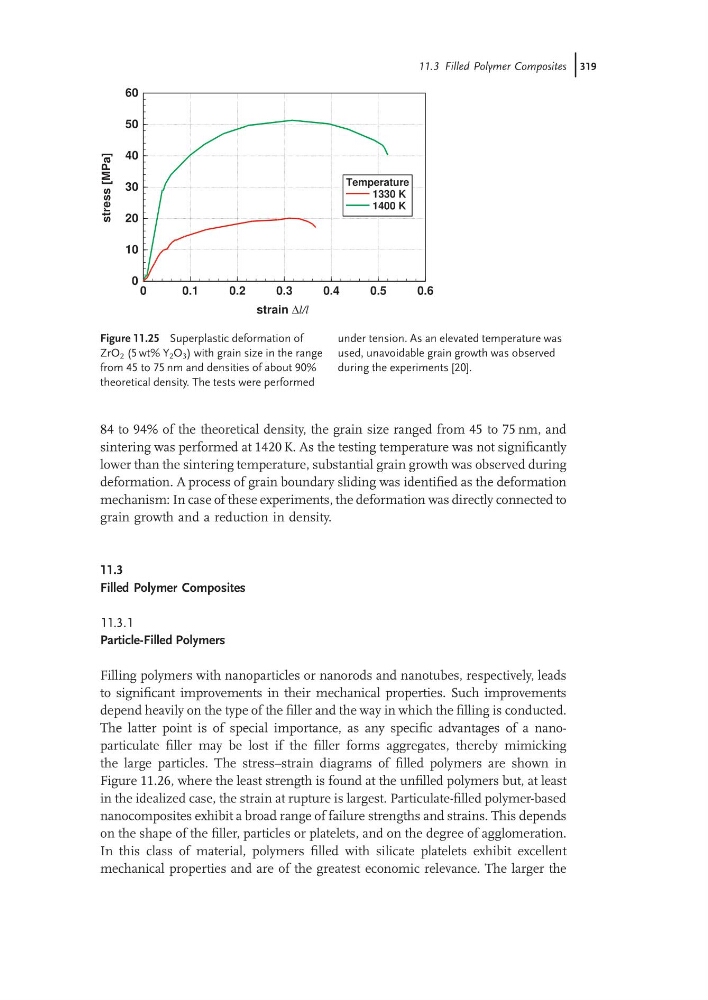
84 to 94% of the theoretical density, the grain size ranged from 45 to 75 nm, and
sintering was performed at 1420 K. As the testing temperature was not significantly
lower than the sintering temperature, substantial grain growth was observed during
deformation. A process of grain boundary sliding was identified as the deformation
mechanism: In case of these experiments, the deformation was directly connected to
grain growth and a reduction in density.
11.3
Filled Polymer Composites
11.3.1
Particle-Filled Polymers
Filling polymers with nanoparticles or nanorods and nanotubes, respectively, leads
to significant improvements in their mechanical properties. Such improvements
depend heavily on the type of the filler and the way in which the filling is conducted.
The latter point is of special importance, as any specific advantages of a nanoparticulate filler may be lost if the filler forms aggregates, thereby mimicking
the large particles. The stress–strain diagrams of filled polymers are shown in
Figure 11.26, where the least strength is found at the unfilled polymers but, at least
in the idealized case, the strain at rupture is largest. Particulate-filled polymer-based
nanocomposites exhibit a broad range of failure strengths and strains. This depends
on the shape of the filler, particles or platelets, and on the degree of agglomeration.
In this class of material, polymers filled with silicate platelets exhibit excellent
mechanical properties and are of the greatest economic relevance. The larger the
0
0.1
0.2
0.3
0.4
0.5
0.6
0
10
20
30
40
50
60
Temperature
1330 K
1400 K
strain Δl/l
stress [MPa]
Figure 11.25 Superplastic deformation of
ZrO 2 (5 wt% Y 2 O 3 ) with grain size in the range
from 45 to 75 nm and densities of about 90%
theoretical density. The tests were performed
under tension. As an elevated temperature was
used, unavoidable grain growth was observed
during the experiments [20].
11.3 Filled Polymer Composites j319
sintering was performed at 1420 K. As the testing temperature was not significantly
lower than the sintering temperature, substantial grain growth was observed during
deformation. A process of grain boundary sliding was identified as the deformation
mechanism: In case of these experiments, the deformation was directly connected to
grain growth and a reduction in density.
11.3
Filled Polymer Composites
11.3.1
Particle-Filled Polymers
Filling polymers with nanoparticles or nanorods and nanotubes, respectively, leads
to significant improvements in their mechanical properties. Such improvements
depend heavily on the type of the filler and the way in which the filling is conducted.
The latter point is of special importance, as any specific advantages of a nanoparticulate filler may be lost if the filler forms aggregates, thereby mimicking
the large particles. The stress–strain diagrams of filled polymers are shown in
Figure 11.26, where the least strength is found at the unfilled polymers but, at least
in the idealized case, the strain at rupture is largest. Particulate-filled polymer-based
nanocomposites exhibit a broad range of failure strengths and strains. This depends
on the shape of the filler, particles or platelets, and on the degree of agglomeration.
In this class of material, polymers filled with silicate platelets exhibit excellent
mechanical properties and are of the greatest economic relevance. The larger the
0
0.1
0.2
0.3
0.4
0.5
0.6
0
10
20
30
40
50
60
Temperature
1330 K
1400 K
strain Δl/l
stress [MPa]
Figure 11.25 Superplastic deformation of
ZrO 2 (5 wt% Y 2 O 3 ) with grain size in the range
from 45 to 75 nm and densities of about 90%
theoretical density. The tests were performed
under tension. As an elevated temperature was
used, unavoidable grain growth was observed
during the experiments [20].
11.3 Filled Polymer Composites j319