

One further interesting application of carbon nanotube/polymer composites
exploits their electrical conductivity and large length/diameter ratios. Owing to
the huge aspect ratio, the amount of carbon nanotubes required to achieve electrical
conductivity is very small and it is possible to produce an optical transparent coating
with relatively good electrical conductivity. Such coatings are necessary as contacts
for organic light-emitting diodes (OLEDs) and organic solar cells. OLEDs may be
used for any type of display, ranging from television sets to computer monitors. The
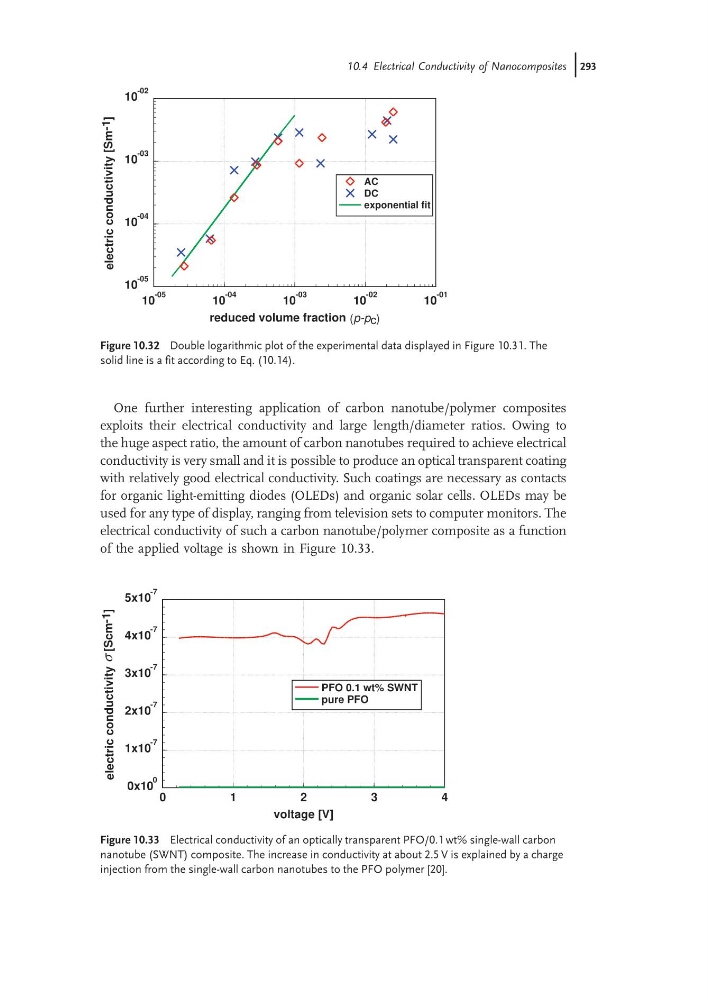
electrical conductivity of such a carbon nanotube/polymer composite as a function
of the applied voltage is shown in Figure 10.33.
10
-05
10
-04
10
-03
10
-02
10
-01
reduced volume fraction (p-pc)
10
-05
10
-04
10
-03
10
-02
electric
conductivity
[Sm
-1 ]
AC
DC
exponential fit
Figure 10.32 Double logarithmic plot of the experimental data displayed in Figure 10.31. The
solid line is a fit according to Eq. (10.14).
0
1
2
3
4
voltage [V]
0x10
0
1x10
-7
2x10
-7
3x10
-7
4x10
-7
5x10
-7
electric
conductivity
σ [Scm
-1 ]
PFO 0.1 wt% SWNT
pure PFO
Figure 10.33 Electrical conductivity of an optically transparent PFO/0.1 wt% single-wall carbon
nanotube (SWNT) composite. The increase in conductivity at about 2.5 V is explained by a charge
injection from the single-wall carbon nanotubes to the PFO polymer [20].
10.4 Electrical Conductivity of Nanocomposites j293
exploits their electrical conductivity and large length/diameter ratios. Owing to
the huge aspect ratio, the amount of carbon nanotubes required to achieve electrical
conductivity is very small and it is possible to produce an optical transparent coating
with relatively good electrical conductivity. Such coatings are necessary as contacts
for organic light-emitting diodes (OLEDs) and organic solar cells. OLEDs may be
used for any type of display, ranging from television sets to computer monitors. The
electrical conductivity of such a carbon nanotube/polymer composite as a function
of the applied voltage is shown in Figure 10.33.
10
-05
10
-04
10
-03
10
-02
10
-01
reduced volume fraction (p-pc)
10
-05
10
-04
10
-03
10
-02
electric
conductivity
[Sm
-1 ]
AC
DC
exponential fit
Figure 10.32 Double logarithmic plot of the experimental data displayed in Figure 10.31. The
solid line is a fit according to Eq. (10.14).
0
1
2
3
4
voltage [V]
0x10
0
1x10
-7
2x10
-7
3x10
-7
4x10
-7
5x10
-7
electric
conductivity
σ [Scm
-1 ]
PFO 0.1 wt% SWNT
pure PFO
Figure 10.33 Electrical conductivity of an optically transparent PFO/0.1 wt% single-wall carbon
nanotube (SWNT) composite. The increase in conductivity at about 2.5 V is explained by a charge
injection from the single-wall carbon nanotubes to the PFO polymer [20].
10.4 Electrical Conductivity of Nanocomposites j293