

of carbon fibers, Mo 6 S 4.5 J 4.5 fibers were used. This material crystallizes linearly in
wires with a diameter of about 1 nm, although it must be pointed out that these
fibers form bundles. It is possible to reduce the diameter of the bundles by
sonication, but during this treatment, the length of the wires is also reduced. After
sonication, the length of the wires was reduced to approximately 1000 nm and this
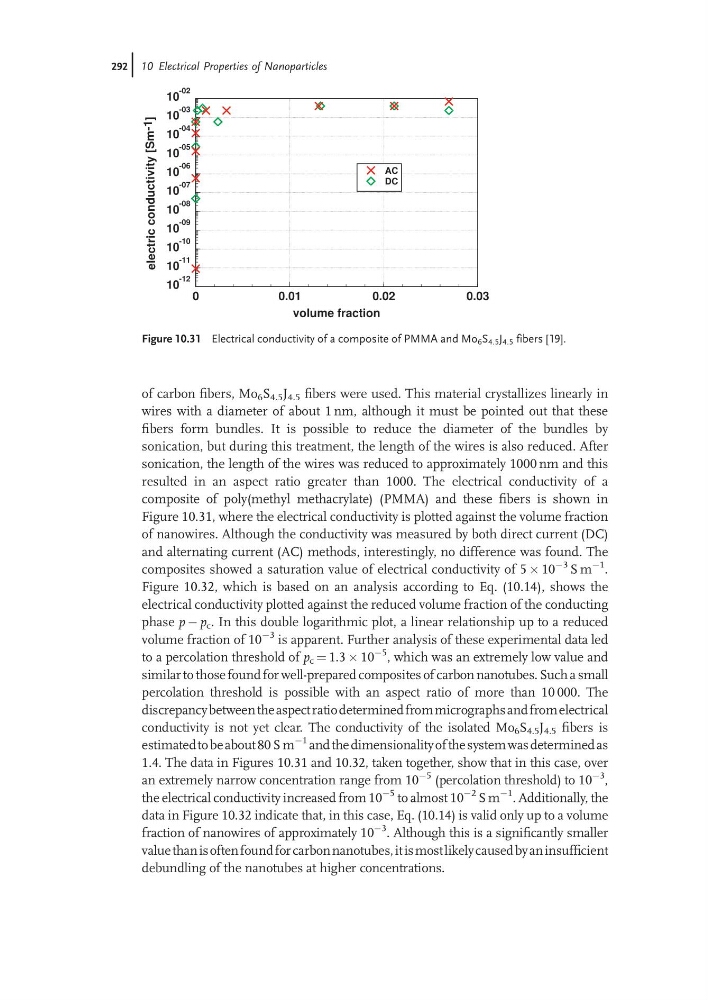
resulted in an aspect ratio greater than 1000. The electrical conductivity of a
composite of poly(methyl methacrylate) (PMMA) and these fibers is shown in
Figure 10.31, where the electrical conductivity is plotted against the volume fraction
of nanowires. Although the conductivity was measured by both direct current (DC)
and alternating current (AC) methods, interestingly, no difference was found. The
composites showed a saturation value of electrical conductivity of 5 Â 10
À3 S m
À1 .
Figure 10.32, which is based on an analysis according to Eq. (10.14), shows the
electrical conductivity plotted against the reduced volume fraction of the conducting
phase p À p c . In this double logarithmic plot, a linear relationship up to a reduced
volume fraction of 10
À3 is apparent. Further analysis of these experimental data led
to a percolation threshold of p c ¼ 1.3 Â 10
À5 , which was an extremely low value and
similar to those found for well-prepared composites of carbon nanotubes. Such a small
percolation threshold is possible with an aspect ratio of more than 10 000. The
discrepancy between the aspect ratio determined from micrographs and from electrical
conductivity is not yet clear. The conductivity of the isolated Mo 6 S 4.5 J 4.5 fibers is
estimated to be about 80 S m
À1 and the dimensionality of the system was determined as
1.4. The data in Figures 10.31 and 10.32, taken together, show that in this case, over
an extremely narrow concentration range from 10
À5 (percolation threshold) to 10
À3
,
the electrical conductivity increased from 10
À5 to almost 10
À2 S m
À1
. Additionally, the
data in Figure 10.32 indicate that, in this case, Eq. (10.14) is valid only up to a volume
fraction of nanowires of approximately 10
À3
. Although this is a significantly smaller
value than is often found for carbon nanotubes, it is most likely caused by an insufficient
debundling of the nanotubes at higher concentrations.
0
0.01
0.02
0.03
volume fraction
10
-12
10
-11
10
-10
10
-09
10
-08
10
-07
10
-06
10
-05
10
-04
10
-03
10
-02
electric
conductivity
[Sm
-1 ]
AC
DC
Figure 10.31 Electrical conductivity of a composite of PMMA and Mo 6 S 4.5 J 4.5 fibers [19].
292j 10 Electrical Properties of Nanoparticles
wires with a diameter of about 1 nm, although it must be pointed out that these
fibers form bundles. It is possible to reduce the diameter of the bundles by
sonication, but during this treatment, the length of the wires is also reduced. After
sonication, the length of the wires was reduced to approximately 1000 nm and this
resulted in an aspect ratio greater than 1000. The electrical conductivity of a
composite of poly(methyl methacrylate) (PMMA) and these fibers is shown in
Figure 10.31, where the electrical conductivity is plotted against the volume fraction
of nanowires. Although the conductivity was measured by both direct current (DC)
and alternating current (AC) methods, interestingly, no difference was found. The
composites showed a saturation value of electrical conductivity of 5 Â 10
À3 S m
À1 .
Figure 10.32, which is based on an analysis according to Eq. (10.14), shows the
electrical conductivity plotted against the reduced volume fraction of the conducting
phase p À p c . In this double logarithmic plot, a linear relationship up to a reduced
volume fraction of 10
À3 is apparent. Further analysis of these experimental data led
to a percolation threshold of p c ¼ 1.3 Â 10
À5 , which was an extremely low value and
similar to those found for well-prepared composites of carbon nanotubes. Such a small
percolation threshold is possible with an aspect ratio of more than 10 000. The
discrepancy between the aspect ratio determined from micrographs and from electrical
conductivity is not yet clear. The conductivity of the isolated Mo 6 S 4.5 J 4.5 fibers is
estimated to be about 80 S m
À1 and the dimensionality of the system was determined as
1.4. The data in Figures 10.31 and 10.32, taken together, show that in this case, over
an extremely narrow concentration range from 10
À5 (percolation threshold) to 10
À3
,
the electrical conductivity increased from 10
À5 to almost 10
À2 S m
À1
. Additionally, the
data in Figure 10.32 indicate that, in this case, Eq. (10.14) is valid only up to a volume
fraction of nanowires of approximately 10
À3
. Although this is a significantly smaller
value than is often found for carbon nanotubes, it is most likely caused by an insufficient
debundling of the nanotubes at higher concentrations.
0
0.01
0.02
0.03
volume fraction
10
-12
10
-11
10
-10
10
-09
10
-08
10
-07
10
-06
10
-05
10
-04
10
-03
10
-02
electric
conductivity
[Sm
-1 ]
AC
DC
Figure 10.31 Electrical conductivity of a composite of PMMA and Mo 6 S 4.5 J 4.5 fibers [19].
292j 10 Electrical Properties of Nanoparticles