

In this example, the amount of carbon nanotubes (single-wall) added to the
composite was 0.1 wt% and poly(2,7-9,9-(di(oxy-2,5,8-trioxadecane))fluorene) (PFO)
was used as the polymer. In Figure 10.30, the conductivity of PFO, which is in the
range of 10
À13 S cm
À1 , is also plotted. The authors correlated the gradual increase in
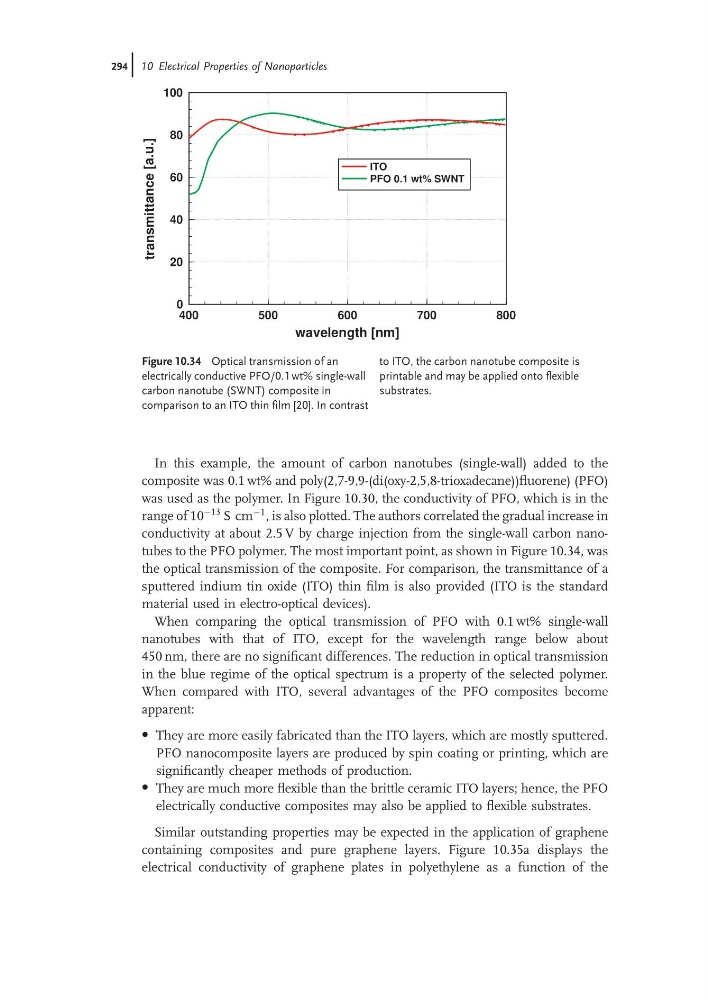
conductivity at about 2.5 V by charge injection from the single-wall carbon nanotubes to the PFO polymer. The most important point, as shown in Figure 10.34, was
the optical transmission of the composite. For comparison, the transmittance of a
sputtered indium tin oxide (ITO) thin film is also provided (ITO is the standard
material used in electro-optical devices).
When comparing the optical transmission of PFO with 0.1 wt% single-wall
nanotubes with that of ITO, except for the wavelength range below about
450 nm, there are no significant differences. The reduction in optical transmission
in the blue regime of the optical spectrum is a property of the selected polymer.
When compared with ITO, several advantages of the PFO composites become
apparent:
They are more easily fabricated than the ITO layers, which are mostly sputtered.
PFO nanocomposite layers are produced by spin coating or printing, which are
significantly cheaper methods of production.
They are much more flexible than the brittle ceramic ITO layers; hence, the PFO
electrically conductive composites may also be applied to flexible substrates.
Similar outstanding properties may be expected in the application of graphene
containing composites and pure graphene layers. Figure 10.35a displays the
electrical conductivity of graphene plates in polyethylene as a function of the
400
500
600
700
800
wavelength [nm]
0
20
40
60
80
100
transmittance
[a.u.]
ITO
PFO 0.1 wt% SWNT
Figure 10.34 Optical transmission of an
electrically conductive PFO/0.1 wt% single-wall
carbon nanotube (SWNT) composite in
comparison to an ITO thin film [20]. In contrast
to ITO, the carbon nanotube composite is
printable and may be applied onto flexible
substrates.
294j 10 Electrical Properties of Nanoparticles
composite was 0.1 wt% and poly(2,7-9,9-(di(oxy-2,5,8-trioxadecane))fluorene) (PFO)
was used as the polymer. In Figure 10.30, the conductivity of PFO, which is in the
range of 10
À13 S cm
À1 , is also plotted. The authors correlated the gradual increase in
conductivity at about 2.5 V by charge injection from the single-wall carbon nanotubes to the PFO polymer. The most important point, as shown in Figure 10.34, was
the optical transmission of the composite. For comparison, the transmittance of a
sputtered indium tin oxide (ITO) thin film is also provided (ITO is the standard
material used in electro-optical devices).
When comparing the optical transmission of PFO with 0.1 wt% single-wall
nanotubes with that of ITO, except for the wavelength range below about
450 nm, there are no significant differences. The reduction in optical transmission
in the blue regime of the optical spectrum is a property of the selected polymer.
When compared with ITO, several advantages of the PFO composites become
apparent:
They are more easily fabricated than the ITO layers, which are mostly sputtered.
PFO nanocomposite layers are produced by spin coating or printing, which are
significantly cheaper methods of production.
They are much more flexible than the brittle ceramic ITO layers; hence, the PFO
electrically conductive composites may also be applied to flexible substrates.
Similar outstanding properties may be expected in the application of graphene
containing composites and pure graphene layers. Figure 10.35a displays the
electrical conductivity of graphene plates in polyethylene as a function of the
400
500
600
700
800
wavelength [nm]
0
20
40
60
80
100
transmittance
[a.u.]
ITO
PFO 0.1 wt% SWNT
Figure 10.34 Optical transmission of an
electrically conductive PFO/0.1 wt% single-wall
carbon nanotube (SWNT) composite in
comparison to an ITO thin film [20]. In contrast
to ITO, the carbon nanotube composite is
printable and may be applied onto flexible
substrates.
294j 10 Electrical Properties of Nanoparticles