

conductivity in an interval of Æ21 V and at higher voltages there is, after a sudden
jump, the expected increase of the current with voltage. The threshold where
electrical conductivity starts depends on the individual nanotube; it ranges from
about 15 to 23 V.
10.3
Photoconductivity of Nanorods
Gallium nitride (GaN) is a semiconducting material that not only demonstrates
photoluminescence, but also, under UV irradiation, shows photoconductivity that is
essential in terms of the compound’s electrical conductivity. Calarco et al. [12]
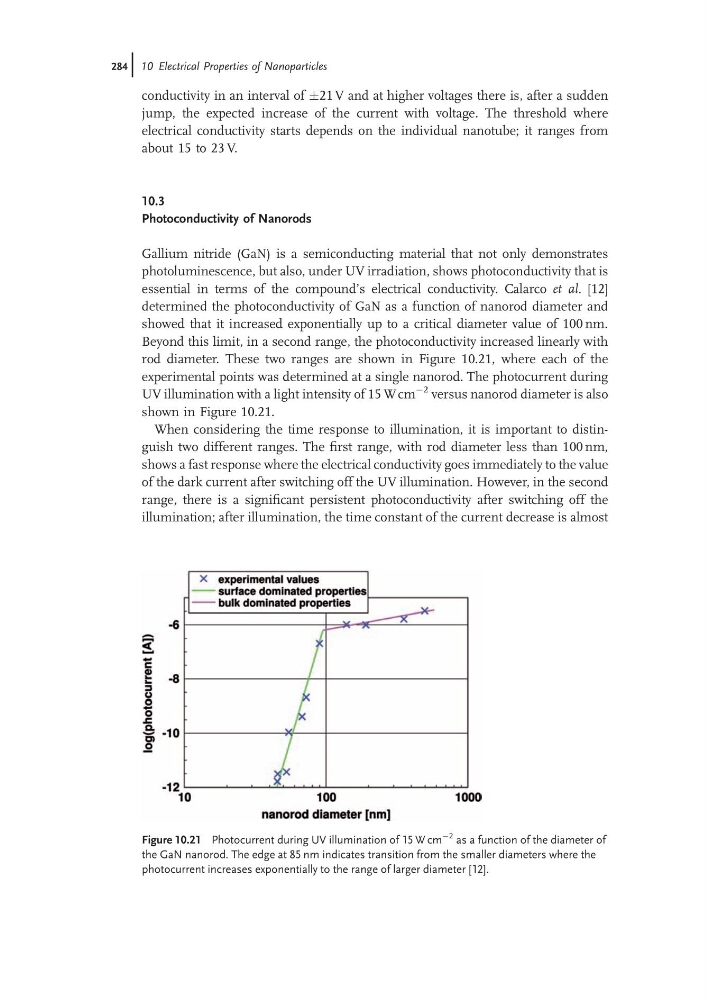
determined the photoconductivity of GaN as a function of nanorod diameter and
showed that it increased exponentially up to a critical diameter value of 100 nm.
Beyond this limit, in a second range, the photoconductivity increased linearly with
rod diameter. These two ranges are shown in Figure 10.21, where each of the
experimental points was determined at a single nanorod. The photocurrent during
UV illumination with a light intensity of 15 W cm
À2 versus nanorod diameter is also
shown in Figure 10.21.
When considering the time response to illumination, it is important to distinguish two different ranges. The first range, with rod diameter less than 100 nm,
shows a fast response where the electrical conductivity goes immediately to the value
of the dark current after switching off the UV illumination. However, in the second
range, there is a significant persistent photoconductivity after switching off the
illumination; after illumination, the time constant of the current decrease is almost
Figure 10.21 Photocurrent during UV illumination of 15 W cm
À2 as a function of the diameter of
the GaN nanorod. The edge at 85 nm indicates transition from the smaller diameters where the
photocurrent increases exponentially to the range of larger diameter [12].
284j 10 Electrical Properties of Nanoparticles
jump, the expected increase of the current with voltage. The threshold where
electrical conductivity starts depends on the individual nanotube; it ranges from
about 15 to 23 V.
10.3
Photoconductivity of Nanorods
Gallium nitride (GaN) is a semiconducting material that not only demonstrates
photoluminescence, but also, under UV irradiation, shows photoconductivity that is
essential in terms of the compound’s electrical conductivity. Calarco et al. [12]
determined the photoconductivity of GaN as a function of nanorod diameter and
showed that it increased exponentially up to a critical diameter value of 100 nm.
Beyond this limit, in a second range, the photoconductivity increased linearly with
rod diameter. These two ranges are shown in Figure 10.21, where each of the
experimental points was determined at a single nanorod. The photocurrent during
UV illumination with a light intensity of 15 W cm
À2 versus nanorod diameter is also
shown in Figure 10.21.
When considering the time response to illumination, it is important to distinguish two different ranges. The first range, with rod diameter less than 100 nm,
shows a fast response where the electrical conductivity goes immediately to the value
of the dark current after switching off the UV illumination. However, in the second
range, there is a significant persistent photoconductivity after switching off the
illumination; after illumination, the time constant of the current decrease is almost
Figure 10.21 Photocurrent during UV illumination of 15 W cm
À2 as a function of the diameter of
the GaN nanorod. The edge at 85 nm indicates transition from the smaller diameters where the
photocurrent increases exponentially to the range of larger diameter [12].
284j 10 Electrical Properties of Nanoparticles