

10.2
Nanotubes
The most important group of nanotubes are those consisting of carbon. In electrically conducting carbon nanotubes, only one electron wave mode is observed that
transports the electrical current. In an interesting experiment, Poncharal et al. [7]
demonstrated the quantized nature of the electrical conductivity of carbon nanotubes. In order to reduce the problems with contacts, these authors measured the
electrical resistance of bundles of multiwall carbon nanotubes that had been pushed
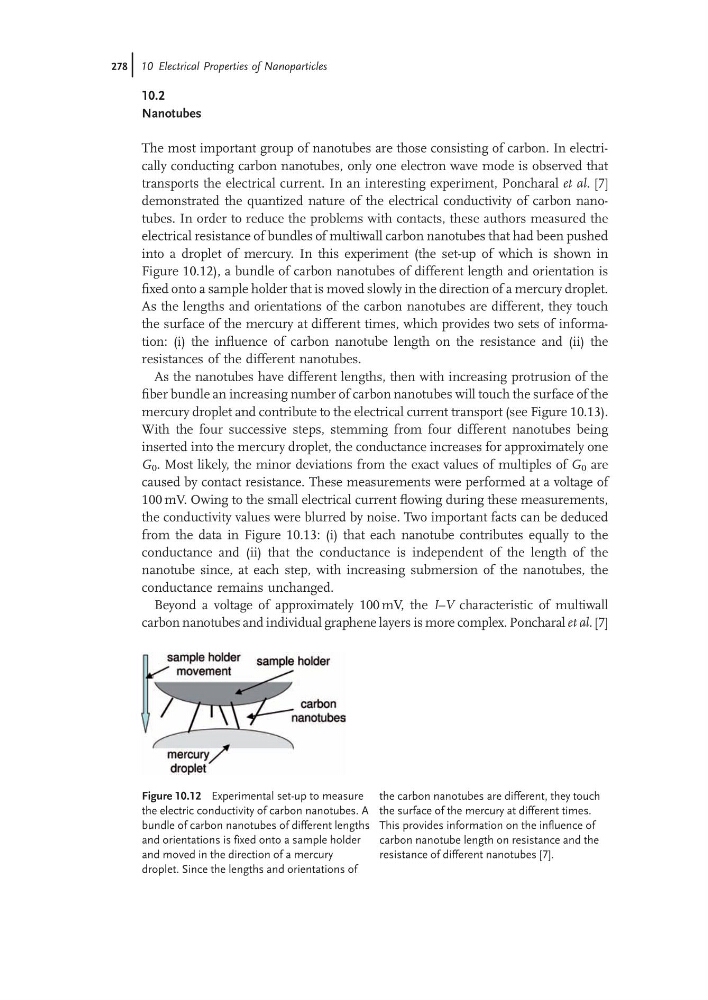
into a droplet of mercury. In this experiment (the set-up of which is shown in
Figure 10.12), a bundle of carbon nanotubes of different length and orientation is
fixed onto a sample holder that is moved slowly in the direction of a mercury droplet.
As the lengths and orientations of the carbon nanotubes are different, they touch
the surface of the mercury at different times, which provides two sets of information: (i) the influence of carbon nanotube length on the resistance and (ii) the
resistances of the different nanotubes.
As the nanotubes have different lengths, then with increasing protrusion of the
fiber bundle an increasing number of carbon nanotubes will touch the surface of the
mercury droplet and contribute to the electrical current transport (see Figure 10.13).
With the four successive steps, stemming from four different nanotubes being
inserted into the mercury droplet, the conductance increases for approximately one
G 0 . Most likely, the minor deviations from the exact values of multiples of G 0 are
caused by contact resistance. These measurements were performed at a voltage of
100 mV. Owing to the small electrical current flowing during these measurements,
the conductivity values were blurred by noise. Two important facts can be deduced
from the data in Figure 10.13: (i) that each nanotube contributes equally to the
conductance and (ii) that the conductance is independent of the length of the
nanotube since, at each step, with increasing submersion of the nanotubes, the
conductance remains unchanged.
Beyond a voltage of approximately 100 mV, the I–V characteristic of multiwall
carbon nanotubes and individual graphene layers is more complex. Poncharal et al. [7]
Figure 10.12 Experimental set-up to measure
the electric conductivity of carbon nanotubes. A
bundle of carbon nanotubes of different lengths
and orientations is fixed onto a sample holder
and moved in the direction of a mercury
droplet. Since the lengths and orientations of
the carbon nanotubes are different, they touch
the surface of the mercury at different times.
This provides information on the influence of
carbon nanotube length on resistance and the
resistance of different nanotubes [7].
278j 10 Electrical Properties of Nanoparticles
Nanotubes
The most important group of nanotubes are those consisting of carbon. In electrically conducting carbon nanotubes, only one electron wave mode is observed that
transports the electrical current. In an interesting experiment, Poncharal et al. [7]
demonstrated the quantized nature of the electrical conductivity of carbon nanotubes. In order to reduce the problems with contacts, these authors measured the
electrical resistance of bundles of multiwall carbon nanotubes that had been pushed
into a droplet of mercury. In this experiment (the set-up of which is shown in
Figure 10.12), a bundle of carbon nanotubes of different length and orientation is
fixed onto a sample holder that is moved slowly in the direction of a mercury droplet.
As the lengths and orientations of the carbon nanotubes are different, they touch
the surface of the mercury at different times, which provides two sets of information: (i) the influence of carbon nanotube length on the resistance and (ii) the
resistances of the different nanotubes.
As the nanotubes have different lengths, then with increasing protrusion of the
fiber bundle an increasing number of carbon nanotubes will touch the surface of the
mercury droplet and contribute to the electrical current transport (see Figure 10.13).
With the four successive steps, stemming from four different nanotubes being
inserted into the mercury droplet, the conductance increases for approximately one
G 0 . Most likely, the minor deviations from the exact values of multiples of G 0 are
caused by contact resistance. These measurements were performed at a voltage of
100 mV. Owing to the small electrical current flowing during these measurements,
the conductivity values were blurred by noise. Two important facts can be deduced
from the data in Figure 10.13: (i) that each nanotube contributes equally to the
conductance and (ii) that the conductance is independent of the length of the
nanotube since, at each step, with increasing submersion of the nanotubes, the
conductance remains unchanged.
Beyond a voltage of approximately 100 mV, the I–V characteristic of multiwall
carbon nanotubes and individual graphene layers is more complex. Poncharal et al. [7]
Figure 10.12 Experimental set-up to measure
the electric conductivity of carbon nanotubes. A
bundle of carbon nanotubes of different lengths
and orientations is fixed onto a sample holder
and moved in the direction of a mercury
droplet. Since the lengths and orientations of
the carbon nanotubes are different, they touch
the surface of the mercury at different times.
This provides information on the influence of
carbon nanotube length on resistance and the
resistance of different nanotubes [7].
278j 10 Electrical Properties of Nanoparticles