

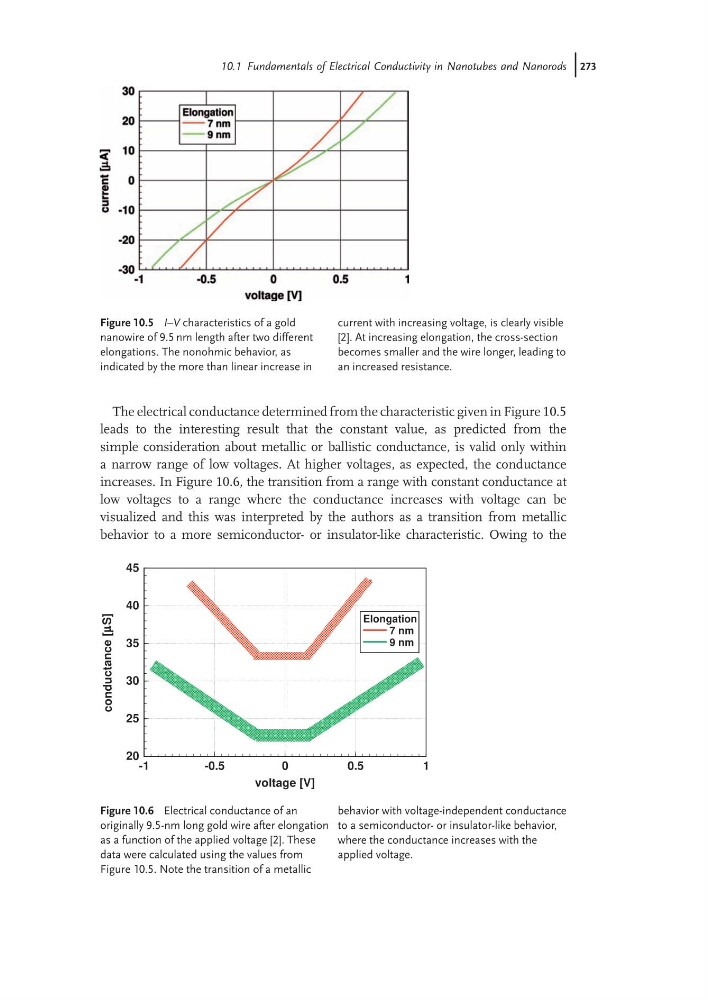
The electrical conductance determined from the characteristic given in Figure 10.5
leads to the interesting result that the constant value, as predicted from the
simple consideration about metallic or ballistic conductance, is valid only within
a narrow range of low voltages. At higher voltages, as expected, the conductance
increases. In Figure 10.6, the transition from a range with constant conductance at
low voltages to a range where the conductance increases with voltage can be
visualized and this was interpreted by the authors as a transition from metallic
behavior to a more semiconductor- or insulator-like characteristic. Owing to the
Figure 10.5 I–V characteristics of a gold
nanowire of 9.5 nm length after two different
elongations. The nonohmic behavior, as
indicated by the more than linear increase in
current with increasing voltage, is clearly visible
[2]. At increasing elongation, the cross-section
becomes smaller and the wire longer, leading to
an increased resistance.
-1
-0.5
0
0.5
1
voltage [V]
20
25
30
35
40
45
conductance
[µS]
Elongation
7 nm
9 nm
Figure 10.6 Electrical conductance of an
originally 9.5-nm long gold wire after elongation
as a function of the applied voltage [2]. These
data were calculated using the values from
Figure 10.5. Note the transition of a metallic
behavior with voltage-independent conductance
to a semiconductor- or insulator-like behavior,
where the conductance increases with the
applied voltage.
10.1 Fundamentals of Electrical Conductivity in Nanotubes and Nanorods j273
leads to the interesting result that the constant value, as predicted from the
simple consideration about metallic or ballistic conductance, is valid only within
a narrow range of low voltages. At higher voltages, as expected, the conductance
increases. In Figure 10.6, the transition from a range with constant conductance at
low voltages to a range where the conductance increases with voltage can be
visualized and this was interpreted by the authors as a transition from metallic
behavior to a more semiconductor- or insulator-like characteristic. Owing to the
Figure 10.5 I–V characteristics of a gold
nanowire of 9.5 nm length after two different
elongations. The nonohmic behavior, as
indicated by the more than linear increase in
current with increasing voltage, is clearly visible
[2]. At increasing elongation, the cross-section
becomes smaller and the wire longer, leading to
an increased resistance.
-1
-0.5
0
0.5
1
voltage [V]
20
25
30
35
40
45
conductance
[µS]
Elongation
7 nm
9 nm
Figure 10.6 Electrical conductance of an
originally 9.5-nm long gold wire after elongation
as a function of the applied voltage [2]. These
data were calculated using the values from
Figure 10.5. Note the transition of a metallic
behavior with voltage-independent conductance
to a semiconductor- or insulator-like behavior,
where the conductance increases with the
applied voltage.
10.1 Fundamentals of Electrical Conductivity in Nanotubes and Nanorods j273