

One interesting method that can be used to demonstrate the steps in conductance
is the mechanical thinning of a nanowire and measurement of the electrical current
at a constant applied voltage. Usually, these measurements are performed at room
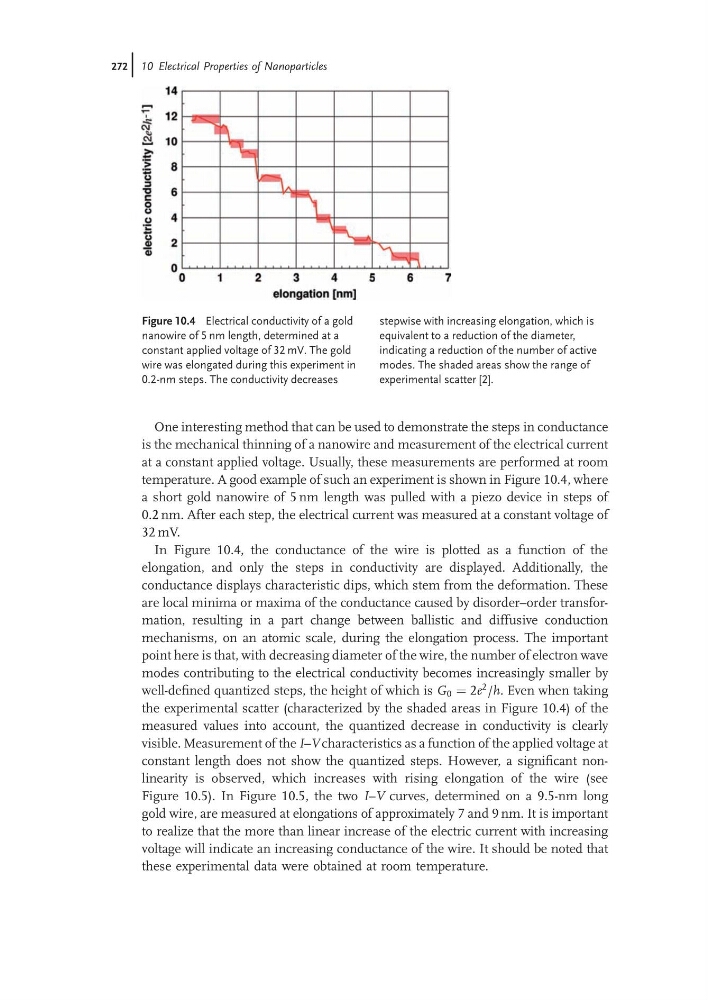
temperature. A good example of such an experiment is shown in Figure 10.4, where
a short gold nanowire of 5 nm length was pulled with a piezo device in steps of
0.2 nm. After each step, the electrical current was measured at a constant voltage of
32 mV.
In Figure 10.4, the conductance of the wire is plotted as a function of the
elongation, and only the steps in conductivity are displayed. Additionally, the
conductance displays characteristic dips, which stem from the deformation. These
are local minima or maxima of the conductance caused by disorder–order transformation, resulting in a part change between ballistic and diffusive conduction
mechanisms, on an atomic scale, during the elongation process. The important
point here is that, with decreasing diameter of the wire, the number of electron wave
modes contributing to the electrical conductivity becomes increasingly smaller by
well-defined quantized steps, the height of which is G 0 ¼ 2e
2 /h. Even when taking
the experimental scatter (characterized by the shaded areas in Figure 10.4) of the
measured values into account, the quantized decrease in conductivity is clearly
visible. Measurement of the I–V characteristics as a function of the applied voltage at
constant length does not show the quantized steps. However, a significant nonlinearity is observed, which increases with rising elongation of the wire (see
Figure 10.5). In Figure 10.5, the two I–V curves, determined on a 9.5-nm long
gold wire, are measured at elongations of approximately 7 and 9 nm. It is important
to realize that the more than linear increase of the electric current with increasing
voltage will indicate an increasing conductance of the wire. It should be noted that
these experimental data were obtained at room temperature.
Figure 10.4 Electrical conductivity of a gold
nanowire of 5 nm length, determined at a
constant applied voltage of 32 mV. The gold
wire was elongated during this experiment in
0.2-nm steps. The conductivity decreases
stepwise with increasing elongation, which is
equivalent to a reduction of the diameter,
indicating a reduction of the number of active
modes. The shaded areas show the range of
experimental scatter [2].
272j 10 Electrical Properties of Nanoparticles
is the mechanical thinning of a nanowire and measurement of the electrical current
at a constant applied voltage. Usually, these measurements are performed at room
temperature. A good example of such an experiment is shown in Figure 10.4, where
a short gold nanowire of 5 nm length was pulled with a piezo device in steps of
0.2 nm. After each step, the electrical current was measured at a constant voltage of
32 mV.
In Figure 10.4, the conductance of the wire is plotted as a function of the
elongation, and only the steps in conductivity are displayed. Additionally, the
conductance displays characteristic dips, which stem from the deformation. These
are local minima or maxima of the conductance caused by disorder–order transformation, resulting in a part change between ballistic and diffusive conduction
mechanisms, on an atomic scale, during the elongation process. The important
point here is that, with decreasing diameter of the wire, the number of electron wave
modes contributing to the electrical conductivity becomes increasingly smaller by
well-defined quantized steps, the height of which is G 0 ¼ 2e
2 /h. Even when taking
the experimental scatter (characterized by the shaded areas in Figure 10.4) of the
measured values into account, the quantized decrease in conductivity is clearly
visible. Measurement of the I–V characteristics as a function of the applied voltage at
constant length does not show the quantized steps. However, a significant nonlinearity is observed, which increases with rising elongation of the wire (see
Figure 10.5). In Figure 10.5, the two I–V curves, determined on a 9.5-nm long
gold wire, are measured at elongations of approximately 7 and 9 nm. It is important
to realize that the more than linear increase of the electric current with increasing
voltage will indicate an increasing conductance of the wire. It should be noted that
these experimental data were obtained at room temperature.
Figure 10.4 Electrical conductivity of a gold
nanowire of 5 nm length, determined at a
constant applied voltage of 32 mV. The gold
wire was elongated during this experiment in
0.2-nm steps. The conductivity decreases
stepwise with increasing elongation, which is
equivalent to a reduction of the diameter,
indicating a reduction of the number of active
modes. The shaded areas show the range of
experimental scatter [2].
272j 10 Electrical Properties of Nanoparticles