

G ¼ m
2e
2
h
¼ mG 0 :
ð10:4Þ
In this formula, there are no longer any variables depending on the material or the
geometry of the wire. It is clear that the electrical conductance of a small, thin
wire increases with the increment G 0 ¼ 2e
2 /h ¼ 7:72 Â 10
À5 S. The resistance value
h/e
2 ¼ 26 kV is called the resistance quantum. It is important to note, again, that in
the ballistic case the electrical conductance is independent of the material and
geometry of the wire. However, this statement needs insofar a restriction, as the free
path length of the electrons may depend on the material and the amount of active
modes may depend on the geometry, and, additionally, on the applied voltage.
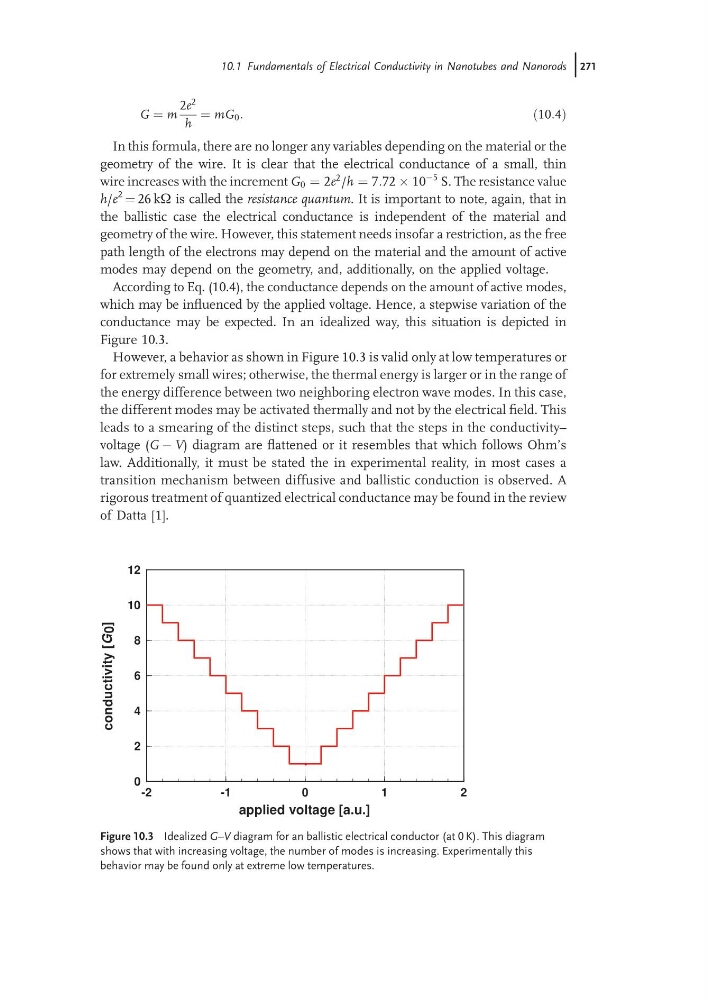
According to Eq. (10.4), the conductance depends on the amount of active modes,
which may be influenced by the applied voltage. Hence, a stepwise variation of the
conductance may be expected. In an idealized way, this situation is depicted in
Figure 10.3.
However, a behavior as shown in Figure 10.3 is valid only at low temperatures or
for extremely small wires; otherwise, the thermal energy is larger or in the range of
the energy difference between two neighboring electron wave modes. In this case,
the different modes may be activated thermally and not by the electrical field. This
leads to a smearing of the distinct steps, such that the steps in the conductivity–
voltage (G À V) diagram are flattened or it resembles that which follows Ohm’s
law. Additionally, it must be stated the in experimental reality, in most cases a
transition mechanism between diffusive and ballistic conduction is observed. A
rigorous treatment of quantized electrical conductance may be found in the review
of Datta [1].
-2
-1
0
1
2
applied voltage [a.u.]
0
2
4
6
8
10
12
conductivity
[G 0
]
Figure 10.3 Idealized G–V diagram for an ballistic electrical conductor (at 0 K). This diagram
shows that with increasing voltage, the number of modes is increasing. Experimentally this
behavior may be found only at extreme low temperatures.
10.1 Fundamentals of Electrical Conductivity in Nanotubes and Nanorods j271
2e
2
h
¼ mG 0 :
ð10:4Þ
In this formula, there are no longer any variables depending on the material or the
geometry of the wire. It is clear that the electrical conductance of a small, thin
wire increases with the increment G 0 ¼ 2e
2 /h ¼ 7:72 Â 10
À5 S. The resistance value
h/e
2 ¼ 26 kV is called the resistance quantum. It is important to note, again, that in
the ballistic case the electrical conductance is independent of the material and
geometry of the wire. However, this statement needs insofar a restriction, as the free
path length of the electrons may depend on the material and the amount of active
modes may depend on the geometry, and, additionally, on the applied voltage.
According to Eq. (10.4), the conductance depends on the amount of active modes,
which may be influenced by the applied voltage. Hence, a stepwise variation of the
conductance may be expected. In an idealized way, this situation is depicted in
Figure 10.3.
However, a behavior as shown in Figure 10.3 is valid only at low temperatures or
for extremely small wires; otherwise, the thermal energy is larger or in the range of
the energy difference between two neighboring electron wave modes. In this case,
the different modes may be activated thermally and not by the electrical field. This
leads to a smearing of the distinct steps, such that the steps in the conductivity–
voltage (G À V) diagram are flattened or it resembles that which follows Ohm’s
law. Additionally, it must be stated the in experimental reality, in most cases a
transition mechanism between diffusive and ballistic conduction is observed. A
rigorous treatment of quantized electrical conductance may be found in the review
of Datta [1].
-2
-1
0
1
2
applied voltage [a.u.]
0
2
4
6
8
10
12
conductivity
[G 0
]
Figure 10.3 Idealized G–V diagram for an ballistic electrical conductor (at 0 K). This diagram
shows that with increasing voltage, the number of modes is increasing. Experimentally this
behavior may be found only at extreme low temperatures.
10.1 Fundamentals of Electrical Conductivity in Nanotubes and Nanorods j271