

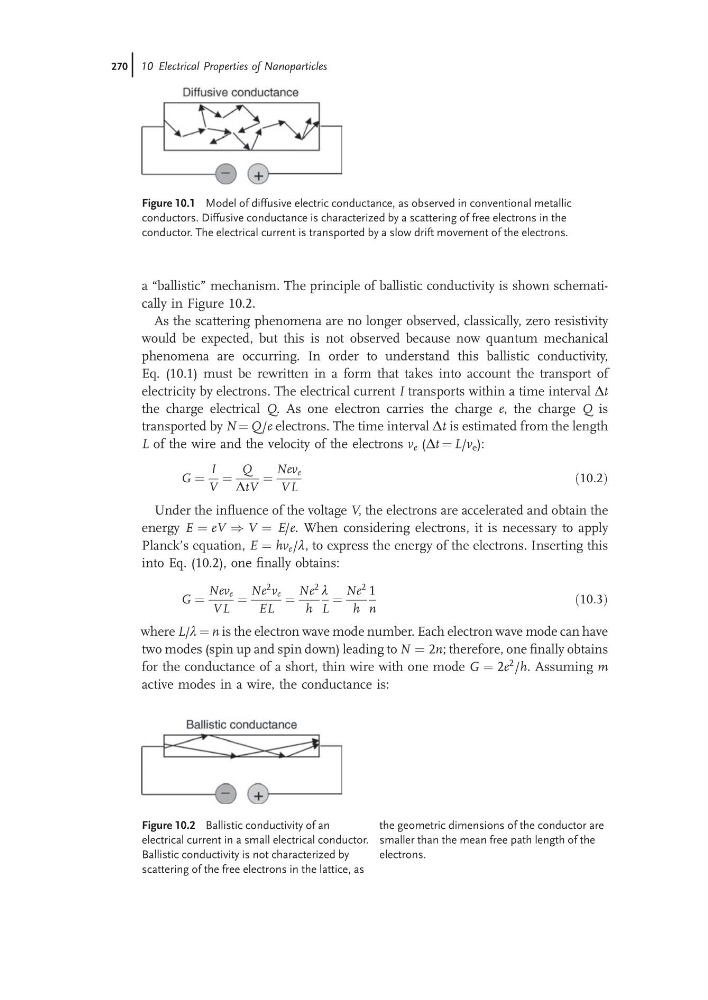
a “ballistic” mechanism. The principle of ballistic conductivity is shown schematically in Figure 10.2.
As the scattering phenomena are no longer observed, classically, zero resistivity
would be expected, but this is not observed because now quantum mechanical
phenomena are occurring. In order to understand this ballistic conductivity,
Eq. (10.1) must be rewritten in a form that takes into account the transport of
electricity by electrons. The electrical current I transports within a time interval Dt
the charge electrical Q. As one electron carries the charge e, the charge Q is
transported by N ¼ Q/e electrons. The time interval Dt is estimated from the length
L of the wire and the velocity of the electrons v e (Dt ¼ L/v e ):
G ¼
I
V
¼
Q
DtV
¼
Nev e
VL
ð10:2Þ
Under the influence of the voltage V, the electrons are accelerated and obtain the
energy E ¼ eV ) V ¼ E/e. When considering electrons, it is necessary to apply
Planck’s equation, E ¼ hv e /l, to express the energy of the electrons. Inserting this
into Eq. (10.2), one finally obtains:
G ¼
Nev e
VL
¼
Ne
2
v e
EL
¼
Ne
2
h
l
L
¼
Ne
2
h
1
n
ð10:3Þ
where L/l ¼ n is the electron wave mode number. Each electron wave mode can have
two modes (spin up and spin down) leading to N ¼ 2n; therefore, one finally obtains
for the conductance of a short, thin wire with one mode G ¼ 2e
2 /h. Assuming m
active modes in a wire, the conductance is:
Figure 10.1 Model of diffusive electric conductance, as observed in conventional metallic
conductors. Diffusive conductance is characterized by a scattering of free electrons in the
conductor. The electrical current is transported by a slow drift movement of the electrons.
Figure 10.2 Ballistic conductivity of an
electrical current in a small electrical conductor.
Ballistic conductivity is not characterized by
scattering of the free electrons in the lattice, as
the geometric dimensions of the conductor are
smaller than the mean free path length of the
electrons.
270j 10 Electrical Properties of Nanoparticles
As the scattering phenomena are no longer observed, classically, zero resistivity
would be expected, but this is not observed because now quantum mechanical
phenomena are occurring. In order to understand this ballistic conductivity,
Eq. (10.1) must be rewritten in a form that takes into account the transport of
electricity by electrons. The electrical current I transports within a time interval Dt
the charge electrical Q. As one electron carries the charge e, the charge Q is
transported by N ¼ Q/e electrons. The time interval Dt is estimated from the length
L of the wire and the velocity of the electrons v e (Dt ¼ L/v e ):
G ¼
I
V
¼
Q
DtV
¼
Nev e
VL
ð10:2Þ
Under the influence of the voltage V, the electrons are accelerated and obtain the
energy E ¼ eV ) V ¼ E/e. When considering electrons, it is necessary to apply
Planck’s equation, E ¼ hv e /l, to express the energy of the electrons. Inserting this
into Eq. (10.2), one finally obtains:
G ¼
Nev e
VL
¼
Ne
2
v e
EL
¼
Ne
2
h
l
L
¼
Ne
2
h
1
n
ð10:3Þ
where L/l ¼ n is the electron wave mode number. Each electron wave mode can have
two modes (spin up and spin down) leading to N ¼ 2n; therefore, one finally obtains
for the conductance of a short, thin wire with one mode G ¼ 2e
2 /h. Assuming m
active modes in a wire, the conductance is:
Figure 10.1 Model of diffusive electric conductance, as observed in conventional metallic
conductors. Diffusive conductance is characterized by a scattering of free electrons in the
conductor. The electrical current is transported by a slow drift movement of the electrons.
Figure 10.2 Ballistic conductivity of an
electrical current in a small electrical conductor.
Ballistic conductivity is not characterized by
scattering of the free electrons in the lattice, as
the geometric dimensions of the conductor are
smaller than the mean free path length of the
electrons.
270j 10 Electrical Properties of Nanoparticles