

10
Electrical Properties of Nanoparticles
10.1
Fundamentals of Electrical Conductivity in Nanotubes and Nanorods
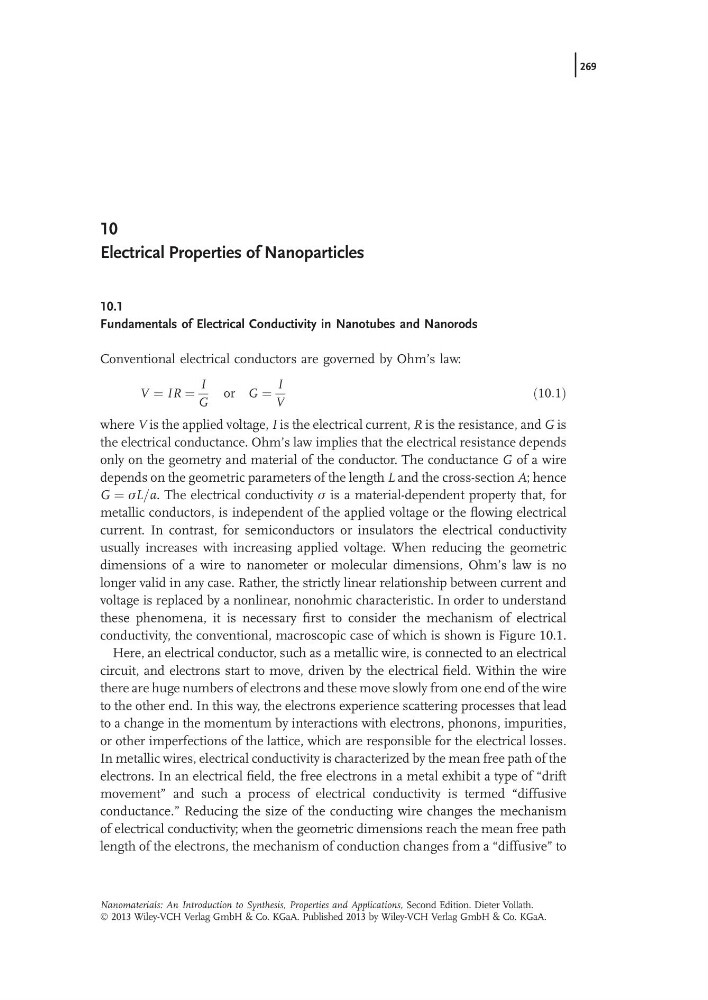
Conventional electrical conductors are governed by Ohm’s law:
V ¼ IR ¼
I
G
or G ¼
I
V
ð10:1Þ
where V is the applied voltage, I is the electrical current, R is the resistance, and G is
the electrical conductance. Ohm’s law implies that the electrical resistance depends
only on the geometry and material of the conductor. The conductance G of a wire
depends on the geometric parameters of the length L and the cross-section A; hence
G ¼ sL=a. The electrical conductivity s is a material-dependent property that, for
metallic conductors, is independent of the applied voltage or the flowing electrical
current. In contrast, for semiconductors or insulators the electrical conductivity
usually increases with increasing applied voltage. When reducing the geometric
dimensions of a wire to nanometer or molecular dimensions, Ohm’s law is no
longer valid in any case. Rather, the strictly linear relationship between current and
voltage is replaced by a nonlinear, nonohmic characteristic. In order to understand
these phenomena, it is necessary first to consider the mechanism of electrical
conductivity, the conventional, macroscopic case of which is shown is Figure 10.1.
Here, an electrical conductor, such as a metallic wire, is connected to an electrical
circuit, and electrons start to move, driven by the electrical field. Within the wire
there are huge numbers of electrons and these move slowly from one end of the wire
to the other end. In this way, the electrons experience scattering processes that lead
to a change in the momentum by interactions with electrons, phonons, impurities,
or other imperfections of the lattice, which are responsible for the electrical losses.
In metallic wires, electrical conductivity is characterized by the mean free path of the
electrons. In an electrical field, the free electrons in a metal exhibit a type of “drift
movement” and such a process of electrical conductivity is termed “diffusive
conductance.” Reducing the size of the conducting wire changes the mechanism
of electrical conductivity; when the geometric dimensions reach the mean free path
length of the electrons, the mechanism of conduction changes from a “diffusive” to
Nanomaterials: An Introduction to Synthesis, Properties and Applications, Second Edition. Dieter Vollath.
Ó 2013 Wiley-VCH Verlag GmbH & Co. KGaA. Published 2013 by Wiley-VCH Verlag GmbH & Co. KGaA.
j269
Electrical Properties of Nanoparticles
10.1
Fundamentals of Electrical Conductivity in Nanotubes and Nanorods
Conventional electrical conductors are governed by Ohm’s law:
V ¼ IR ¼
I
G
or G ¼
I
V
ð10:1Þ
where V is the applied voltage, I is the electrical current, R is the resistance, and G is
the electrical conductance. Ohm’s law implies that the electrical resistance depends
only on the geometry and material of the conductor. The conductance G of a wire
depends on the geometric parameters of the length L and the cross-section A; hence
G ¼ sL=a. The electrical conductivity s is a material-dependent property that, for
metallic conductors, is independent of the applied voltage or the flowing electrical
current. In contrast, for semiconductors or insulators the electrical conductivity
usually increases with increasing applied voltage. When reducing the geometric
dimensions of a wire to nanometer or molecular dimensions, Ohm’s law is no
longer valid in any case. Rather, the strictly linear relationship between current and
voltage is replaced by a nonlinear, nonohmic characteristic. In order to understand
these phenomena, it is necessary first to consider the mechanism of electrical
conductivity, the conventional, macroscopic case of which is shown is Figure 10.1.
Here, an electrical conductor, such as a metallic wire, is connected to an electrical
circuit, and electrons start to move, driven by the electrical field. Within the wire
there are huge numbers of electrons and these move slowly from one end of the wire
to the other end. In this way, the electrons experience scattering processes that lead
to a change in the momentum by interactions with electrons, phonons, impurities,
or other imperfections of the lattice, which are responsible for the electrical losses.
In metallic wires, electrical conductivity is characterized by the mean free path of the
electrons. In an electrical field, the free electrons in a metal exhibit a type of “drift
movement” and such a process of electrical conductivity is termed “diffusive
conductance.” Reducing the size of the conducting wire changes the mechanism
of electrical conductivity; when the geometric dimensions reach the mean free path
length of the electrons, the mechanism of conduction changes from a “diffusive” to
Nanomaterials: An Introduction to Synthesis, Properties and Applications, Second Edition. Dieter Vollath.
Ó 2013 Wiley-VCH Verlag GmbH & Co. KGaA. Published 2013 by Wiley-VCH Verlag GmbH & Co. KGaA.
j269