

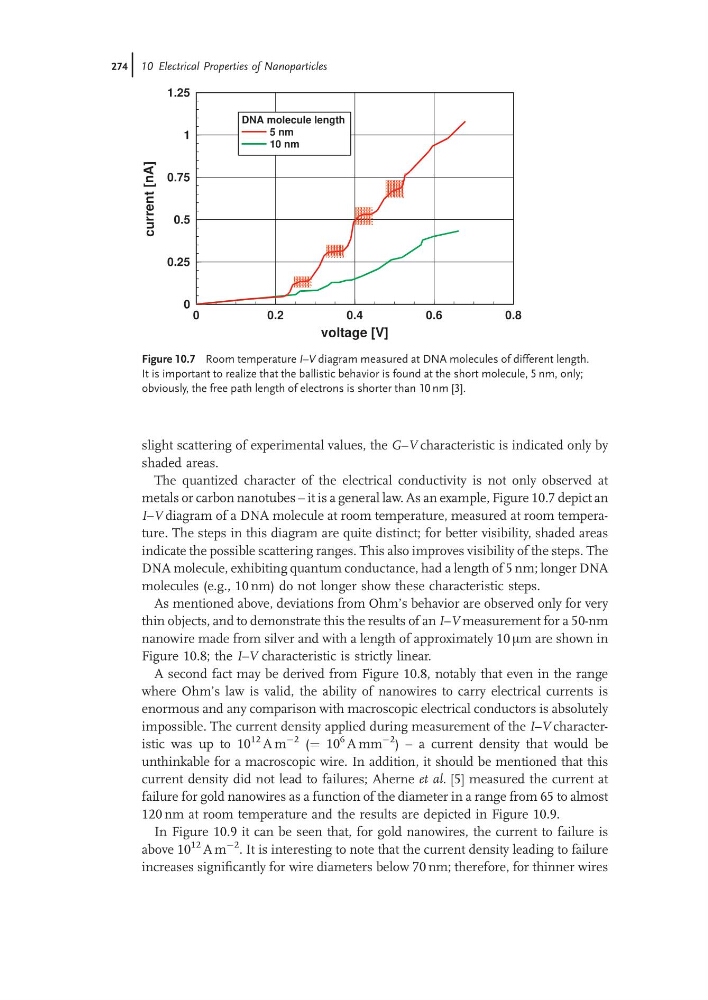
slight scattering of experimental values, the G–V characteristic is indicated only by
shaded areas.
The quantized character of the electrical conductivity is not only observed at
metals or carbon nanotubes – it is a general law. As an example, Figure 10.7 depict an
I–V diagram of a DNA molecule at room temperature, measured at room temperature. The steps in this diagram are quite distinct; for better visibility, shaded areas
indicate the possible scattering ranges. This also improves visibility of the steps. The
DNA molecule, exhibiting quantum conductance, had a length of 5 nm; longer DNA
molecules (e.g., 10 nm) do not longer show these characteristic steps.
As mentioned above, deviations from Ohm’s behavior are observed only for very
thin objects, and to demonstrate this the results of an I–V measurement for a 50-nm
nanowire made from silver and with a length of approximately 10 mm are shown in
Figure 10.8; the I–V characteristic is strictly linear.
A second fact may be derived from Figure 10.8, notably that even in the range
where Ohm’s law is valid, the ability of nanowires to carry electrical currents is
enormous and any comparison with macroscopic electrical conductors is absolutely
impossible. The current density applied during measurement of the I–V characteristic was up to 10
12 A m
À2 (¼ 10
6 A mm
À2 ) – a current density that would be
unthinkable for a macroscopic wire. In addition, it should be mentioned that this
current density did not lead to failures; Aherne et al. [5] measured the current at
failure for gold nanowires as a function of the diameter in a range from 65 to almost
120 nm at room temperature and the results are depicted in Figure 10.9.
In Figure 10.9 it can be seen that, for gold nanowires, the current to failure is
above 10
12 A m
À2 . It is interesting to note that the current density leading to failure
increases significantly for wire diameters below 70 nm; therefore, for thinner wires
0
0.2
0.4
0.6
0.8
voltage [V]
0
0.25
0.5
0.75
1
1.25
current
[nA]
DNA molecule length
5 nm
10 nm
Figure 10.7 Room temperature I–V diagram measured at DNA molecules of different length.
It is important to realize that the ballistic behavior is found at the short molecule, 5 nm, only;
obviously, the free path length of electrons is shorter than 10 nm [3].
274j 10 Electrical Properties of Nanoparticles
shaded areas.
The quantized character of the electrical conductivity is not only observed at
metals or carbon nanotubes – it is a general law. As an example, Figure 10.7 depict an
I–V diagram of a DNA molecule at room temperature, measured at room temperature. The steps in this diagram are quite distinct; for better visibility, shaded areas
indicate the possible scattering ranges. This also improves visibility of the steps. The
DNA molecule, exhibiting quantum conductance, had a length of 5 nm; longer DNA
molecules (e.g., 10 nm) do not longer show these characteristic steps.
As mentioned above, deviations from Ohm’s behavior are observed only for very
thin objects, and to demonstrate this the results of an I–V measurement for a 50-nm
nanowire made from silver and with a length of approximately 10 mm are shown in
Figure 10.8; the I–V characteristic is strictly linear.
A second fact may be derived from Figure 10.8, notably that even in the range
where Ohm’s law is valid, the ability of nanowires to carry electrical currents is
enormous and any comparison with macroscopic electrical conductors is absolutely
impossible. The current density applied during measurement of the I–V characteristic was up to 10
12 A m
À2 (¼ 10
6 A mm
À2 ) – a current density that would be
unthinkable for a macroscopic wire. In addition, it should be mentioned that this
current density did not lead to failures; Aherne et al. [5] measured the current at
failure for gold nanowires as a function of the diameter in a range from 65 to almost
120 nm at room temperature and the results are depicted in Figure 10.9.
In Figure 10.9 it can be seen that, for gold nanowires, the current to failure is
above 10
12 A m
À2 . It is interesting to note that the current density leading to failure
increases significantly for wire diameters below 70 nm; therefore, for thinner wires
0
0.2
0.4
0.6
0.8
voltage [V]
0
0.25
0.5
0.75
1
1.25
current
[nA]
DNA molecule length
5 nm
10 nm
Figure 10.7 Room temperature I–V diagram measured at DNA molecules of different length.
It is important to realize that the ballistic behavior is found at the short molecule, 5 nm, only;
obviously, the free path length of electrons is shorter than 10 nm [3].
274j 10 Electrical Properties of Nanoparticles