

that are in the range of a few degree per Tesla and meter. However, in contrast to
the highly transparent garnets, because of the relatively large absorbance, only
thin films of iron oxide can be used, in the range of a few micrometers, or
equivalently thin suspensions stabilized by surfactants. Lastly, as maghemite is
significantly cheaper than the above-mentioned garnets, this material has a great
potential for these applications. However, as also mentioned above, the efficient
transmission of light through c-Fe 2 O 3 is possible only in the red and IR range of
the optical spectrum.
Although for optomagnetic devices thin films of ferromagnetic materials are
normally used, various attempts have been made to use nanoparticulate ferrites in a
polymer matrix [51]. However, to date better results have been obtained with ferrite/
silica nanocomposites. All of these materials are hampered by the high absorption of
visible light by ferrites and therefore useful applications are possible only in the
range of red light. Zhou et al. [52] synthesized ZnFe 2 O 4 nanoparticles in silica; this
material was shown to be superparamagnetic and the magnetization curves were –
at least down to a temperature of 78 K– free of hysteresis. The optical absorption
coefficient as a function of wavelength for particle concentrations of 30 and 5 wt%
are shown in Figure 9.69.
As might be expected, a higher concentration of ferrite particles clearly increases
optical absorption. Furthermore, the strong increase in absorption for shorter
wavelengths is shifted significantly to shorter wavelengths when the concentration
is reduced. This blue shift may be attributed to a smaller particle size or surface
phenomena on the band gap.
With respect to the application of the Kerr effect, data relating to optical reflectance
in the UV-visible range of c-Fe 2 O 3 /SiO 2 nanocomposites are provided by Moreno
et al. [53].
-1
-0.5
0
0.5
1
magnetic field [T]
-5
-3
-1
1
3
5
Faraday
rotation
[degree
T
-1
µm -1 ]
Wavelength
645 nm
1550 nm
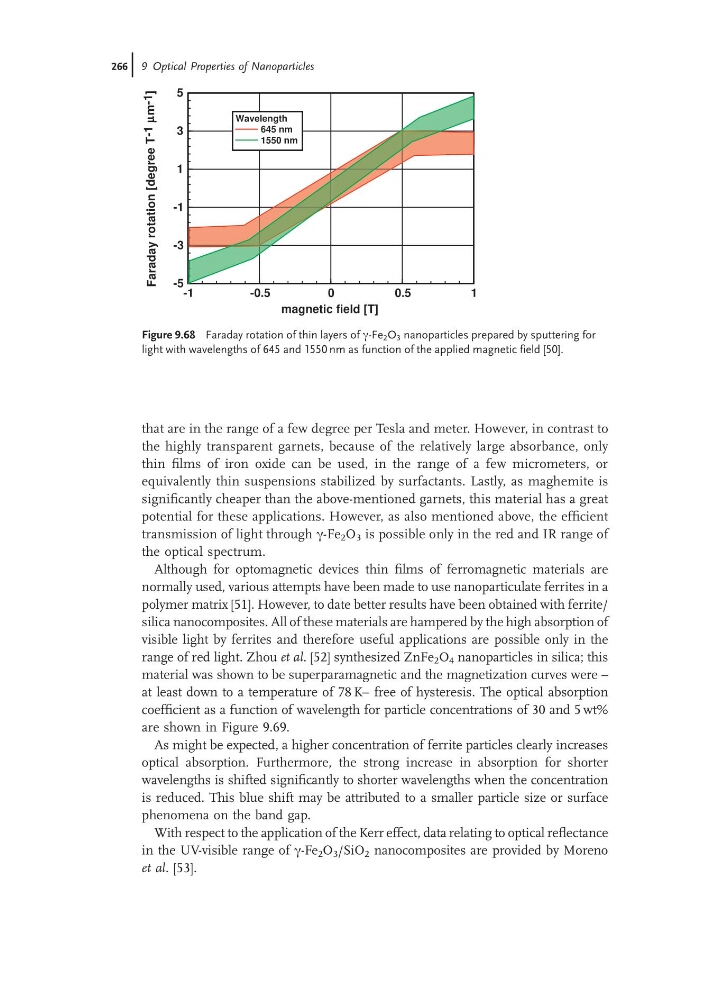
Figure 9.68 Faraday rotation of thin layers of c-Fe 2 O 3 nanoparticles prepared by sputtering for
light with wavelengths of 645 and 1550 nm as function of the applied magnetic field [50].
266j 9 Optical Properties of Nanoparticles
the highly transparent garnets, because of the relatively large absorbance, only
thin films of iron oxide can be used, in the range of a few micrometers, or
equivalently thin suspensions stabilized by surfactants. Lastly, as maghemite is
significantly cheaper than the above-mentioned garnets, this material has a great
potential for these applications. However, as also mentioned above, the efficient
transmission of light through c-Fe 2 O 3 is possible only in the red and IR range of
the optical spectrum.
Although for optomagnetic devices thin films of ferromagnetic materials are
normally used, various attempts have been made to use nanoparticulate ferrites in a
polymer matrix [51]. However, to date better results have been obtained with ferrite/
silica nanocomposites. All of these materials are hampered by the high absorption of
visible light by ferrites and therefore useful applications are possible only in the
range of red light. Zhou et al. [52] synthesized ZnFe 2 O 4 nanoparticles in silica; this
material was shown to be superparamagnetic and the magnetization curves were –
at least down to a temperature of 78 K– free of hysteresis. The optical absorption
coefficient as a function of wavelength for particle concentrations of 30 and 5 wt%
are shown in Figure 9.69.
As might be expected, a higher concentration of ferrite particles clearly increases
optical absorption. Furthermore, the strong increase in absorption for shorter
wavelengths is shifted significantly to shorter wavelengths when the concentration
is reduced. This blue shift may be attributed to a smaller particle size or surface
phenomena on the band gap.
With respect to the application of the Kerr effect, data relating to optical reflectance
in the UV-visible range of c-Fe 2 O 3 /SiO 2 nanocomposites are provided by Moreno
et al. [53].
-1
-0.5
0
0.5
1
magnetic field [T]
-5
-3
-1
1
3
5
Faraday
rotation
[degree
T
-1
µm -1 ]
Wavelength
645 nm
1550 nm
Figure 9.68 Faraday rotation of thin layers of c-Fe 2 O 3 nanoparticles prepared by sputtering for
light with wavelengths of 645 and 1550 nm as function of the applied magnetic field [50].
266j 9 Optical Properties of Nanoparticles