

where v is the Verdet constant, d is the thickness of the active medium, and jBj is the
strength of the magnetic field.
As shown in Figure 9.67, the polarization plane of the incoming light is rotated by
angle b after passing the layer with thickness d. Figure 9.68 shows experimentally
determined values for the Faraday rotation of c-Fe 2 O 3 nanoparticles [50]. These data
are given within a relative broad scattering band, as the absorption in the magnetooptic active layer of c-Fe 2 O 3 nanoparticles is quite high.
Using the data given in Figure 9.68, one can calculate the Verdet constant for
c-Fe 2 O 3 to be in the range of between 2 and 4 Â 10
6 degree T
À1 m
À1
. These values of
the Faraday rotation are significantly larger than those of the best magneto-optic active
materials, which are garnets with the compositions Tb 3 Ga 5 O 12 or (Tb x , Y 1Àx ) 3 Fe 5 O 12
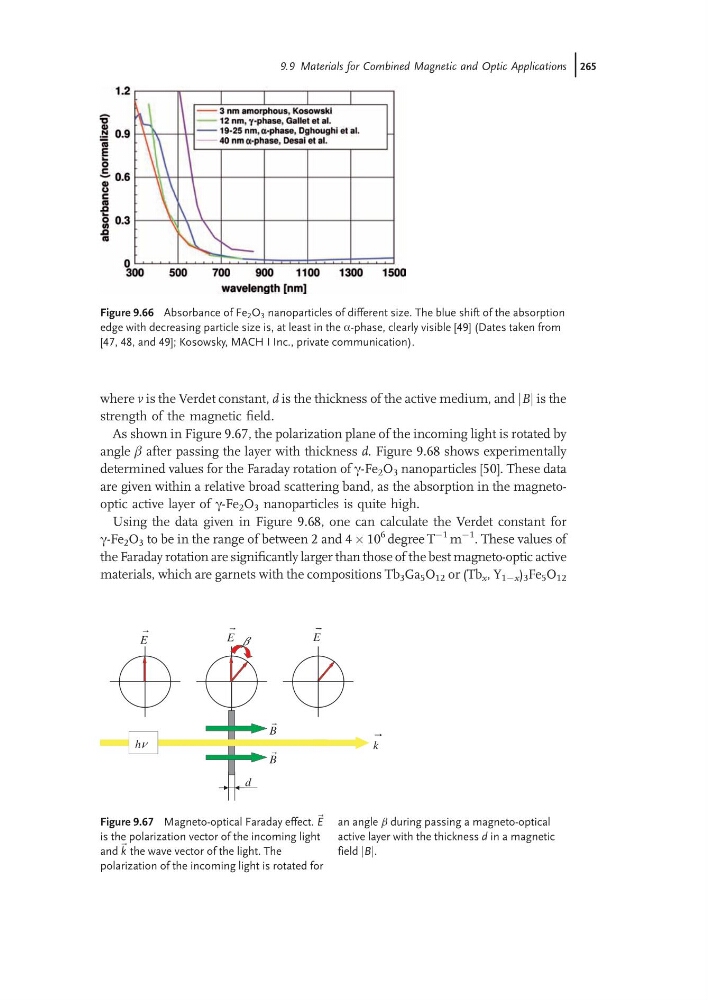
Figure 9.66 Absorbance of Fe 2 O 3 nanoparticles of different size. The blue shift of the absorption
edge with decreasing particle size is, at least in the a-phase, clearly visible [49] (Dates taken from
[47, 48, and 49]; Kosowsky, MACH I Inc., private communication).
ν
h
E
E
E
B
B
k
d
β
Figure 9.67 Magneto-optical Faraday effect. ~ E
is the polarization vector of the incoming light
and ~ k the wave vector of the light. The
polarization of the incoming light is rotated for
an angle b during passing a magneto-optical
active layer with the thickness d in a magnetic
field jBj.
9.9 Materials for Combined Magnetic and Optic Applications j265
strength of the magnetic field.
As shown in Figure 9.67, the polarization plane of the incoming light is rotated by
angle b after passing the layer with thickness d. Figure 9.68 shows experimentally
determined values for the Faraday rotation of c-Fe 2 O 3 nanoparticles [50]. These data
are given within a relative broad scattering band, as the absorption in the magnetooptic active layer of c-Fe 2 O 3 nanoparticles is quite high.
Using the data given in Figure 9.68, one can calculate the Verdet constant for
c-Fe 2 O 3 to be in the range of between 2 and 4 Â 10
6 degree T
À1 m
À1
. These values of
the Faraday rotation are significantly larger than those of the best magneto-optic active
materials, which are garnets with the compositions Tb 3 Ga 5 O 12 or (Tb x , Y 1Àx ) 3 Fe 5 O 12
Figure 9.66 Absorbance of Fe 2 O 3 nanoparticles of different size. The blue shift of the absorption
edge with decreasing particle size is, at least in the a-phase, clearly visible [49] (Dates taken from
[47, 48, and 49]; Kosowsky, MACH I Inc., private communication).
ν
h
E
E
E
B
B
k
d
β
Figure 9.67 Magneto-optical Faraday effect. ~ E
is the polarization vector of the incoming light
and ~ k the wave vector of the light. The
polarization of the incoming light is rotated for
an angle b during passing a magneto-optical
active layer with the thickness d in a magnetic
field jBj.
9.9 Materials for Combined Magnetic and Optic Applications j265