

data displayed in Figure 9.66 that, for a device working in transmission, only the
c-phase material is applicable. In any case, wavelengths shorter than about 700 nm
should be avoided.
Figure 9.67 shows the general outline of an arrangement using the Faraday effect.
The rotation angle b of the polarization plane of the incoming light in a transparent
medium exhibiting Faraday rotation is given by:
b ¼ vdjBj
ð 9:14Þ
-1
-0.5
0
0.5
1
μ 0 H [T]
-150
-100
-50
0
50
100
150
magnetization
[Am
2
kg
-1
]
(a)
300
400
500
600
700
800
wavelength [nm]
luminescence
intensity
[a.u.]
(b)
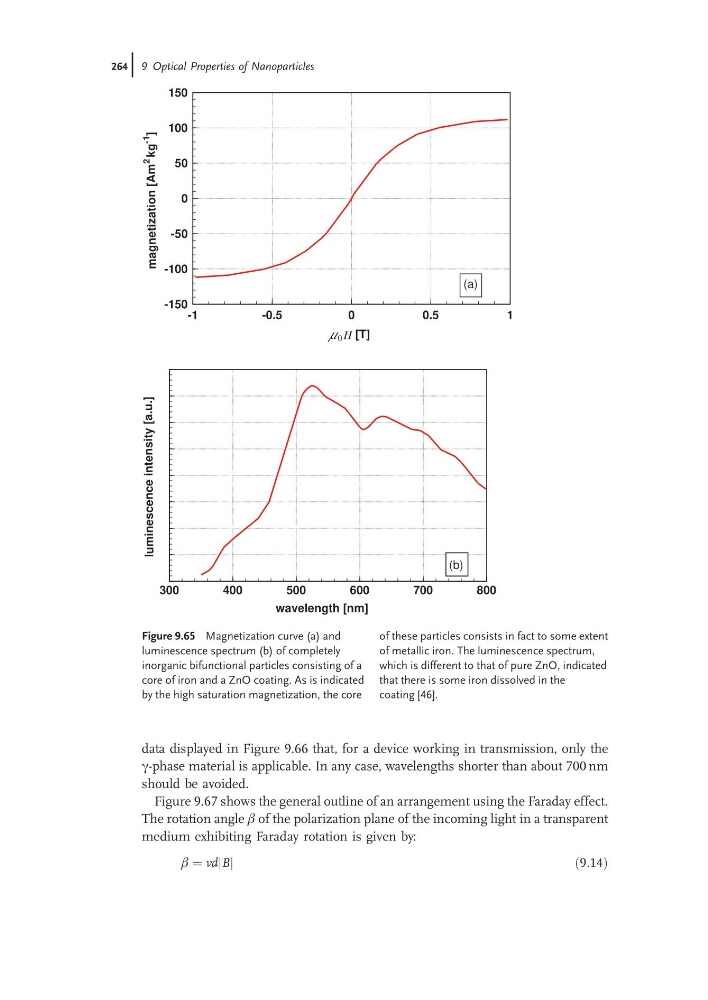
Figure 9.65 Magnetization curve (a) and
luminescence spectrum (b) of completely
inorganic bifunctional particles consisting of a
core of iron and a ZnO coating. As is indicated
by the high saturation magnetization, the core
of these particles consists in fact to some extent
of metallic iron. The luminescence spectrum,
which is different to that of pure ZnO, indicated
that there is some iron dissolved in the
coating [46].
264j 9 Optical Properties of Nanoparticles
c-phase material is applicable. In any case, wavelengths shorter than about 700 nm
should be avoided.
Figure 9.67 shows the general outline of an arrangement using the Faraday effect.
The rotation angle b of the polarization plane of the incoming light in a transparent
medium exhibiting Faraday rotation is given by:
b ¼ vdjBj
ð 9:14Þ
-1
-0.5
0
0.5
1
μ 0 H [T]
-150
-100
-50
0
50
100
150
magnetization
[Am
2
kg
-1
]
(a)
300
400
500
600
700
800
wavelength [nm]
luminescence
intensity
[a.u.]
(b)
Figure 9.65 Magnetization curve (a) and
luminescence spectrum (b) of completely
inorganic bifunctional particles consisting of a
core of iron and a ZnO coating. As is indicated
by the high saturation magnetization, the core
of these particles consists in fact to some extent
of metallic iron. The luminescence spectrum,
which is different to that of pure ZnO, indicated
that there is some iron dissolved in the
coating [46].
264j 9 Optical Properties of Nanoparticles