

When discussing a phenomenon working in transmission, like the Faraday effect,
it is necessary to look first at the wavelength range where the absorption is
sufficiently small for technical applications. Figure 9.66 displays the absorbance
of Fe 2 O 3 nanoparticles of different size.
Figure 9.66 shows the well-known blue shift with decreasing particle size. This
phenomenon is very distinct for a-Fe 2 O 3 ; in this case, the decrease of the particle
size from 40 to about 25 nm brings a significant shift of the onset of the optical
absorption to shorter wavelength. Therefore, the 40-nm material is red and the
25-nm material is brown. When looking at the c-phase material, one realizes that a
reduction in grain size from 12 to 3 nm has almost no influence. However, the
transition from the 25-nm a-phase particles to the 12-nm c-phase particles shows
the expected significant blue shift. Additionally, one realizes from the absorbance
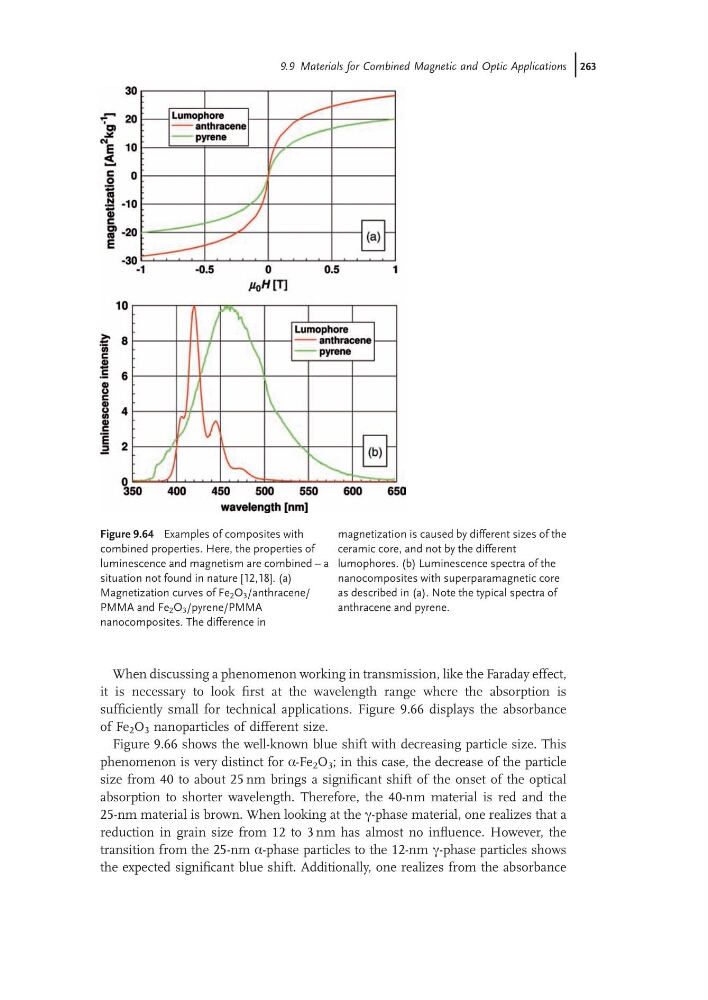
Figure 9.64 Examples of composites with
combined properties. Here, the properties of
luminescence and magnetism are combined – a
situation not found in nature [12,18]. (a)
Magnetization curves of Fe 2 O 3 /anthracene/
PMMA and Fe 2 O 3 /pyrene/PMMA
nanocomposites. The difference in
magnetization is caused by different sizes of the
ceramic core, and not by the different
lumophores. (b) Luminescence spectra of the
nanocomposites with superparamagnetic core
as described in (a). Note the typical spectra of
anthracene and pyrene.
9.9 Materials for Combined Magnetic and Optic Applications j263
it is necessary to look first at the wavelength range where the absorption is
sufficiently small for technical applications. Figure 9.66 displays the absorbance
of Fe 2 O 3 nanoparticles of different size.
Figure 9.66 shows the well-known blue shift with decreasing particle size. This
phenomenon is very distinct for a-Fe 2 O 3 ; in this case, the decrease of the particle
size from 40 to about 25 nm brings a significant shift of the onset of the optical
absorption to shorter wavelength. Therefore, the 40-nm material is red and the
25-nm material is brown. When looking at the c-phase material, one realizes that a
reduction in grain size from 12 to 3 nm has almost no influence. However, the
transition from the 25-nm a-phase particles to the 12-nm c-phase particles shows
the expected significant blue shift. Additionally, one realizes from the absorbance
Figure 9.64 Examples of composites with
combined properties. Here, the properties of
luminescence and magnetism are combined – a
situation not found in nature [12,18]. (a)
Magnetization curves of Fe 2 O 3 /anthracene/
PMMA and Fe 2 O 3 /pyrene/PMMA
nanocomposites. The difference in
magnetization is caused by different sizes of the
ceramic core, and not by the different
lumophores. (b) Luminescence spectra of the
nanocomposites with superparamagnetic core
as described in (a). Note the typical spectra of
anthracene and pyrene.
9.9 Materials for Combined Magnetic and Optic Applications j263