

combination of properties is extremely valuable. The luminescence spectra and
magnetization curves of some materials that are both luminescent and superparamagnetic (e.g., Fe 2 O 3 /anthracene/PMMA and Fe 2 O 3 /pyrene/PMMA nanocomposites) are shown in Figure 9.64a and b.
The difference in saturation magnetization for composites with anthracene and
pyrene as lumophore is due to different sizes of the magnetic core, and not to the
lumophore.
A more recent development are fully inorganic composite particles exhibiting
luminescence and ferromagnetism. In this case, the basic idea was to coat
metallic iron particles with zinc oxide [46]. Certainly, an at least partial oxidation
of the metallic core is unavoidable; however, even small residues of metallic iron
should provide high magnetic moments of the particles. Figure 9.65a and b
display the magnetization curve and the emission spectrum of this kind of coated
particles.
Analyzing the magnetization curve depicted in Figure 9.65a one realizes two
essential features. (i) The saturation magnetization is in the range of 110 A m
2 kg
À1 ;
this is significantly more as compared to the bulk values of c-Fe 2 O 3 or Fe 3 O 4 . This is
a clear indication that within the core of the particle there is in fact some metallic
iron left. (ii) The luminescence spectrum depicted in Figure 9.65b is fundamentally
different to the spectrum of pure ZnO. Therefore, one has to assume that at least a
minor fraction of the iron from the core is dissolved in the coating.
One further interesting optical application of ceramic/polymer nanocomposites is
their use as magneto-optical materials. Within this context, the phenomena under
question include the Faraday effect (rotation of the plane of polarization of light in
transmission) and the Kerr effect (rotation of the polarization plane after reflection at
the surface of magnetic materials).
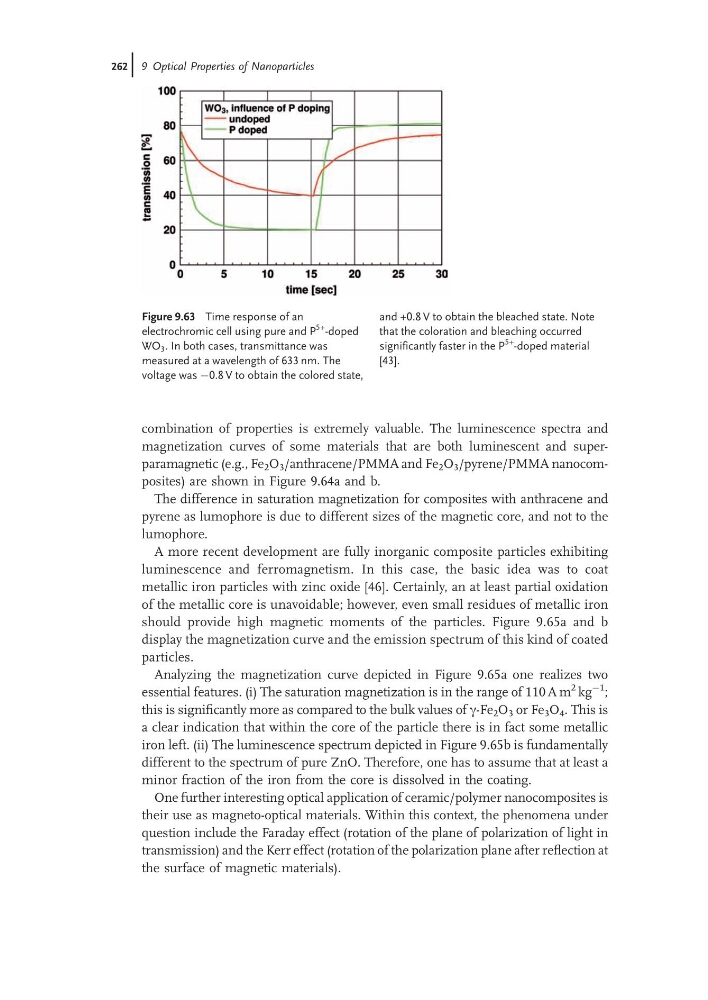
Figure 9.63 Time response of an
electrochromic cell using pure and P
5+ -doped
WO 3 . In both cases, transmittance was
measured at a wavelength of 633 nm. The
voltage was À0.8 V to obtain the colored state,
and +0.8 V to obtain the bleached state. Note
that the coloration and bleaching occurred
significantly faster in the P
5+
-doped material
[43].
262j 9 Optical Properties of Nanoparticles
magnetization curves of some materials that are both luminescent and superparamagnetic (e.g., Fe 2 O 3 /anthracene/PMMA and Fe 2 O 3 /pyrene/PMMA nanocomposites) are shown in Figure 9.64a and b.
The difference in saturation magnetization for composites with anthracene and
pyrene as lumophore is due to different sizes of the magnetic core, and not to the
lumophore.
A more recent development are fully inorganic composite particles exhibiting
luminescence and ferromagnetism. In this case, the basic idea was to coat
metallic iron particles with zinc oxide [46]. Certainly, an at least partial oxidation
of the metallic core is unavoidable; however, even small residues of metallic iron
should provide high magnetic moments of the particles. Figure 9.65a and b
display the magnetization curve and the emission spectrum of this kind of coated
particles.
Analyzing the magnetization curve depicted in Figure 9.65a one realizes two
essential features. (i) The saturation magnetization is in the range of 110 A m
2 kg
À1 ;
this is significantly more as compared to the bulk values of c-Fe 2 O 3 or Fe 3 O 4 . This is
a clear indication that within the core of the particle there is in fact some metallic
iron left. (ii) The luminescence spectrum depicted in Figure 9.65b is fundamentally
different to the spectrum of pure ZnO. Therefore, one has to assume that at least a
minor fraction of the iron from the core is dissolved in the coating.
One further interesting optical application of ceramic/polymer nanocomposites is
their use as magneto-optical materials. Within this context, the phenomena under
question include the Faraday effect (rotation of the plane of polarization of light in
transmission) and the Kerr effect (rotation of the polarization plane after reflection at
the surface of magnetic materials).
Figure 9.63 Time response of an
electrochromic cell using pure and P
5+ -doped
WO 3 . In both cases, transmittance was
measured at a wavelength of 633 nm. The
voltage was À0.8 V to obtain the colored state,
and +0.8 V to obtain the bleached state. Note
that the coloration and bleaching occurred
significantly faster in the P
5+
-doped material
[43].
262j 9 Optical Properties of Nanoparticles