

completed, although bleaching and coloration of the doped film were significantly
faster than for the undoped film. Additionally, the difference in transmittance
between both states was seen to be larger for the P-doped layer than for the undoped
material (see Figure 9.63).
In the pure and doped states, essentially the same mechanisms are active in
materials such as V 2 O 5 and Nb 2 O 5 [44]. Owing to its high coloration efficiency,
nickel oxide (NiO) is an interesting electrochromic material, as it shows good
reversibility and low cost. Nanostructured materials containing the hydroxide phase,
Ni(OH) 2 , are cycled with the following coloring/bleaching process:
Ni
2þ ðOHÞ 2 ðbleached; reducedÞ , Ni
3þ OðOHÞ þ H
þ þ e
À ðcolored; oxidizedÞ
Although the efficiency of this process may be improved by distributing the NiO
nanoparticles in an amorphous Ta 2 O 5 matrix [45], the most important point is the
finding that the NiO/Ta 2 O 5 nanocomposite withstands at least an order of magnitude more coloration–bleaching cycles than does pure NiO.
9.9
Materials for Combined Magnetic and Optic Applications
Although magnetism and luminescence are never found together in nature, for
special applications in biotechnology and medical diagnosis a combination of
these properties is quite often demanded. When such applications are connected
to, for example, magnetic cell separation, identification, and quantification, this
300
400
500
600
700
800
wavelength [nm]
0
20
40
60
80
100
transmission
[%]
Electrochromic WO 3
colored pure
bleached pure
colored Li doped
bleached Li doped
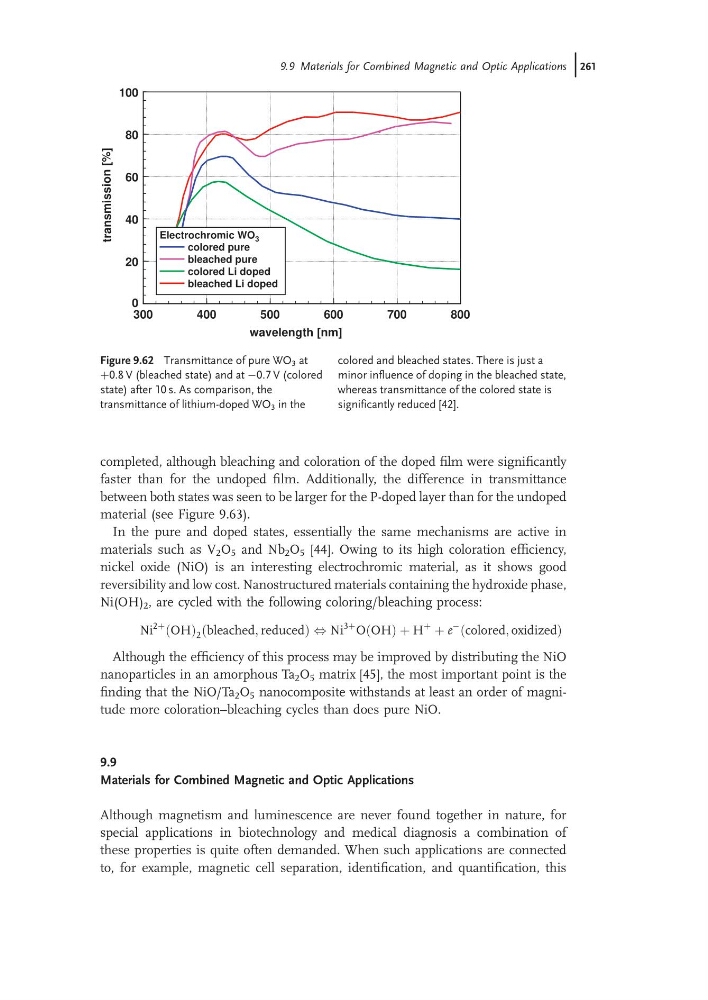
Figure 9.62 Transmittance of pure WO 3 at
þ0.8 V (bleached state) and at À0.7 V (colored
state) after 10 s. As comparison, the
transmittance of lithium-doped WO 3 in the
colored and bleached states. There is just a
minor influence of doping in the bleached state,
whereas transmittance of the colored state is
significantly reduced [42].
9.9 Materials for Combined Magnetic and Optic Applications j261
faster than for the undoped film. Additionally, the difference in transmittance
between both states was seen to be larger for the P-doped layer than for the undoped
material (see Figure 9.63).
In the pure and doped states, essentially the same mechanisms are active in
materials such as V 2 O 5 and Nb 2 O 5 [44]. Owing to its high coloration efficiency,
nickel oxide (NiO) is an interesting electrochromic material, as it shows good
reversibility and low cost. Nanostructured materials containing the hydroxide phase,
Ni(OH) 2 , are cycled with the following coloring/bleaching process:
Ni
2þ ðOHÞ 2 ðbleached; reducedÞ , Ni
3þ OðOHÞ þ H
þ þ e
À ðcolored; oxidizedÞ
Although the efficiency of this process may be improved by distributing the NiO
nanoparticles in an amorphous Ta 2 O 5 matrix [45], the most important point is the
finding that the NiO/Ta 2 O 5 nanocomposite withstands at least an order of magnitude more coloration–bleaching cycles than does pure NiO.
9.9
Materials for Combined Magnetic and Optic Applications
Although magnetism and luminescence are never found together in nature, for
special applications in biotechnology and medical diagnosis a combination of
these properties is quite often demanded. When such applications are connected
to, for example, magnetic cell separation, identification, and quantification, this
300
400
500
600
700
800
wavelength [nm]
0
20
40
60
80
100
transmission
[%]
Electrochromic WO 3
colored pure
bleached pure
colored Li doped
bleached Li doped
Figure 9.62 Transmittance of pure WO 3 at
þ0.8 V (bleached state) and at À0.7 V (colored
state) after 10 s. As comparison, the
transmittance of lithium-doped WO 3 in the
colored and bleached states. There is just a
minor influence of doping in the bleached state,
whereas transmittance of the colored state is
significantly reduced [42].
9.9 Materials for Combined Magnetic and Optic Applications j261