

material and an additional electrolyte layer containing monovalent ions. The
electrolyte layer may, for example, consist of propylene carbonate containing a
few tenths of a mol% of LiClO 4 as electrolyte. In order to switch the system into the
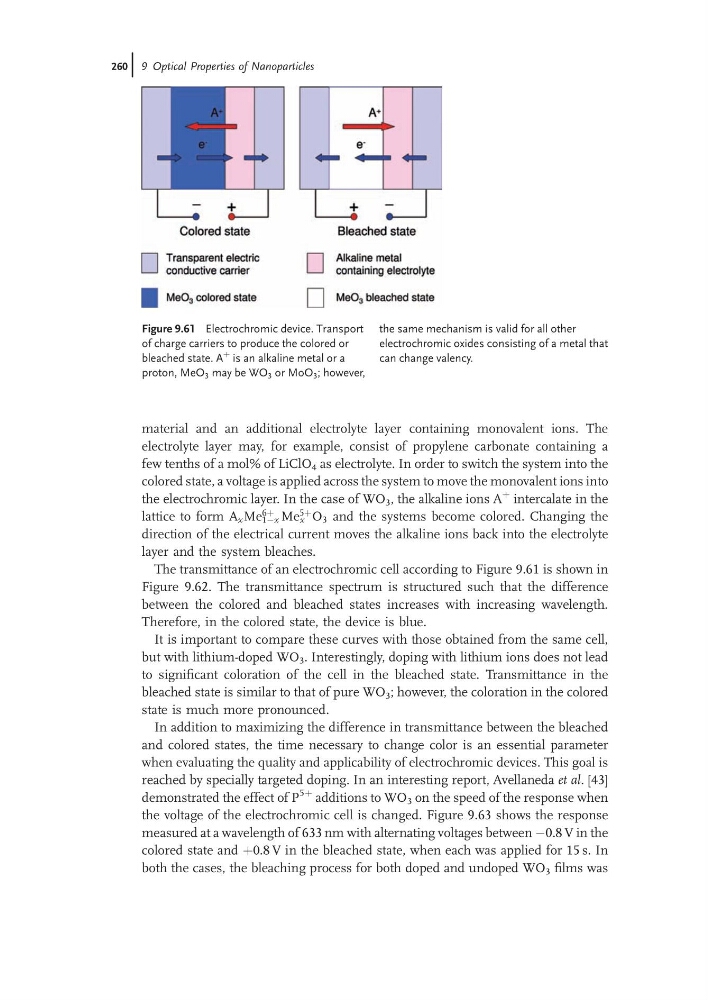
colored state, a voltage is applied across the system to move the monovalent ions into
the electrochromic layer. In the case of WO 3 , the alkaline ions A
þ intercalate in the
lattice to form A x Me 1Àx
6þ Me x
5þ O 3 and the systems become colored. Changing the
direction of the electrical current moves the alkaline ions back into the electrolyte
layer and the system bleaches.
The transmittance of an electrochromic cell according to Figure 9.61 is shown in
Figure 9.62. The transmittance spectrum is structured such that the difference
between the colored and bleached states increases with increasing wavelength.
Therefore, in the colored state, the device is blue.
It is important to compare these curves with those obtained from the same cell,
but with lithium-doped WO 3 . Interestingly, doping with lithium ions does not lead
to significant coloration of the cell in the bleached state. Transmittance in the
bleached state is similar to that of pure WO 3 ; however, the coloration in the colored
state is much more pronounced.
In addition to maximizing the difference in transmittance between the bleached
and colored states, the time necessary to change color is an essential parameter
when evaluating the quality and applicability of electrochromic devices. This goal is
reached by specially targeted doping. In an interesting report, Avellaneda et al. [43]
demonstrated the effect of P
5þ additions to WO 3 on the speed of the response when
the voltage of the electrochromic cell is changed. Figure 9.63 shows the response
measured at a wavelength of 633 nm with alternating voltages between À0.8 V in the
colored state and þ0.8 V in the bleached state, when each was applied for 15 s. In
both the cases, the bleaching process for both doped and undoped WO 3 films was
Figure 9.61 Electrochromic device. Transport
of charge carriers to produce the colored or
bleached state. A
þ is an alkaline metal or a
proton, MeO 3 may be WO 3 or MoO 3 ; however,
the same mechanism is valid for all other
electrochromic oxides consisting of a metal that
can change valency.
260j 9 Optical Properties of Nanoparticles
electrolyte layer may, for example, consist of propylene carbonate containing a
few tenths of a mol% of LiClO 4 as electrolyte. In order to switch the system into the
colored state, a voltage is applied across the system to move the monovalent ions into
the electrochromic layer. In the case of WO 3 , the alkaline ions A
þ intercalate in the
lattice to form A x Me 1Àx
6þ Me x
5þ O 3 and the systems become colored. Changing the
direction of the electrical current moves the alkaline ions back into the electrolyte
layer and the system bleaches.
The transmittance of an electrochromic cell according to Figure 9.61 is shown in
Figure 9.62. The transmittance spectrum is structured such that the difference
between the colored and bleached states increases with increasing wavelength.
Therefore, in the colored state, the device is blue.
It is important to compare these curves with those obtained from the same cell,
but with lithium-doped WO 3 . Interestingly, doping with lithium ions does not lead
to significant coloration of the cell in the bleached state. Transmittance in the
bleached state is similar to that of pure WO 3 ; however, the coloration in the colored
state is much more pronounced.
In addition to maximizing the difference in transmittance between the bleached
and colored states, the time necessary to change color is an essential parameter
when evaluating the quality and applicability of electrochromic devices. This goal is
reached by specially targeted doping. In an interesting report, Avellaneda et al. [43]
demonstrated the effect of P
5þ additions to WO 3 on the speed of the response when
the voltage of the electrochromic cell is changed. Figure 9.63 shows the response
measured at a wavelength of 633 nm with alternating voltages between À0.8 V in the
colored state and þ0.8 V in the bleached state, when each was applied for 15 s. In
both the cases, the bleaching process for both doped and undoped WO 3 films was
Figure 9.61 Electrochromic device. Transport
of charge carriers to produce the colored or
bleached state. A
þ is an alkaline metal or a
proton, MeO 3 may be WO 3 or MoO 3 ; however,
the same mechanism is valid for all other
electrochromic oxides consisting of a metal that
can change valency.
260j 9 Optical Properties of Nanoparticles