

nanoparticles, and a length of 400 nm and diameter of approximately 35 nm for the
rods. The nanorods were grown by aging in aqueous suspension by agglomeration
of more or less spherical particles; this indicated that, under these conditions, the
rods were the thermodynamically more stable shapes. In addition, in order to obtain
a broad emission band, the particles and rods were doped with 0.13% Cu
þ and 0.1%
Al
3þ
. As zinc is Zn
2þ in the lattice, the doping created positively charged holes and
additional electrons in the energy bands. Sulfur vacancies, predominantly at the
surface, were also the reason for the side bands extending the spectral range of the
emitted light to a shorter wavelength. Owing to the smaller surface/volume ratio of
the rods, such emission is less important for the larger nanorods. In total, the
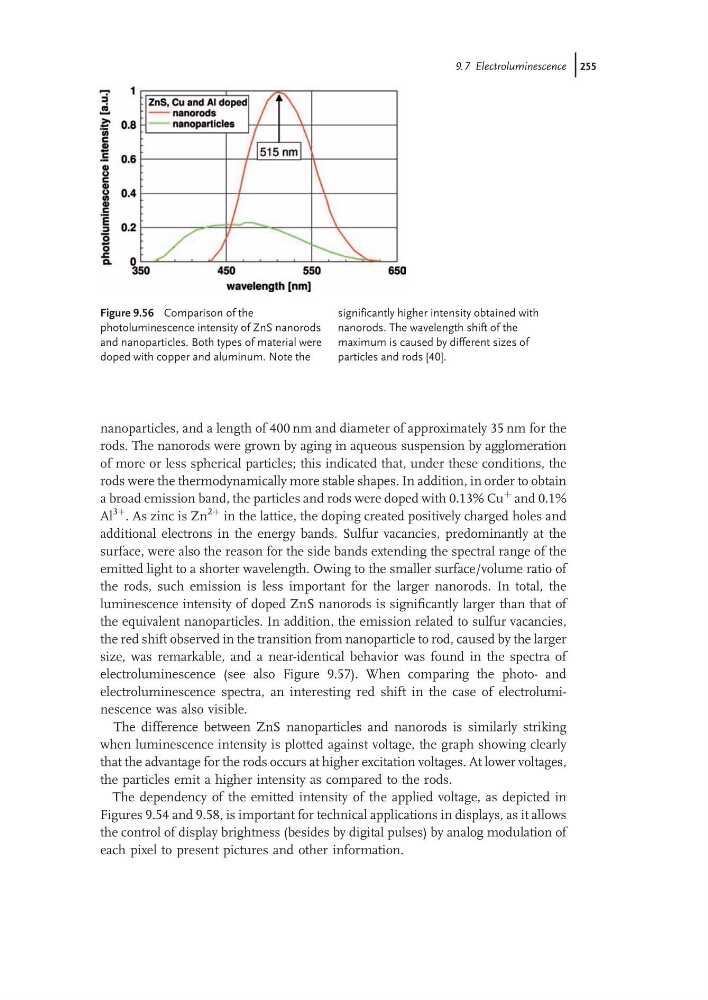
luminescence intensity of doped ZnS nanorods is significantly larger than that of
the equivalent nanoparticles. In addition, the emission related to sulfur vacancies,
the red shift observed in the transition from nanoparticle to rod, caused by the larger
size, was remarkable, and a near-identical behavior was found in the spectra of
electroluminescence (see also Figure 9.57). When comparing the photo- and
electroluminescence spectra, an interesting red shift in the case of electroluminescence was also visible.
The difference between ZnS nanoparticles and nanorods is similarly striking
when luminescence intensity is plotted against voltage, the graph showing clearly
that the advantage for the rods occurs at higher excitation voltages. At lower voltages,
the particles emit a higher intensity as compared to the rods.
The dependency of the emitted intensity of the applied voltage, as depicted in
Figures 9.54 and 9.58, is important for technical applications in displays, as it allows
the control of display brightness (besides by digital pulses) by analog modulation of
each pixel to present pictures and other information.
Figure 9.56 Comparison of the
photoluminescence intensity of ZnS nanorods
and nanoparticles. Both types of material were
doped with copper and aluminum. Note the
significantly higher intensity obtained with
nanorods. The wavelength shift of the
maximum is caused by different sizes of
particles and rods [40].
9.7 Electroluminescence j255
rods. The nanorods were grown by aging in aqueous suspension by agglomeration
of more or less spherical particles; this indicated that, under these conditions, the
rods were the thermodynamically more stable shapes. In addition, in order to obtain
a broad emission band, the particles and rods were doped with 0.13% Cu
þ and 0.1%
Al
3þ
. As zinc is Zn
2þ in the lattice, the doping created positively charged holes and
additional electrons in the energy bands. Sulfur vacancies, predominantly at the
surface, were also the reason for the side bands extending the spectral range of the
emitted light to a shorter wavelength. Owing to the smaller surface/volume ratio of
the rods, such emission is less important for the larger nanorods. In total, the
luminescence intensity of doped ZnS nanorods is significantly larger than that of
the equivalent nanoparticles. In addition, the emission related to sulfur vacancies,
the red shift observed in the transition from nanoparticle to rod, caused by the larger
size, was remarkable, and a near-identical behavior was found in the spectra of
electroluminescence (see also Figure 9.57). When comparing the photo- and
electroluminescence spectra, an interesting red shift in the case of electroluminescence was also visible.
The difference between ZnS nanoparticles and nanorods is similarly striking
when luminescence intensity is plotted against voltage, the graph showing clearly
that the advantage for the rods occurs at higher excitation voltages. At lower voltages,
the particles emit a higher intensity as compared to the rods.
The dependency of the emitted intensity of the applied voltage, as depicted in
Figures 9.54 and 9.58, is important for technical applications in displays, as it allows
the control of display brightness (besides by digital pulses) by analog modulation of
each pixel to present pictures and other information.
Figure 9.56 Comparison of the
photoluminescence intensity of ZnS nanorods
and nanoparticles. Both types of material were
doped with copper and aluminum. Note the
significantly higher intensity obtained with
nanorods. The wavelength shift of the
maximum is caused by different sizes of
particles and rods [40].
9.7 Electroluminescence j255