

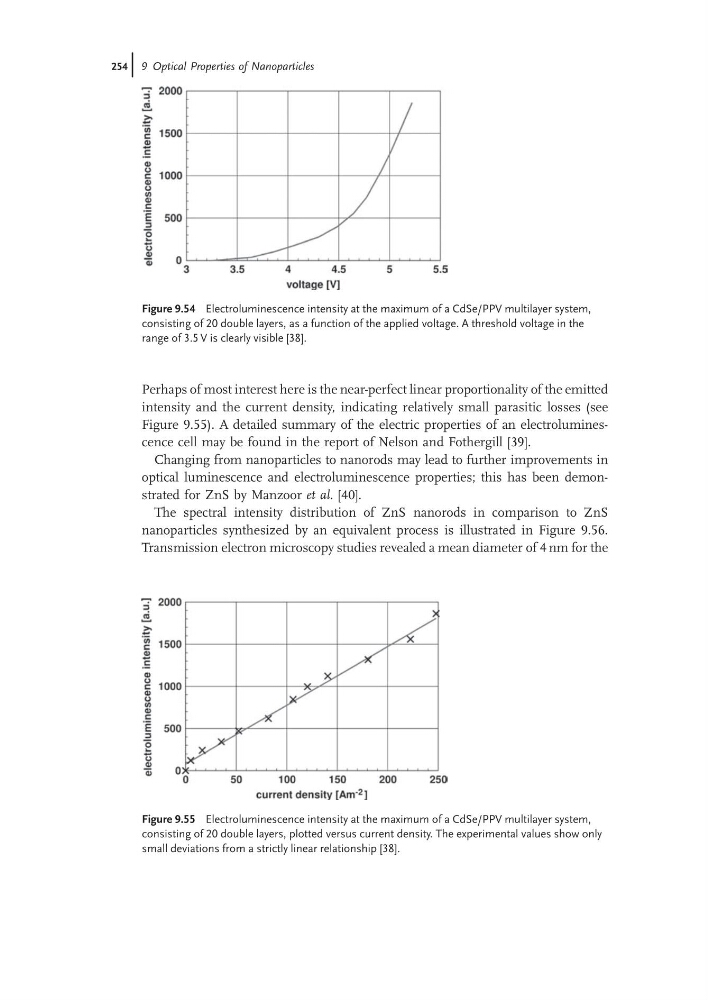
Perhaps of most interest here is the near-perfect linear proportionality of the emitted
intensity and the current density, indicating relatively small parasitic losses (see
Figure 9.55). A detailed summary of the electric properties of an electroluminescence cell may be found in the report of Nelson and Fothergill [39].
Changing from nanoparticles to nanorods may lead to further improvements in
optical luminescence and electroluminescence properties; this has been demonstrated for ZnS by Manzoor et al. [40].
The spectral intensity distribution of ZnS nanorods in comparison to ZnS
nanoparticles synthesized by an equivalent process is illustrated in Figure 9.56.
Transmission electron microscopy studies revealed a mean diameter of 4 nm for the
Figure 9.54 Electroluminescence intensity at the maximum of a CdSe/PPV multilayer system,
consisting of 20 double layers, as a function of the applied voltage. A threshold voltage in the
range of 3.5 V is clearly visible [38].
Figure 9.55 Electroluminescence intensity at the maximum of a CdSe/PPV multilayer system,
consisting of 20 double layers, plotted versus current density. The experimental values show only
small deviations from a strictly linear relationship [38].
254j 9 Optical Properties of Nanoparticles
intensity and the current density, indicating relatively small parasitic losses (see
Figure 9.55). A detailed summary of the electric properties of an electroluminescence cell may be found in the report of Nelson and Fothergill [39].
Changing from nanoparticles to nanorods may lead to further improvements in
optical luminescence and electroluminescence properties; this has been demonstrated for ZnS by Manzoor et al. [40].
The spectral intensity distribution of ZnS nanorods in comparison to ZnS
nanoparticles synthesized by an equivalent process is illustrated in Figure 9.56.
Transmission electron microscopy studies revealed a mean diameter of 4 nm for the
Figure 9.54 Electroluminescence intensity at the maximum of a CdSe/PPV multilayer system,
consisting of 20 double layers, as a function of the applied voltage. A threshold voltage in the
range of 3.5 V is clearly visible [38].
Figure 9.55 Electroluminescence intensity at the maximum of a CdSe/PPV multilayer system,
consisting of 20 double layers, plotted versus current density. The experimental values show only
small deviations from a strictly linear relationship [38].
254j 9 Optical Properties of Nanoparticles