

necessary if the active layer system is to be repeated a few times to increase the
efficiency of the system. Based on this concept, such electroluminescence systems
with semiconducting nanoparticles have several important advantages, the most
important of which are:
The emission wavelength of these quantum dots can be adjusted by the particle
size.
As a result, the emission color can be tuned according to the application, without
changing the process chemistry and technology.
Various intermediate polymer layers may be applied to optimize charge carrier
transport.
The polymer itself may be luminescent, thus improving the yield of light.
Finally, an unmatched quantum efficiency of such inorganic/organic layered
systems may be expected. Certainly, one of the crucial problems of organic
electricity-conducting compounds (i.e., the high sensitivity against oxidation) is
reintroduced and this may limit the lifetime of these devices.
Pioneering studies on such double-layer systems were conducted by Colvin et al.
[37], who applied CdSe semiconducting quantum dots and a poly(p-phenylene
vinylene) (PPV) layer, which showed luminescence and electric conductivity
together. A typical example of a system using CdSe nanoparticles and a PPV layer
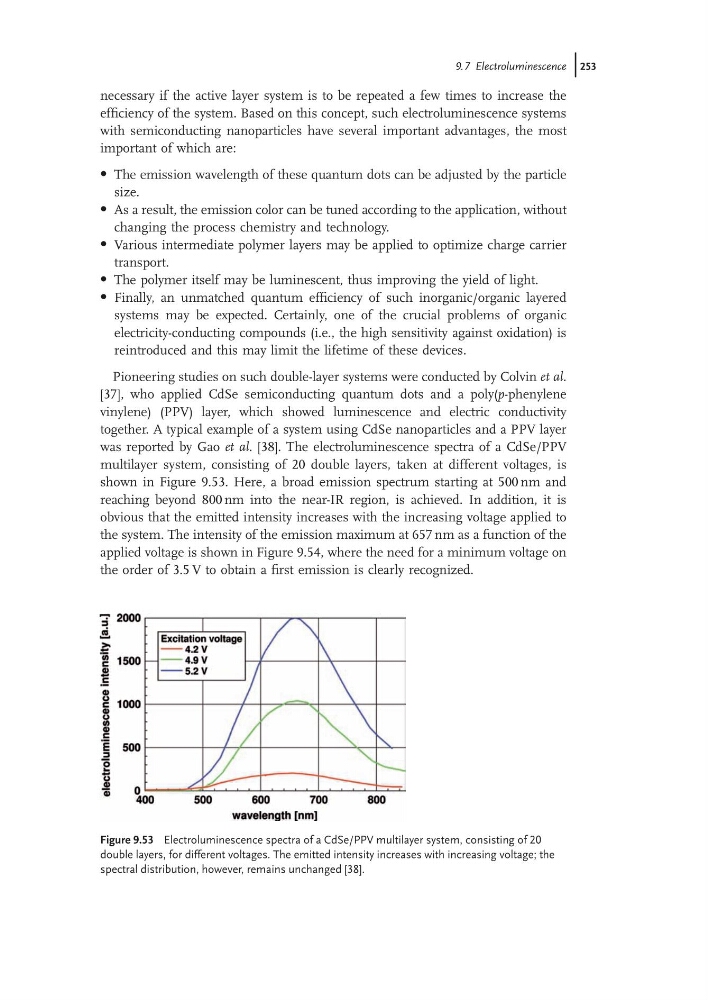
was reported by Gao et al. [38]. The electroluminescence spectra of a CdSe/PPV
multilayer system, consisting of 20 double layers, taken at different voltages, is
shown in Figure 9.53. Here, a broad emission spectrum starting at 500 nm and
reaching beyond 800 nm into the near-IR region, is achieved. In addition, it is
obvious that the emitted intensity increases with the increasing voltage applied to
the system. The intensity of the emission maximum at 657 nm as a function of the
applied voltage is shown in Figure 9.54, where the need for a minimum voltage on
the order of 3.5 V to obtain a first emission is clearly recognized.
Figure 9.53 Electroluminescence spectra of a CdSe/PPV multilayer system, consisting of 20
double layers, for different voltages. The emitted intensity increases with increasing voltage; the
spectral distribution, however, remains unchanged [38].
9.7 Electroluminescence j253
efficiency of the system. Based on this concept, such electroluminescence systems
with semiconducting nanoparticles have several important advantages, the most
important of which are:
The emission wavelength of these quantum dots can be adjusted by the particle
size.
As a result, the emission color can be tuned according to the application, without
changing the process chemistry and technology.
Various intermediate polymer layers may be applied to optimize charge carrier
transport.
The polymer itself may be luminescent, thus improving the yield of light.
Finally, an unmatched quantum efficiency of such inorganic/organic layered
systems may be expected. Certainly, one of the crucial problems of organic
electricity-conducting compounds (i.e., the high sensitivity against oxidation) is
reintroduced and this may limit the lifetime of these devices.
Pioneering studies on such double-layer systems were conducted by Colvin et al.
[37], who applied CdSe semiconducting quantum dots and a poly(p-phenylene
vinylene) (PPV) layer, which showed luminescence and electric conductivity
together. A typical example of a system using CdSe nanoparticles and a PPV layer
was reported by Gao et al. [38]. The electroluminescence spectra of a CdSe/PPV
multilayer system, consisting of 20 double layers, taken at different voltages, is
shown in Figure 9.53. Here, a broad emission spectrum starting at 500 nm and
reaching beyond 800 nm into the near-IR region, is achieved. In addition, it is
obvious that the emitted intensity increases with the increasing voltage applied to
the system. The intensity of the emission maximum at 657 nm as a function of the
applied voltage is shown in Figure 9.54, where the need for a minimum voltage on
the order of 3.5 V to obtain a first emission is clearly recognized.
Figure 9.53 Electroluminescence spectra of a CdSe/PPV multilayer system, consisting of 20
double layers, for different voltages. The emitted intensity increases with increasing voltage; the
spectral distribution, however, remains unchanged [38].
9.7 Electroluminescence j253