

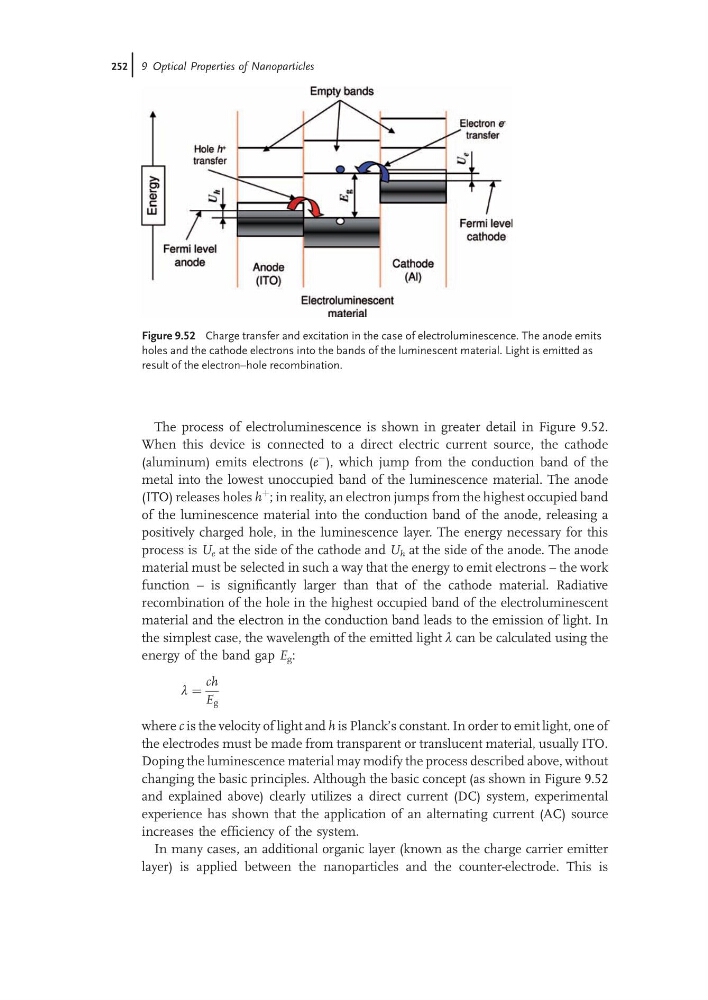
The process of electroluminescence is shown in greater detail in Figure 9.52.
When this device is connected to a direct electric current source, the cathode
(aluminum) emits electrons (e
À ), which jump from the conduction band of the
metal into the lowest unoccupied band of the luminescence material. The anode
(ITO) releases holes h
þ ; in reality, an electron jumps from the highest occupied band
of the luminescence material into the conduction band of the anode, releasing a
positively charged hole, in the luminescence layer. The energy necessary for this
process is U e at the side of the cathode and U h at the side of the anode. The anode
material must be selected in such a way that the energy to emit electrons – the work
function – is significantly larger than that of the cathode material. Radiative
recombination of the hole in the highest occupied band of the electroluminescent
material and the electron in the conduction band leads to the emission of light. In
the simplest case, the wavelength of the emitted light l can be calculated using the
energy of the band gap E g :
l ¼
ch
E g
where c is the velocity of light and h is Planck’s constant. In order to emit light, one of
the electrodes must be made from transparent or translucent material, usually ITO.
Doping the luminescence material may modify the process described above, without
changing the basic principles. Although the basic concept (as shown in Figure 9.52
and explained above) clearly utilizes a direct current (DC) system, experimental
experience has shown that the application of an alternating current (AC) source
increases the efficiency of the system.
In many cases, an additional organic layer (known as the charge carrier emitter
layer) is applied between the nanoparticles and the counter-electrode. This is
Figure 9.52 Charge transfer and excitation in the case of electroluminescence. The anode emits
holes and the cathode electrons into the bands of the luminescent material. Light is emitted as
result of the electron–hole recombination.
252j 9 Optical Properties of Nanoparticles
When this device is connected to a direct electric current source, the cathode
(aluminum) emits electrons (e
À ), which jump from the conduction band of the
metal into the lowest unoccupied band of the luminescence material. The anode
(ITO) releases holes h
þ ; in reality, an electron jumps from the highest occupied band
of the luminescence material into the conduction band of the anode, releasing a
positively charged hole, in the luminescence layer. The energy necessary for this
process is U e at the side of the cathode and U h at the side of the anode. The anode
material must be selected in such a way that the energy to emit electrons – the work
function – is significantly larger than that of the cathode material. Radiative
recombination of the hole in the highest occupied band of the electroluminescent
material and the electron in the conduction band leads to the emission of light. In
the simplest case, the wavelength of the emitted light l can be calculated using the
energy of the band gap E g :
l ¼
ch
E g
where c is the velocity of light and h is Planck’s constant. In order to emit light, one of
the electrodes must be made from transparent or translucent material, usually ITO.
Doping the luminescence material may modify the process described above, without
changing the basic principles. Although the basic concept (as shown in Figure 9.52
and explained above) clearly utilizes a direct current (DC) system, experimental
experience has shown that the application of an alternating current (AC) source
increases the efficiency of the system.
In many cases, an additional organic layer (known as the charge carrier emitter
layer) is applied between the nanoparticles and the counter-electrode. This is
Figure 9.52 Charge transfer and excitation in the case of electroluminescence. The anode emits
holes and the cathode electrons into the bands of the luminescent material. Light is emitted as
result of the electron–hole recombination.
252j 9 Optical Properties of Nanoparticles