

longer necessary. Today, most electroluminescent devices function with organic
materials; these compounds are used as the starting materials for organic lightemitting diodess (OLEDs). Nowadays, the three basic colors of red, magenta, and
yellow each age with a different time constant, and therefore a discoloration of the
displayed image could be observed well before the end of the device’s lifetime. These
problems have forced research teams to seek alternatives based on inorganic
materials. However, as in most cases electroluminescent nanoparticles are
embedded in organic matrices, this situation is – until now – not significantly
improved. Primarily, nanoparticles made from semiconducting materials or doped
insulating particles are applied as luminescent materials.
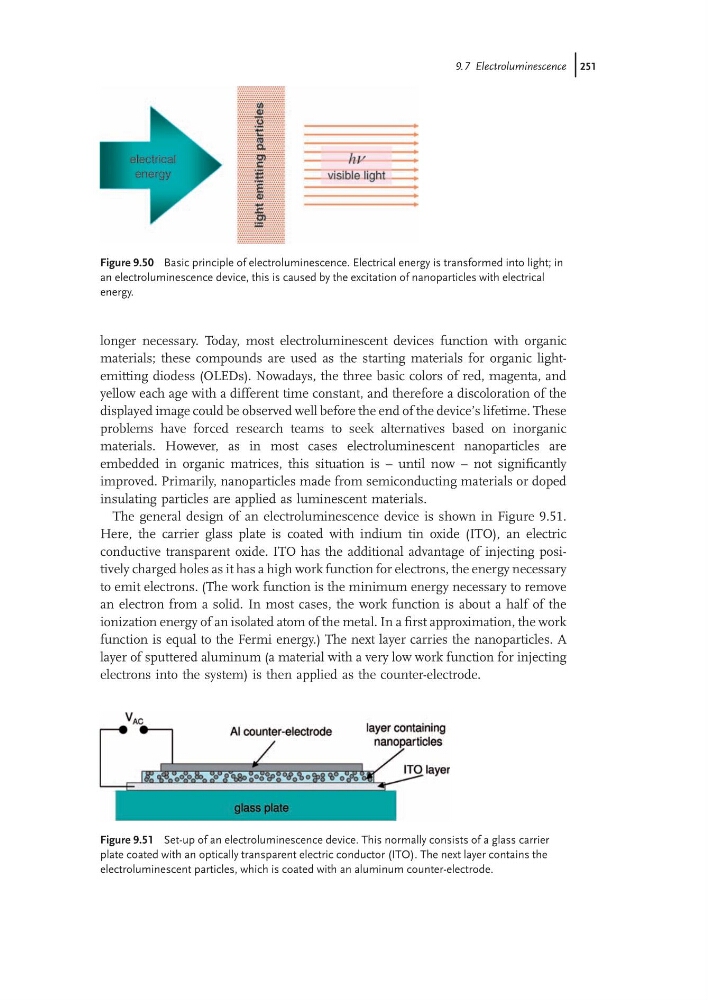
The general design of an electroluminescence device is shown in Figure 9.51.
Here, the carrier glass plate is coated with indium tin oxide (ITO), an electric
conductive transparent oxide. ITO has the additional advantage of injecting positively charged holes as it has a high work function for electrons, the energy necessary
to emit electrons. (The work function is the minimum energy necessary to remove
an electron from a solid. In most cases, the work function is about a half of the
ionization energy of an isolated atom of the metal. In a first approximation, the work
function is equal to the Fermi energy.) The next layer carries the nanoparticles. A
layer of sputtered aluminum (a material with a very low work function for injecting
electrons into the system) is then applied as the counter-electrode.
Figure 9.50 Basic principle of electroluminescence. Electrical energy is transformed into light; in
an electroluminescence device, this is caused by the excitation of nanoparticles with electrical
energy.
Figure 9.51 Set-up of an electroluminescence device. This normally consists of a glass carrier
plate coated with an optically transparent electric conductor (ITO). The next layer contains the
electroluminescent particles, which is coated with an aluminum counter-electrode.
9.7 Electroluminescence j251
materials; these compounds are used as the starting materials for organic lightemitting diodess (OLEDs). Nowadays, the three basic colors of red, magenta, and
yellow each age with a different time constant, and therefore a discoloration of the
displayed image could be observed well before the end of the device’s lifetime. These
problems have forced research teams to seek alternatives based on inorganic
materials. However, as in most cases electroluminescent nanoparticles are
embedded in organic matrices, this situation is – until now – not significantly
improved. Primarily, nanoparticles made from semiconducting materials or doped
insulating particles are applied as luminescent materials.
The general design of an electroluminescence device is shown in Figure 9.51.
Here, the carrier glass plate is coated with indium tin oxide (ITO), an electric
conductive transparent oxide. ITO has the additional advantage of injecting positively charged holes as it has a high work function for electrons, the energy necessary
to emit electrons. (The work function is the minimum energy necessary to remove
an electron from a solid. In most cases, the work function is about a half of the
ionization energy of an isolated atom of the metal. In a first approximation, the work
function is equal to the Fermi energy.) The next layer carries the nanoparticles. A
layer of sputtered aluminum (a material with a very low work function for injecting
electrons into the system) is then applied as the counter-electrode.
Figure 9.50 Basic principle of electroluminescence. Electrical energy is transformed into light; in
an electroluminescence device, this is caused by the excitation of nanoparticles with electrical
energy.
Figure 9.51 Set-up of an electroluminescence device. This normally consists of a glass carrier
plate coated with an optically transparent electric conductor (ITO). The next layer contains the
electroluminescent particles, which is coated with an aluminum counter-electrode.
9.7 Electroluminescence j251