

diameter and these agglomerates were embedded in the organic lumophore matrix.
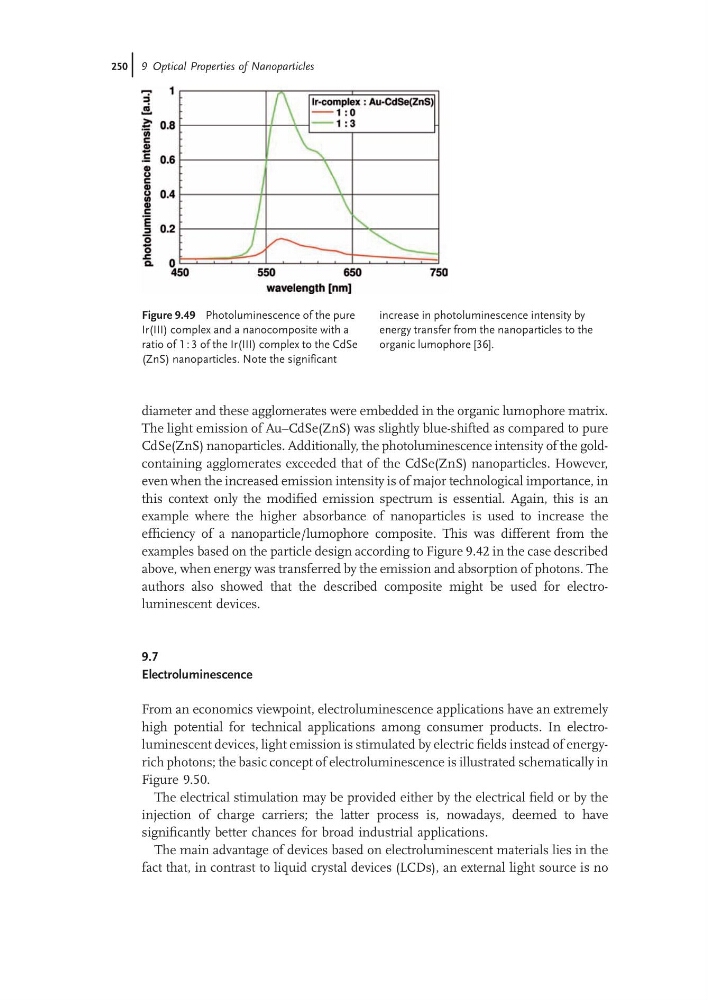
The light emission of Au–CdSe(ZnS) was slightly blue-shifted as compared to pure
CdSe(ZnS) nanoparticles. Additionally, the photoluminescence intensity of the goldcontaining agglomerates exceeded that of the CdSe(ZnS) nanoparticles. However,
even when the increased emission intensity is of major technological importance, in
this context only the modified emission spectrum is essential. Again, this is an
example where the higher absorbance of nanoparticles is used to increase the
efficiency of a nanoparticle/lumophore composite. This was different from the
examples based on the particle design according to Figure 9.42 in the case described
above, when energy was transferred by the emission and absorption of photons. The
authors also showed that the described composite might be used for electroluminescent devices.
9.7
Electroluminescence
From an economics viewpoint, electroluminescence applications have an extremely
high potential for technical applications among consumer products. In electroluminescent devices, light emission is stimulated by electric fields instead of energyrich photons; the basic concept of electroluminescence is illustrated schematically in
Figure 9.50.
The electrical stimulation may be provided either by the electrical field or by the
injection of charge carriers; the latter process is, nowadays, deemed to have
significantly better chances for broad industrial applications.
The main advantage of devices based on electroluminescent materials lies in the
fact that, in contrast to liquid crystal devices (LCDs), an external light source is no
Figure 9.49 Photoluminescence of the pure
Ir(III) complex and a nanocomposite with a
ratio of 1 : 3 of the Ir(III) complex to the CdSe
(ZnS) nanoparticles. Note the significant
increase in photoluminescence intensity by
energy transfer from the nanoparticles to the
organic lumophore [36].
250j 9 Optical Properties of Nanoparticles
The light emission of Au–CdSe(ZnS) was slightly blue-shifted as compared to pure
CdSe(ZnS) nanoparticles. Additionally, the photoluminescence intensity of the goldcontaining agglomerates exceeded that of the CdSe(ZnS) nanoparticles. However,
even when the increased emission intensity is of major technological importance, in
this context only the modified emission spectrum is essential. Again, this is an
example where the higher absorbance of nanoparticles is used to increase the
efficiency of a nanoparticle/lumophore composite. This was different from the
examples based on the particle design according to Figure 9.42 in the case described
above, when energy was transferred by the emission and absorption of photons. The
authors also showed that the described composite might be used for electroluminescent devices.
9.7
Electroluminescence
From an economics viewpoint, electroluminescence applications have an extremely
high potential for technical applications among consumer products. In electroluminescent devices, light emission is stimulated by electric fields instead of energyrich photons; the basic concept of electroluminescence is illustrated schematically in
Figure 9.50.
The electrical stimulation may be provided either by the electrical field or by the
injection of charge carriers; the latter process is, nowadays, deemed to have
significantly better chances for broad industrial applications.
The main advantage of devices based on electroluminescent materials lies in the
fact that, in contrast to liquid crystal devices (LCDs), an external light source is no
Figure 9.49 Photoluminescence of the pure
Ir(III) complex and a nanocomposite with a
ratio of 1 : 3 of the Ir(III) complex to the CdSe
(ZnS) nanoparticles. Note the significant
increase in photoluminescence intensity by
energy transfer from the nanoparticles to the
organic lumophore [36].
250j 9 Optical Properties of Nanoparticles