

by the different constant of dielectricity of these two materials), but in terms of
absorbance the differences between the two particle sizes are clearly visible. As
expected, a reduction in grain size leads to a significant blue shift. The same blue
shift is visible in the emission lines, but there is no difference between the
emissions of particles suspended in a liquid or those dispersed in a glass. The
relatively narrow emission lines indicate a narrow particle size distribution.
Even when the behavior of semiconducting nanoparticles in pure silica glass is –
more or less – straightforward, the complexity increases dramatically in more
complex glasses, as the dopants and nanoparticles will interact with the glass
matrix. Thus, easily interpreted results cannot be expected. As an example,
the optical properties of nanoparticles in the system CdSe–CdTe dispersed in an
alkali-containing silica glass are shown [31]. The glass matrix was composed of
SiO 2 –CaO–A 2 O (A ¼ alkali metal), and as an alkaline a mixture of equal amounts
of Na 2 O, K 2 O, and Li 2 O were used. Up to 1 wt%, any composition of CdSe x Te 1Àx
dissolves in the selected melted glass, without causing it to crystallize. During
cooling, CdSe x Te 1Àx precipitates in uniform distribution as a nanoparticle. In order
to understand the behavior of these materials, it is necessary to examine the phase
diagram of the CdSe–CdTe quasibinary system (see Figure 9.38), where two phases
may be observed: (i) on the selenium-rich side the particles crystallize in the
wurtzite; while (ii) on the tellurium side they crystallize in the sphalerite structure.
However, it must be pointed out that this phase diagram is valid for materials of
conventional grain size and that, due to the large surface of the nanoparticles, the
phase diagram may be significantly different for nanoparticulate systems. Bodnar
et al. [31] assumed that the two-phase region, which is quite narrow for bulk
materials, broadens significantly with decreasing particle size; this suggestion may
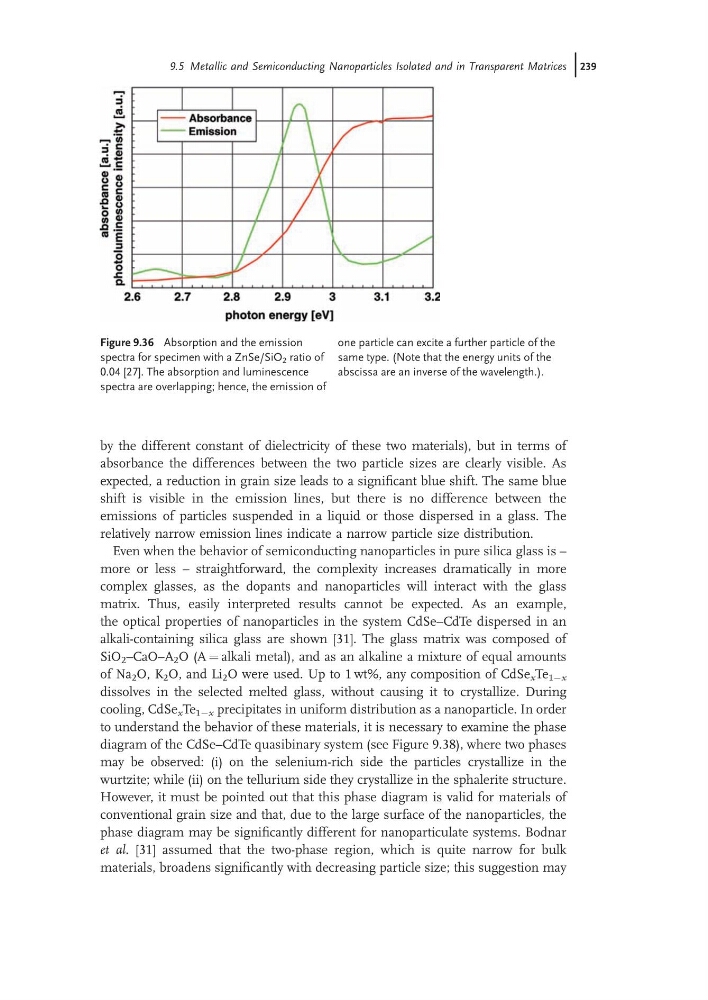
Figure 9.36 Absorption and the emission
spectra for specimen with a ZnSe/SiO 2 ratio of
0.04 [27]. The absorption and luminescence
spectra are overlapping; hence, the emission of
one particle can excite a further particle of the
same type. (Note that the energy units of the
abscissa are an inverse of the wavelength.).
9.5 Metallic and Semiconducting Nanoparticles Isolated and in Transparent Matrices j239
absorbance the differences between the two particle sizes are clearly visible. As
expected, a reduction in grain size leads to a significant blue shift. The same blue
shift is visible in the emission lines, but there is no difference between the
emissions of particles suspended in a liquid or those dispersed in a glass. The
relatively narrow emission lines indicate a narrow particle size distribution.
Even when the behavior of semiconducting nanoparticles in pure silica glass is –
more or less – straightforward, the complexity increases dramatically in more
complex glasses, as the dopants and nanoparticles will interact with the glass
matrix. Thus, easily interpreted results cannot be expected. As an example,
the optical properties of nanoparticles in the system CdSe–CdTe dispersed in an
alkali-containing silica glass are shown [31]. The glass matrix was composed of
SiO 2 –CaO–A 2 O (A ¼ alkali metal), and as an alkaline a mixture of equal amounts
of Na 2 O, K 2 O, and Li 2 O were used. Up to 1 wt%, any composition of CdSe x Te 1Àx
dissolves in the selected melted glass, without causing it to crystallize. During
cooling, CdSe x Te 1Àx precipitates in uniform distribution as a nanoparticle. In order
to understand the behavior of these materials, it is necessary to examine the phase
diagram of the CdSe–CdTe quasibinary system (see Figure 9.38), where two phases
may be observed: (i) on the selenium-rich side the particles crystallize in the
wurtzite; while (ii) on the tellurium side they crystallize in the sphalerite structure.
However, it must be pointed out that this phase diagram is valid for materials of
conventional grain size and that, due to the large surface of the nanoparticles, the
phase diagram may be significantly different for nanoparticulate systems. Bodnar
et al. [31] assumed that the two-phase region, which is quite narrow for bulk
materials, broadens significantly with decreasing particle size; this suggestion may
Figure 9.36 Absorption and the emission
spectra for specimen with a ZnSe/SiO 2 ratio of
0.04 [27]. The absorption and luminescence
spectra are overlapping; hence, the emission of
one particle can excite a further particle of the
same type. (Note that the energy units of the
abscissa are an inverse of the wavelength.).
9.5 Metallic and Semiconducting Nanoparticles Isolated and in Transparent Matrices j239