

from deep red to orange and yellow, are obtained with these systems, more recently,
the luminescence properties of these materials have also attracted attention and
therefore these groups of semiconducting compounds move into the center of
interest.
Semiconducting nanoparticles in a transparent matrix are extremely interesting
with respect to their absorption and luminescence properties. In this context,
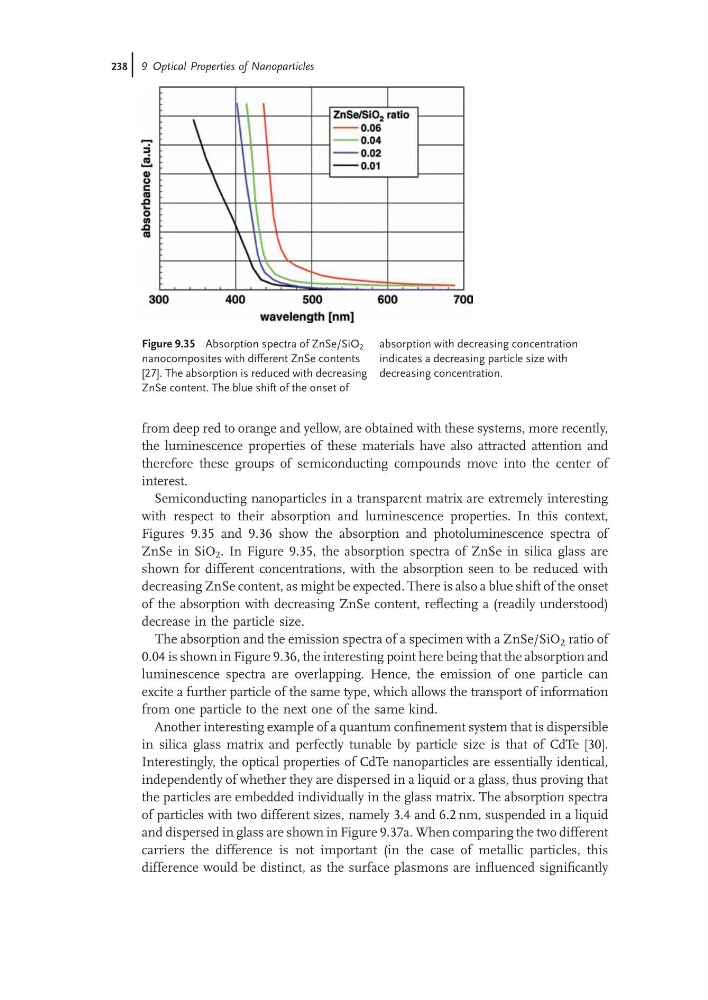
Figures 9.35 and 9.36 show the absorption and photoluminescence spectra of
ZnSe in SiO 2 . In Figure 9.35, the absorption spectra of ZnSe in silica glass are
shown for different concentrations, with the absorption seen to be reduced with
decreasing ZnSe content, as might be expected. There is also a blue shift of the onset
of the absorption with decreasing ZnSe content, reflecting a (readily understood)
decrease in the particle size.
The absorption and the emission spectra of a specimen with a ZnSe/SiO 2 ratio of
0.04 is shown in Figure 9.36, the interesting point here being that the absorption and
luminescence spectra are overlapping. Hence, the emission of one particle can
excite a further particle of the same type, which allows the transport of information
from one particle to the next one of the same kind.
Another interesting example of a quantum confinement system that is dispersible
in silica glass matrix and perfectly tunable by particle size is that of CdTe [30].
Interestingly, the optical properties of CdTe nanoparticles are essentially identical,
independently of whether they are dispersed in a liquid or a glass, thus proving that
the particles are embedded individually in the glass matrix. The absorption spectra
of particles with two different sizes, namely 3.4 and 6.2 nm, suspended in a liquid
and dispersed in glass are shown in Figure 9.37a. When comparing the two different
carriers the difference is not important (in the case of metallic particles, this
difference would be distinct, as the surface plasmons are influenced significantly
Figure 9.35 Absorption spectra of ZnSe/SiO 2
nanocomposites with different ZnSe contents
[27]. The absorption is reduced with decreasing
ZnSe content. The blue shift of the onset of
absorption with decreasing concentration
indicates a decreasing particle size with
decreasing concentration.
238j 9 Optical Properties of Nanoparticles
the luminescence properties of these materials have also attracted attention and
therefore these groups of semiconducting compounds move into the center of
interest.
Semiconducting nanoparticles in a transparent matrix are extremely interesting
with respect to their absorption and luminescence properties. In this context,
Figures 9.35 and 9.36 show the absorption and photoluminescence spectra of
ZnSe in SiO 2 . In Figure 9.35, the absorption spectra of ZnSe in silica glass are
shown for different concentrations, with the absorption seen to be reduced with
decreasing ZnSe content, as might be expected. There is also a blue shift of the onset
of the absorption with decreasing ZnSe content, reflecting a (readily understood)
decrease in the particle size.
The absorption and the emission spectra of a specimen with a ZnSe/SiO 2 ratio of
0.04 is shown in Figure 9.36, the interesting point here being that the absorption and
luminescence spectra are overlapping. Hence, the emission of one particle can
excite a further particle of the same type, which allows the transport of information
from one particle to the next one of the same kind.
Another interesting example of a quantum confinement system that is dispersible
in silica glass matrix and perfectly tunable by particle size is that of CdTe [30].
Interestingly, the optical properties of CdTe nanoparticles are essentially identical,
independently of whether they are dispersed in a liquid or a glass, thus proving that
the particles are embedded individually in the glass matrix. The absorption spectra
of particles with two different sizes, namely 3.4 and 6.2 nm, suspended in a liquid
and dispersed in glass are shown in Figure 9.37a. When comparing the two different
carriers the difference is not important (in the case of metallic particles, this
difference would be distinct, as the surface plasmons are influenced significantly
Figure 9.35 Absorption spectra of ZnSe/SiO 2
nanocomposites with different ZnSe contents
[27]. The absorption is reduced with decreasing
ZnSe content. The blue shift of the onset of
absorption with decreasing concentration
indicates a decreasing particle size with
decreasing concentration.
238j 9 Optical Properties of Nanoparticles