

equivalent size clearly indicated. A complete theoretical description of the color of
metal nanoparticles in glass has been provided by Quinten [29].
With respect to recent technological developments, nanoparticles made from
semiconducting compounds are attracting an increasing amount of attention.
Originally, nanoparticles made of solid solutions from the system CdSe–CdS–
ZnS–ZnSe dispersed in glass were used as pigments, but the equivalent compounds
of tellurium (either pure or as a solid solution) are also used. While nearly all colors,
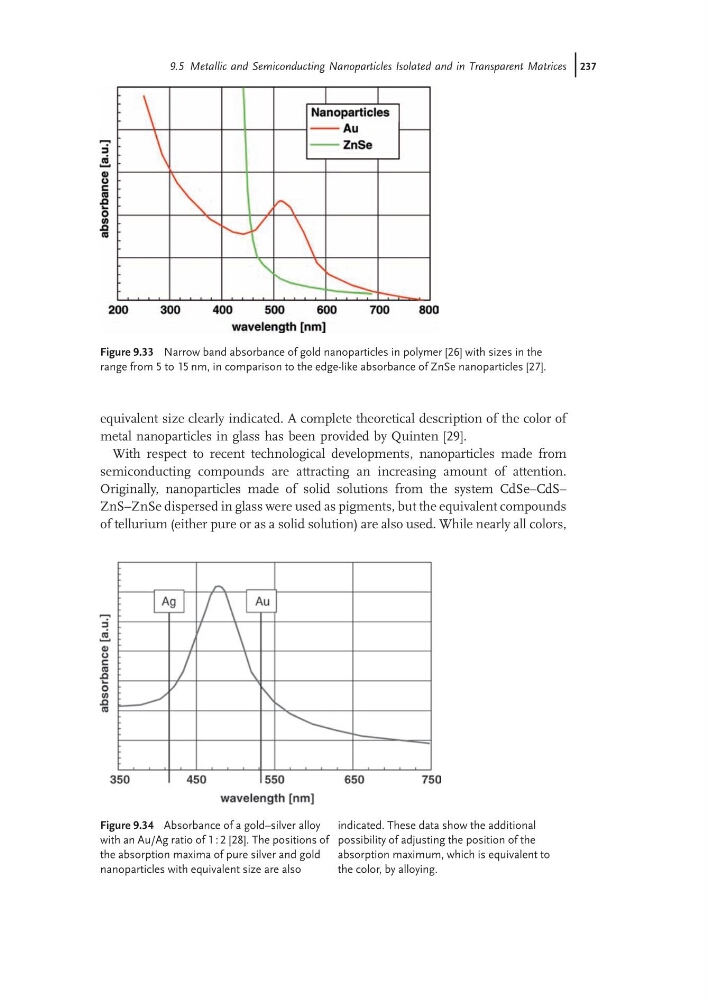
Figure 9.33 Narrow band absorbance of gold nanoparticles in polymer [26] with sizes in the
range from 5 to 15 nm, in comparison to the edge-like absorbance of ZnSe nanoparticles [27].
Figure 9.34 Absorbance of a gold–silver alloy
with an Au/Ag ratio of 1 : 2 [28]. The positions of
the absorption maxima of pure silver and gold
nanoparticles with equivalent size are also
indicated. These data show the additional
possibility of adjusting the position of the
absorption maximum, which is equivalent to
the color, by alloying.
9.5 Metallic and Semiconducting Nanoparticles Isolated and in Transparent Matrices j237
metal nanoparticles in glass has been provided by Quinten [29].
With respect to recent technological developments, nanoparticles made from
semiconducting compounds are attracting an increasing amount of attention.
Originally, nanoparticles made of solid solutions from the system CdSe–CdS–
ZnS–ZnSe dispersed in glass were used as pigments, but the equivalent compounds
of tellurium (either pure or as a solid solution) are also used. While nearly all colors,
Figure 9.33 Narrow band absorbance of gold nanoparticles in polymer [26] with sizes in the
range from 5 to 15 nm, in comparison to the edge-like absorbance of ZnSe nanoparticles [27].
Figure 9.34 Absorbance of a gold–silver alloy
with an Au/Ag ratio of 1 : 2 [28]. The positions of
the absorption maxima of pure silver and gold
nanoparticles with equivalent size are also
indicated. These data show the additional
possibility of adjusting the position of the
absorption maximum, which is equivalent to
the color, by alloying.
9.5 Metallic and Semiconducting Nanoparticles Isolated and in Transparent Matrices j237