

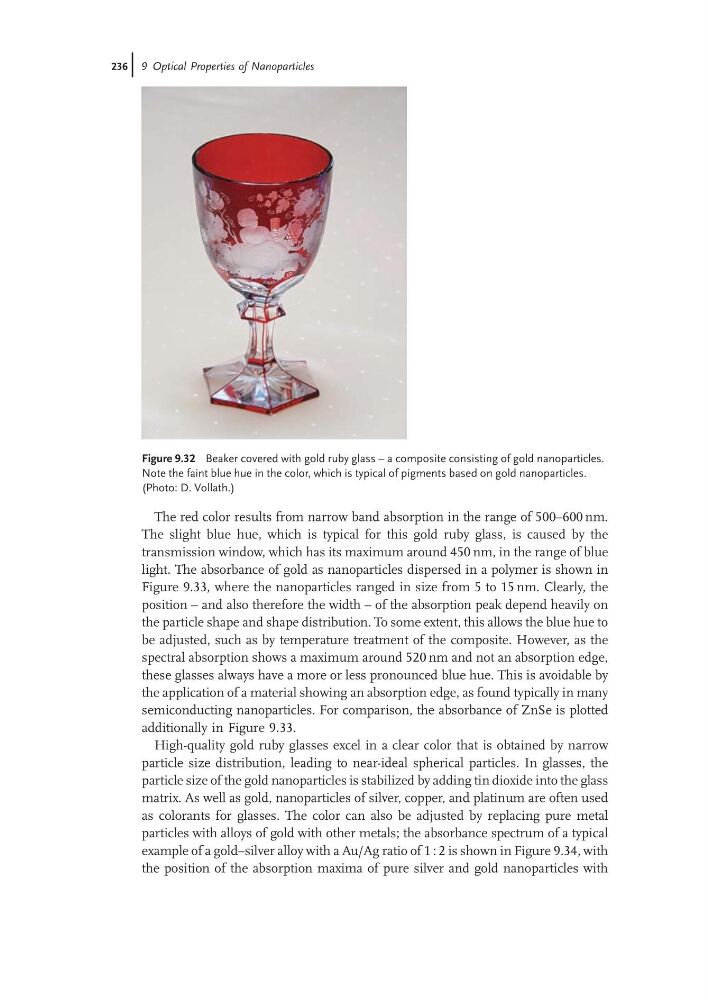
The red color results from narrow band absorption in the range of 500–600 nm.
The slight blue hue, which is typical for this gold ruby glass, is caused by the
transmission window, which has its maximum around 450 nm, in the range of blue
light. The absorbance of gold as nanoparticles dispersed in a polymer is shown in
Figure 9.33, where the nanoparticles ranged in size from 5 to 15 nm. Clearly, the
position – and also therefore the width – of the absorption peak depend heavily on
the particle shape and shape distribution. To some extent, this allows the blue hue to
be adjusted, such as by temperature treatment of the composite. However, as the
spectral absorption shows a maximum around 520 nm and not an absorption edge,
these glasses always have a more or less pronounced blue hue. This is avoidable by
the application of a material showing an absorption edge, as found typically in many
semiconducting nanoparticles. For comparison, the absorbance of ZnSe is plotted
additionally in Figure 9.33.
High-quality gold ruby glasses excel in a clear color that is obtained by narrow
particle size distribution, leading to near-ideal spherical particles. In glasses, the
particle size of the gold nanoparticles is stabilized by adding tin dioxide into the glass
matrix. As well as gold, nanoparticles of silver, copper, and platinum are often used
as colorants for glasses. The color can also be adjusted by replacing pure metal
particles with alloys of gold with other metals; the absorbance spectrum of a typical
example of a gold–silver alloy with a Au/Ag ratio of 1 : 2 is shown in Figure 9.34, with
the position of the absorption maxima of pure silver and gold nanoparticles with
Figure 9.32 Beaker covered with gold ruby glass – a composite consisting of gold nanoparticles.
Note the faint blue hue in the color, which is typical of pigments based on gold nanoparticles.
(Photo: D. Vollath.)
236j 9 Optical Properties of Nanoparticles
The slight blue hue, which is typical for this gold ruby glass, is caused by the
transmission window, which has its maximum around 450 nm, in the range of blue
light. The absorbance of gold as nanoparticles dispersed in a polymer is shown in
Figure 9.33, where the nanoparticles ranged in size from 5 to 15 nm. Clearly, the
position – and also therefore the width – of the absorption peak depend heavily on
the particle shape and shape distribution. To some extent, this allows the blue hue to
be adjusted, such as by temperature treatment of the composite. However, as the
spectral absorption shows a maximum around 520 nm and not an absorption edge,
these glasses always have a more or less pronounced blue hue. This is avoidable by
the application of a material showing an absorption edge, as found typically in many
semiconducting nanoparticles. For comparison, the absorbance of ZnSe is plotted
additionally in Figure 9.33.
High-quality gold ruby glasses excel in a clear color that is obtained by narrow
particle size distribution, leading to near-ideal spherical particles. In glasses, the
particle size of the gold nanoparticles is stabilized by adding tin dioxide into the glass
matrix. As well as gold, nanoparticles of silver, copper, and platinum are often used
as colorants for glasses. The color can also be adjusted by replacing pure metal
particles with alloys of gold with other metals; the absorbance spectrum of a typical
example of a gold–silver alloy with a Au/Ag ratio of 1 : 2 is shown in Figure 9.34, with
the position of the absorption maxima of pure silver and gold nanoparticles with
Figure 9.32 Beaker covered with gold ruby glass – a composite consisting of gold nanoparticles.
Note the faint blue hue in the color, which is typical of pigments based on gold nanoparticles.
(Photo: D. Vollath.)
236j 9 Optical Properties of Nanoparticles