

520 nm, which is more or less identical with the absorption maximum for the
spherical particles, and the broad absorption band attributed to the longitudinal
plasmon resonances. Additionally, Figure 9.30 shows clearly that the relative
contribution of transversal oscillation modes decreases with increasing aspect ratio.
As mentioned above, the energy of the plasmon resonance depends heavily on the
surrounding medium and its composition, and, especially when producing colored
glasses and pigments, the composition of the matrix must be selected carefully. One
of the oldest applications of nanoparticles is their use as pigment in glass. The first
known application of these composites dates back to the Assyrians who, in
approximately 700 BC, documented the composition of a red glass with gold
nanoparticles as pigment. This was reinvented by Kunkel [24] during the seventeenth century in Leipzig. It was later found that, besides gold changing the color of
the glass to a characteristic red, the addition of silver leads to a yellow coloration.
During the nineteenth century, Faraday attributed this color to very finely divided
colloidal gold, the particle size of which was estimated by Szigmondi to be
approximately 50 nm, well within the recent notation of nanoparticles.
During its long history, the composition of this “gold ruby glass” has not changed
significantly to the present day. Currently, this colored glass is used not only for
decoration but, after grinding, also as a pigment. Glasses containing metallic or
semiconducting nanoparticles as colorants usually are composed of 50–60 wt%
SiO 2 , 10–20 wt% ZnO, and roughly the same amount of K 2 O. Minor amounts of
K 2 O may be replaced by Na 2 O, while some ZnO could be exchanged for CaO. In
order to improve the melting behavior, a few weight percent of B 2 O 3 are sometimes
added, while to adjust the index of refraction, PbO or Sb 2 O 3 may be added [25]. A
typical example of such a glass containing gold nanoparticles is shown in Figure 9.32.
The glass beaker is coated with a thin layer of a glass that contains gold nanoparticles
as pigment and into this layer of gold ruby glass an artist has engraved an image.
Even when this glass shows a deep red, a slight blue hue is both visible and
unavoidable.
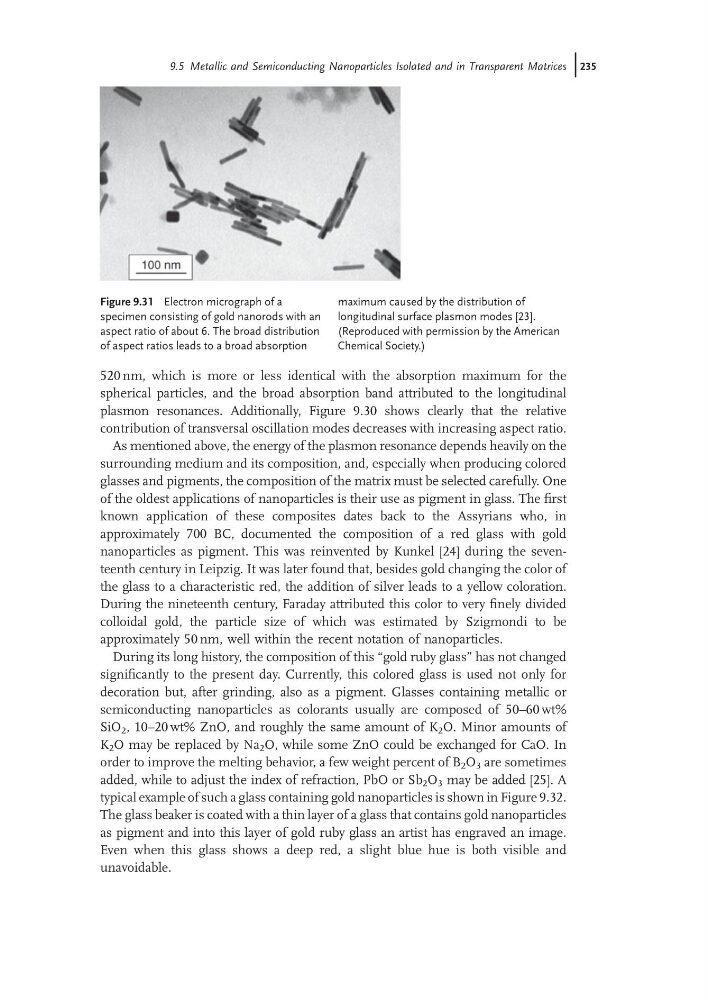
Figure 9.31 Electron micrograph of a
specimen consisting of gold nanorods with an
aspect ratio of about 6. The broad distribution
of aspect ratios leads to a broad absorption
maximum caused by the distribution of
longitudinal surface plasmon modes [23].
(Reproduced with permission by the American
Chemical Society.)
9.5 Metallic and Semiconducting Nanoparticles Isolated and in Transparent Matrices j235
spherical particles, and the broad absorption band attributed to the longitudinal
plasmon resonances. Additionally, Figure 9.30 shows clearly that the relative
contribution of transversal oscillation modes decreases with increasing aspect ratio.
As mentioned above, the energy of the plasmon resonance depends heavily on the
surrounding medium and its composition, and, especially when producing colored
glasses and pigments, the composition of the matrix must be selected carefully. One
of the oldest applications of nanoparticles is their use as pigment in glass. The first
known application of these composites dates back to the Assyrians who, in
approximately 700 BC, documented the composition of a red glass with gold
nanoparticles as pigment. This was reinvented by Kunkel [24] during the seventeenth century in Leipzig. It was later found that, besides gold changing the color of
the glass to a characteristic red, the addition of silver leads to a yellow coloration.
During the nineteenth century, Faraday attributed this color to very finely divided
colloidal gold, the particle size of which was estimated by Szigmondi to be
approximately 50 nm, well within the recent notation of nanoparticles.
During its long history, the composition of this “gold ruby glass” has not changed
significantly to the present day. Currently, this colored glass is used not only for
decoration but, after grinding, also as a pigment. Glasses containing metallic or
semiconducting nanoparticles as colorants usually are composed of 50–60 wt%
SiO 2 , 10–20 wt% ZnO, and roughly the same amount of K 2 O. Minor amounts of
K 2 O may be replaced by Na 2 O, while some ZnO could be exchanged for CaO. In
order to improve the melting behavior, a few weight percent of B 2 O 3 are sometimes
added, while to adjust the index of refraction, PbO or Sb 2 O 3 may be added [25]. A
typical example of such a glass containing gold nanoparticles is shown in Figure 9.32.
The glass beaker is coated with a thin layer of a glass that contains gold nanoparticles
as pigment and into this layer of gold ruby glass an artist has engraved an image.
Even when this glass shows a deep red, a slight blue hue is both visible and
unavoidable.
Figure 9.31 Electron micrograph of a
specimen consisting of gold nanorods with an
aspect ratio of about 6. The broad distribution
of aspect ratios leads to a broad absorption
maximum caused by the distribution of
longitudinal surface plasmon modes [23].
(Reproduced with permission by the American
Chemical Society.)
9.5 Metallic and Semiconducting Nanoparticles Isolated and in Transparent Matrices j235