

The data in Figure 9.29a and b indicate that anisotropy adds an additional
parameter to tune optical properties of metallic nanoparticles with respect to
application. Additionally, the electron cloud around metal nanoparticles is the origin
of strong electromagnetic fields, determined by the geometry of the nanoparticle,
and affects the local environment. This electrical field influences the adsorption of
other organic molecules and is itself altered by such adsorption processes. The
retroaction to the surface plasmon resonance frequency is caused by changing the
dielectric constant of the surrounding material locally, thus influencing the oscillation modes to a significant degree. As this phenomenon is used for the detection and
identification of other molecules, metallic nanoparticles – and especially highly
anisotropic nanoparticles – may be used as extremely sensitive sensors. In addition,
for dispersed metallic nanoparticles, entirely different absorption spectra as a
function of the surrounding medium may be expected.
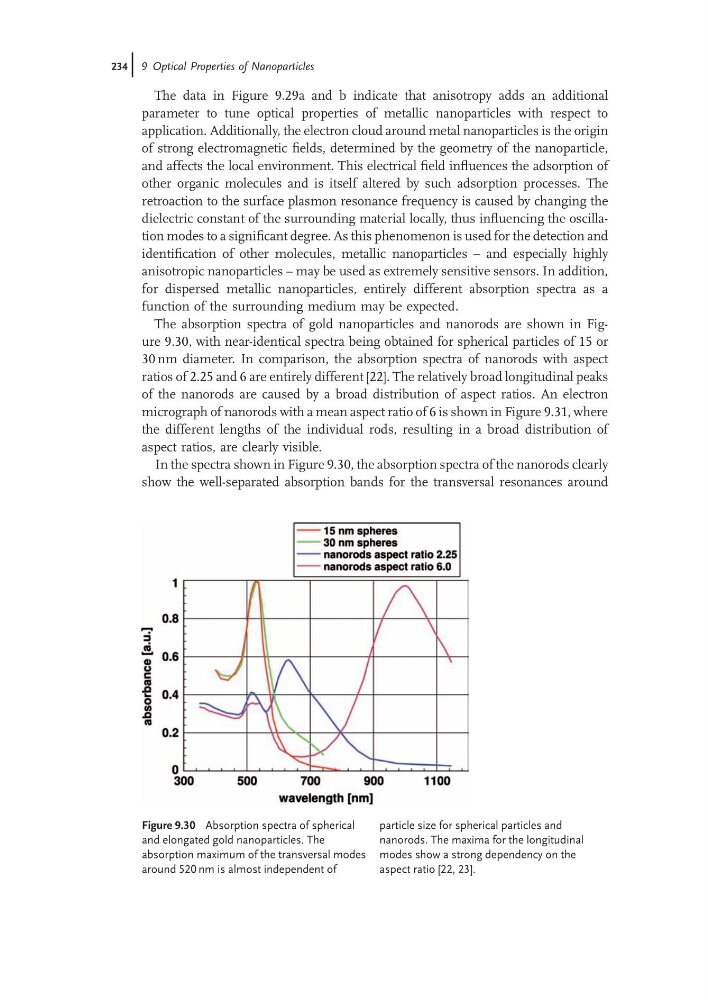
The absorption spectra of gold nanoparticles and nanorods are shown in Figure 9.30, with near-identical spectra being obtained for spherical particles of 15 or
30 nm diameter. In comparison, the absorption spectra of nanorods with aspect
ratios of 2.25 and 6 are entirely different [22]. The relatively broad longitudinal peaks
of the nanorods are caused by a broad distribution of aspect ratios. An electron
micrograph of nanorods with a mean aspect ratio of 6 is shown in Figure 9.31, where
the different lengths of the individual rods, resulting in a broad distribution of
aspect ratios, are clearly visible.
In the spectra shown in Figure 9.30, the absorption spectra of the nanorods clearly
show the well-separated absorption bands for the transversal resonances around
Figure 9.30 Absorption spectra of spherical
and elongated gold nanoparticles. The
absorption maximum of the transversal modes
around 520 nm is almost independent of
particle size for spherical particles and
nanorods. The maxima for the longitudinal
modes show a strong dependency on the
aspect ratio [22, 23].
234j 9 Optical Properties of Nanoparticles
parameter to tune optical properties of metallic nanoparticles with respect to
application. Additionally, the electron cloud around metal nanoparticles is the origin
of strong electromagnetic fields, determined by the geometry of the nanoparticle,
and affects the local environment. This electrical field influences the adsorption of
other organic molecules and is itself altered by such adsorption processes. The
retroaction to the surface plasmon resonance frequency is caused by changing the
dielectric constant of the surrounding material locally, thus influencing the oscillation modes to a significant degree. As this phenomenon is used for the detection and
identification of other molecules, metallic nanoparticles – and especially highly
anisotropic nanoparticles – may be used as extremely sensitive sensors. In addition,
for dispersed metallic nanoparticles, entirely different absorption spectra as a
function of the surrounding medium may be expected.
The absorption spectra of gold nanoparticles and nanorods are shown in Figure 9.30, with near-identical spectra being obtained for spherical particles of 15 or
30 nm diameter. In comparison, the absorption spectra of nanorods with aspect
ratios of 2.25 and 6 are entirely different [22]. The relatively broad longitudinal peaks
of the nanorods are caused by a broad distribution of aspect ratios. An electron
micrograph of nanorods with a mean aspect ratio of 6 is shown in Figure 9.31, where
the different lengths of the individual rods, resulting in a broad distribution of
aspect ratios, are clearly visible.
In the spectra shown in Figure 9.30, the absorption spectra of the nanorods clearly
show the well-separated absorption bands for the transversal resonances around
Figure 9.30 Absorption spectra of spherical
and elongated gold nanoparticles. The
absorption maximum of the transversal modes
around 520 nm is almost independent of
particle size for spherical particles and
nanorods. The maxima for the longitudinal
modes show a strong dependency on the
aspect ratio [22, 23].
234j 9 Optical Properties of Nanoparticles