

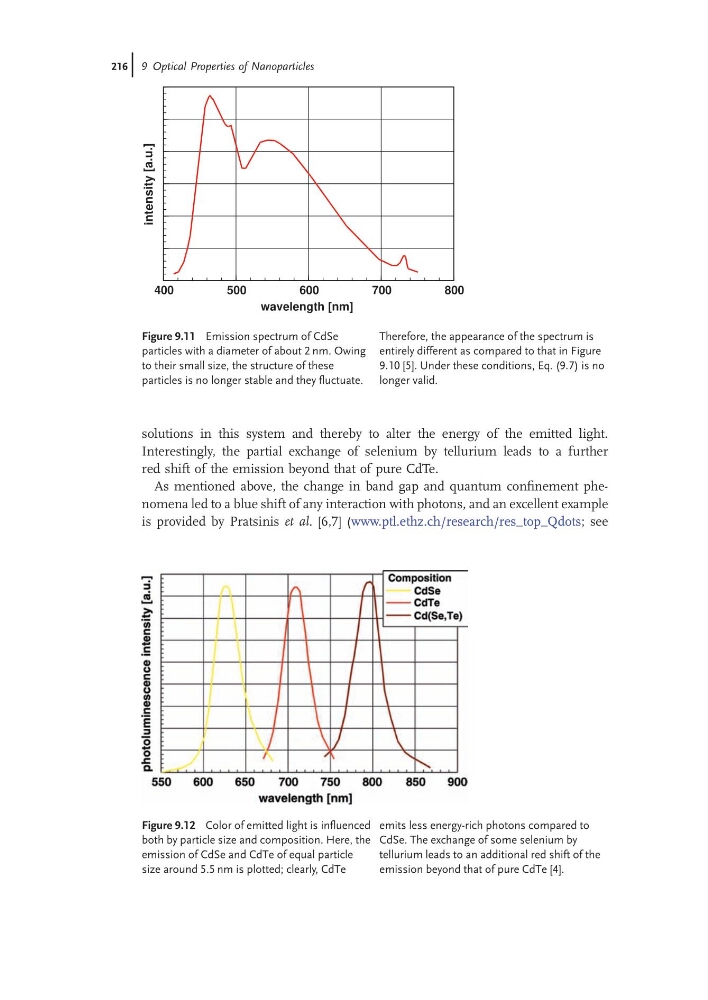
solutions in this system and thereby to alter the energy of the emitted light.
Interestingly, the partial exchange of selenium by tellurium leads to a further
red shift of the emission beyond that of pure CdTe.
As mentioned above, the change in band gap and quantum confinement phenomena led to a blue shift of any interaction with photons, and an excellent example
is provided by Pratsinis et al . [6,7] ( www.ptl.ethz.ch/research/res_top_Qdots; see
400
500
600
700
800
wavelength [nm]
0
intensity
[a.u.]
Figure 9.11 Emission spectrum of CdSe
particles with a diameter of about 2 nm. Owing
to their small size, the structure of these
particles is no longer stable and they fluctuate.
Therefore, the appearance of the spectrum is
entirely different as compared to that in Figure
9.10 [5]. Under these conditions, Eq. (9.7) is no
longer valid.
Figure 9.12 Color of emitted light is influenced
both by particle size and composition. Here, the
emission of CdSe and CdTe of equal particle
size around 5.5 nm is plotted; clearly, CdTe
emits less energy-rich photons compared to
CdSe. The exchange of some selenium by
tellurium leads to an additional red shift of the
emission beyond that of pure CdTe [4].
216j 9 Optical Properties of Nanoparticles
Interestingly, the partial exchange of selenium by tellurium leads to a further
red shift of the emission beyond that of pure CdTe.
As mentioned above, the change in band gap and quantum confinement phenomena led to a blue shift of any interaction with photons, and an excellent example
is provided by Pratsinis et al . [6,7] ( www.ptl.ethz.ch/research/res_top_Qdots; see
400
500
600
700
800
wavelength [nm]
0
intensity
[a.u.]
Figure 9.11 Emission spectrum of CdSe
particles with a diameter of about 2 nm. Owing
to their small size, the structure of these
particles is no longer stable and they fluctuate.
Therefore, the appearance of the spectrum is
entirely different as compared to that in Figure
9.10 [5]. Under these conditions, Eq. (9.7) is no
longer valid.
Figure 9.12 Color of emitted light is influenced
both by particle size and composition. Here, the
emission of CdSe and CdTe of equal particle
size around 5.5 nm is plotted; clearly, CdTe
emits less energy-rich photons compared to
CdSe. The exchange of some selenium by
tellurium leads to an additional red shift of the
emission beyond that of pure CdTe [4].
216j 9 Optical Properties of Nanoparticles