

9.3
Optical Properties Related to Quantum Confinement
Quantum confinement is observed in cases of interaction between light and small
particles. Provided the particles are small enough, this interaction is dependent on
the particle size. The most important phenomena in this group are absorption and
emission of light. Emission of light by particles excited by energy-rich light is called
luminescence, which is the umbrella term summarizing fluorescence, where the
emission follows nearly immediately the absorption act, and phosphorescence, where
a significant time delay between absorption and emission is observed. The basic idea
of luminescence is depicted in Figure 9.4.
As noted in Section 9.2, the onset and the maximum of photon absorption exhibits
a blue shift with decreasing particle size. The same phenomenon is observed for the
most important optical property, light emission, and in this context a series of
phenomena characteristic of nanoparticles may be identified. One of the most
important groups of properties is connected with quantum confinement, which is
observed in the interaction of very small nanoparticles with light, when free
electrons and holes are created. The hole and the electron form a hydrogen-like
complex, called an exciton. Depending on the properties of the particle, the radius of
the exciton (known as the “exciton Bohr radius”), which increases linearly with
increasing dielectric constant, may range from 0.1 nm to a few nanometers.
Quantum confinement occurs when one or more of the dimensions of a nanocrystal is/are smaller than the diameter of the exciton. This situation is depicted in
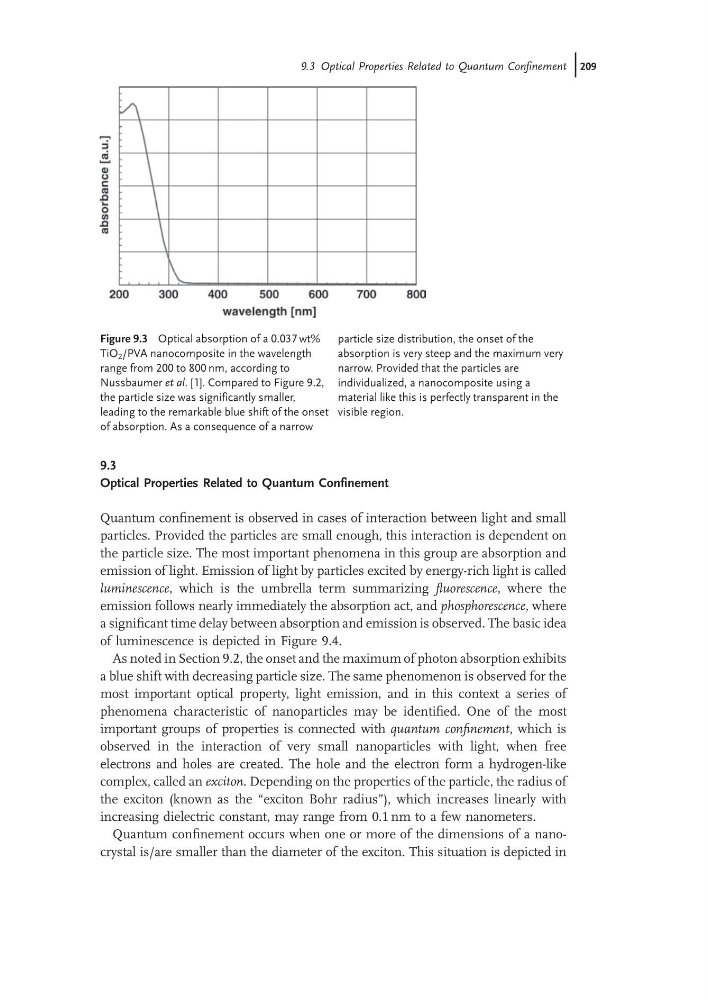
Figure 9.3 Optical absorption of a 0.037 wt%
TiO 2 /PVA nanocomposite in the wavelength
range from 200 to 800 nm, according to
Nussbaumer et al. [1]. Compared to Figure 9.2,
the particle size was significantly smaller,
leading to the remarkable blue shift of the onset
of absorption. As a consequence of a narrow
particle size distribution, the onset of the
absorption is very steep and the maximum very
narrow. Provided that the particles are
individualized, a nanocomposite using a
material like this is perfectly transparent in the
visible region.
9.3 Optical Properties Related to Quantum Confinement j209
Optical Properties Related to Quantum Confinement
Quantum confinement is observed in cases of interaction between light and small
particles. Provided the particles are small enough, this interaction is dependent on
the particle size. The most important phenomena in this group are absorption and
emission of light. Emission of light by particles excited by energy-rich light is called
luminescence, which is the umbrella term summarizing fluorescence, where the
emission follows nearly immediately the absorption act, and phosphorescence, where
a significant time delay between absorption and emission is observed. The basic idea
of luminescence is depicted in Figure 9.4.
As noted in Section 9.2, the onset and the maximum of photon absorption exhibits
a blue shift with decreasing particle size. The same phenomenon is observed for the
most important optical property, light emission, and in this context a series of
phenomena characteristic of nanoparticles may be identified. One of the most
important groups of properties is connected with quantum confinement, which is
observed in the interaction of very small nanoparticles with light, when free
electrons and holes are created. The hole and the electron form a hydrogen-like
complex, called an exciton. Depending on the properties of the particle, the radius of
the exciton (known as the “exciton Bohr radius”), which increases linearly with
increasing dielectric constant, may range from 0.1 nm to a few nanometers.
Quantum confinement occurs when one or more of the dimensions of a nanocrystal is/are smaller than the diameter of the exciton. This situation is depicted in
Figure 9.3 Optical absorption of a 0.037 wt%
TiO 2 /PVA nanocomposite in the wavelength
range from 200 to 800 nm, according to
Nussbaumer et al. [1]. Compared to Figure 9.2,
the particle size was significantly smaller,
leading to the remarkable blue shift of the onset
of absorption. As a consequence of a narrow
particle size distribution, the onset of the
absorption is very steep and the maximum very
narrow. Provided that the particles are
individualized, a nanocomposite using a
material like this is perfectly transparent in the
visible region.
9.3 Optical Properties Related to Quantum Confinement j209