

combination of polymer matrix and nanoparticles. As mentioned above, the active
UV-absorbing nanoparticle must be coated with a second, catalytically inactive,
ceramic material such as alumina or silica.
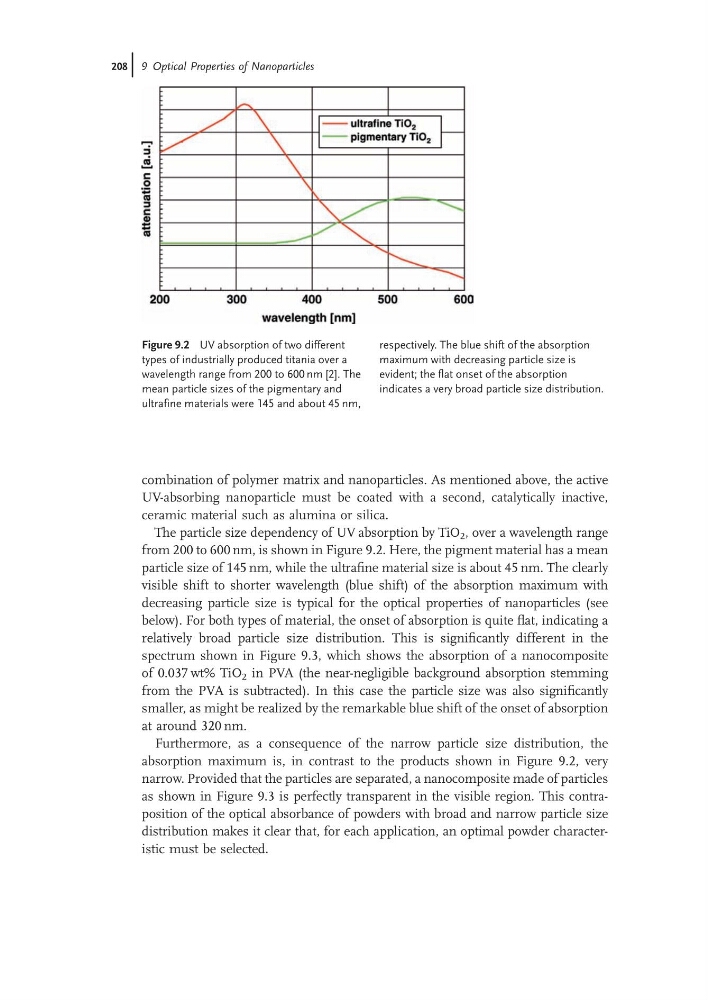
The particle size dependency of UV absorption by TiO 2 , over a wavelength range
from 200 to 600 nm, is shown in Figure 9.2. Here, the pigment material has a mean
particle size of 145 nm, while the ultrafine material size is about 45 nm. The clearly
visible shift to shorter wavelength (blue shift) of the absorption maximum with
decreasing particle size is typical for the optical properties of nanoparticles (see
below). For both types of material, the onset of absorption is quite flat, indicating a
relatively broad particle size distribution. This is significantly different in the
spectrum shown in Figure 9.3, which shows the absorption of a nanocomposite
of 0.037 wt% TiO 2 in PVA (the near-negligible background absorption stemming
from the PVA is subtracted). In this case the particle size was also significantly
smaller, as might be realized by the remarkable blue shift of the onset of absorption
at around 320 nm.
Furthermore, as a consequence of the narrow particle size distribution, the
absorption maximum is, in contrast to the products shown in Figure 9.2, very
narrow. Provided that the particles are separated, a nanocomposite made of particles
as shown in Figure 9.3 is perfectly transparent in the visible region. This contraposition of the optical absorbance of powders with broad and narrow particle size
distribution makes it clear that, for each application, an optimal powder characteristic must be selected.
Figure 9.2 UV absorption of two different
types of industrially produced titania over a
wavelength range from 200 to 600 nm [2]. The
mean particle sizes of the pigmentary and
ultrafine materials were 145 and about 45 nm,
respectively. The blue shift of the absorption
maximum with decreasing particle size is
evident; the flat onset of the absorption
indicates a very broad particle size distribution.
208j 9 Optical Properties of Nanoparticles
UV-absorbing nanoparticle must be coated with a second, catalytically inactive,
ceramic material such as alumina or silica.
The particle size dependency of UV absorption by TiO 2 , over a wavelength range
from 200 to 600 nm, is shown in Figure 9.2. Here, the pigment material has a mean
particle size of 145 nm, while the ultrafine material size is about 45 nm. The clearly
visible shift to shorter wavelength (blue shift) of the absorption maximum with
decreasing particle size is typical for the optical properties of nanoparticles (see
below). For both types of material, the onset of absorption is quite flat, indicating a
relatively broad particle size distribution. This is significantly different in the
spectrum shown in Figure 9.3, which shows the absorption of a nanocomposite
of 0.037 wt% TiO 2 in PVA (the near-negligible background absorption stemming
from the PVA is subtracted). In this case the particle size was also significantly
smaller, as might be realized by the remarkable blue shift of the onset of absorption
at around 320 nm.
Furthermore, as a consequence of the narrow particle size distribution, the
absorption maximum is, in contrast to the products shown in Figure 9.2, very
narrow. Provided that the particles are separated, a nanocomposite made of particles
as shown in Figure 9.3 is perfectly transparent in the visible region. This contraposition of the optical absorbance of powders with broad and narrow particle size
distribution makes it clear that, for each application, an optimal powder characteristic must be selected.
Figure 9.2 UV absorption of two different
types of industrially produced titania over a
wavelength range from 200 to 600 nm [2]. The
mean particle sizes of the pigmentary and
ultrafine materials were 145 and about 45 nm,
respectively. The blue shift of the absorption
maximum with decreasing particle size is
evident; the flat onset of the absorption
indicates a very broad particle size distribution.
208j 9 Optical Properties of Nanoparticles